
Rising costs prompt large increase in living wage estimates
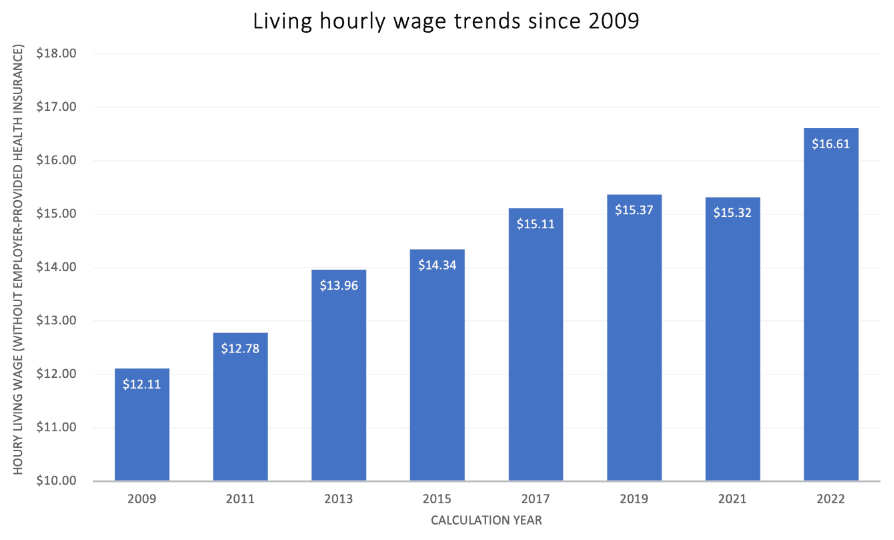
Late last month, Alternatives Federal Credit Union and the Tompkins County Workers’ Center jointly announced a new living wage estimate for the county — $16.61/hour. That figure is 8.5% higher than last year’s calculation of $15.32/hour, which those involved said can largely be attributed to the recent stark rise in residents’ expenses due to factors like inflation.
As Alternatives (alternatives.org) CEO Kevin Mietlicki explained, the credit union first started calculating living wage in the county in 1994, initially meant to ensure Alternatives was properly providing for its employees.
“What this started with was an employee who said, ‘I’m going to have to find another job’ because they’re just not making enough money,” Mietlicki said. “So, rather than just refer back to, ‘well, what is the minimum wage’ or what were other banks and credit unions paying their employees, they decided to do a study of what necessities that a person has to pay for. And we know it doesn’t cover everything, but it’s a pretty good place to start.”
In the 2000s, the Tompkins County Workers’ Center (tcworkerscenter.org) got involved, and together, the two have released living wage calculations on a biennial basis, with the exception of this year.
“While normally the living wage is calculated on a biennial basis, we’ve also never experienced these inflationary pressures,” said Pete Meyers, coordinator of the Workers’ Center, in a press release. “Workers can no longer live on last year’s wages. It is clear we needed a new living wage now.”
The living wage estimate is meant to represent the living wage for a single individual and includes expenses like rent, food, transportation, communication (i.e., cell phones), health care and recreation, along with allocations for savings.
Meyers said that the living wage estimates used to include two numbers — one for those who receive employer-provided health insurance and another for those who don’t — but they’ve since decided to simplify it and only provide the latter metric, which was typically the higher of the two.
“Health care coverage in workplaces is kind of across the board,” Meyers said. “It’s just all over the place how much health care people get and how good health insurance it is. So, we did away with that figure and just made it the higher figure.”
For more information on the makeup of this year’s estimates, visit tinyurl.com/25hdwtcz.
Currently, 119 Tompkins County employers are certified Living Wage Employers by the Workers’ Center (tinyurl.com/2xvdnnbp). Those employers will have one year to meet the new standard in order to keep their certification.
Complicating the conversation this year is a long list of challenges facing county employers, which Tompkins Weekly has documented before, like rising supply costs, supply shortages and staffing shortages (tinyurl.com/26pxhr4f).
As Mietlicki explained, those factors and more may make it difficult for some employers — including those currently certified as a Living Wage Employer — to meet this new standard.
“I think the Tompkins County employers will have the want to meet it if they’ve been certified — I believe they have a desire to continue to be certified,” he said. “But yeah, this is an increase like we haven’t seen in a little while, so it’s going to be hard.”
Still, as Mietlicki and others pointed out, wages in Tompkins County have generally increased in recent years, largely due to the shortage of job applicants prompting employers to raise wages to try to bring in more employees.
“What’s really driving wages up, especially, is the economy,” Meyers said. “And if places want to find workers, they need to pay them more. There’s kind of a certain amount of power in workers’ hands right now [that] might not been quite the same two years ago, for example.”
Gary Ferguson, executive director of the Downtown Ithaca Alliance (DIA), a certified Living Wage Employer, shared Meyers’ sentiment.
“A lot of our wages are at or near that point now anyway, and that always wasn’t the case,” Ferguson said. “Oftentimes, living wage was ahead of normal market conditions. But especially over the last couple of years, there’s been some dramatic changes in the marketplace. And so, you see a lot of wages that have gotten gone up significantly. And so, in a lot of sectors, not all sectors, but a lot of sectors … are at or near that wage now. So, depending on who you are, depending on the sector, it may not make as much difference.”
As far as where we go from here, Mietlicki and Meyers said it’s unclear whether their organizations will go back to a biennial estimate next year or switch to an annual calculation. It’s also unclear what the next estimate will look like since inflation continues to spike, Ferguson added.
“It’s a real effort to try to bring inflation under control,” he said. “I don’t know how long that will take to see that happen. But at some point, as the economy begins to slow and through the measures that the federal government is pursuing, that will begin to, I think, slow down things all the way around, probably including wage growth as well because at some point, it becomes unsustainable.”
In the meantime, employers like the DIA will work to adjust their wages to meet the new standard. Ferguson explained why doing so is important for his organization.
“It’s a good signal to the people who work here and to our all of our that we’re trying to be as good of employer as possible,” he said. “And then secondly, I think it’s a good example for others. So, to the extent that we can, that’s what we do.”
For further information on certifying as a Living Wage Employer, visit tcworkerscenter.org/campaigns/living-wage-certification/. To learn more about Alternatives’ living wage estimates since the 1990s, visit tinyurl.com/2ysjw725.
Jessica Wickham is the managing editor of Tompkins Weekly. Send story ideas to them at editorial@VizellaMedia.com.
Related Articles

Dryden Fiber looks back on another year of service
Dryden Fiber reflects on a year of growth as the municipal internet provider expands service across Dryden and Caroline.
Cayuga Medical Center improves patient safety score
Cayuga Medical Center Leapfrog Grade rises to “B,” showing improved patient safety and nursing care quality.

Local startup Seen Nutrition wins $500,000 prize in GROW-NY competition
Seen Nutrition wins $500,000 in the GROW-NY prize to expand sales, marketing, and global reach of its bone health product.