
Congressional primary candidates speak to policies, plans
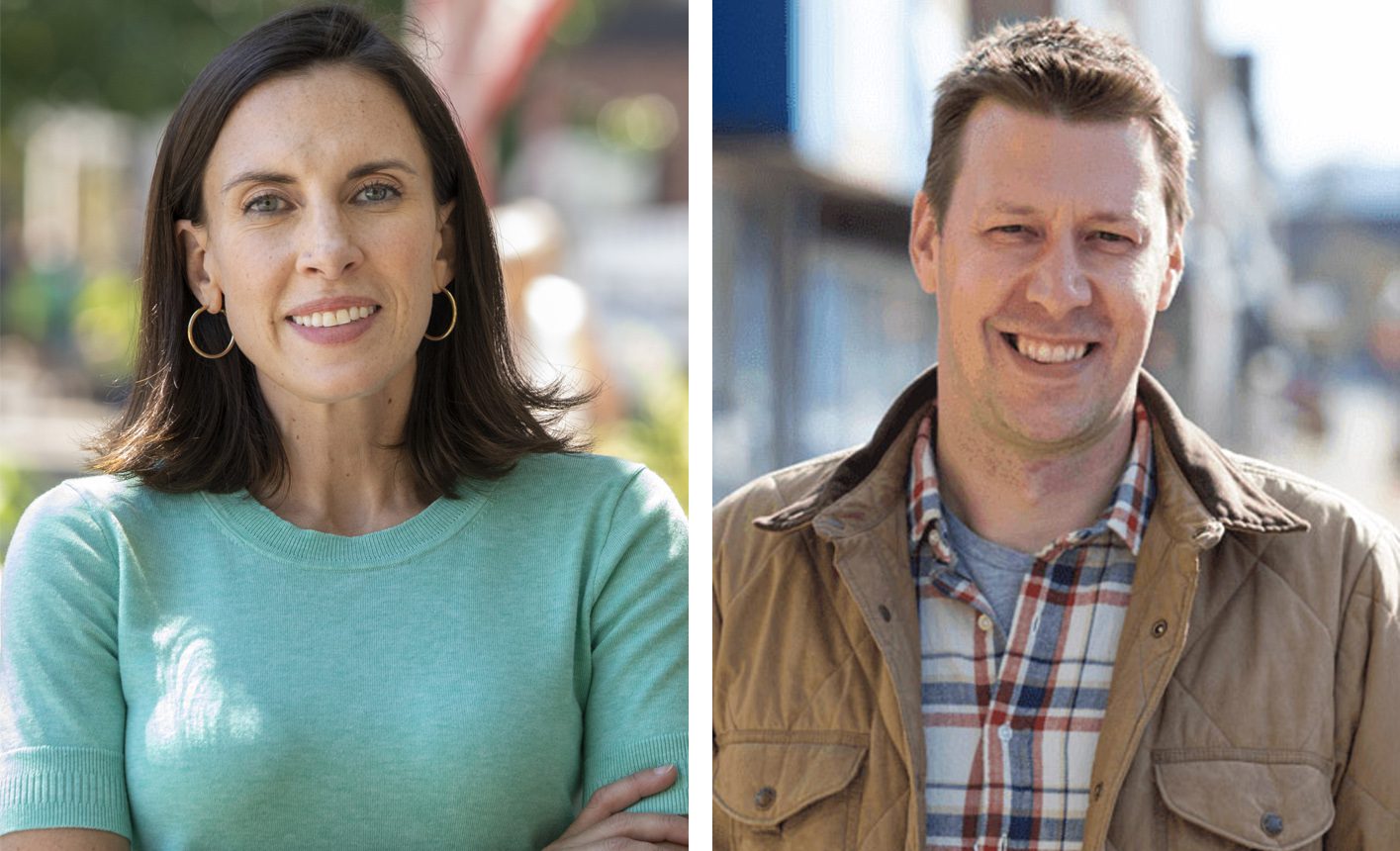
The Democratic Primary for the new 19th Congressional District will occur Aug. 23 of this year. District 19 includes Broome, Tompkins, Chenango, Cortland, Tioga, Delaware, Columbia and Sullivan counties and parts of Ulster County. Tompkins Weekly asked the two candidates, Jamie Cheney and Josh Riley, a series of questions, which they both answered over email. Their answers are below.
TW: Why are you running for Congress?
Jamie Cheney: These are not easy times for New York’s 19th Congressional District. In just the last few months, we have seen a Republican controlled Supreme Court take away a woman’s right to choose, make it easier to carry a weapon, and roll back provisions to help fight climate change.
I am running for Congress because I will not tolerate inaction on the climate or guns and because I understand the deep damage we are doing to women’s lives. I will champion real change before we damage a generation.
Our working families also need a voice who understands the very real pocketbook issues facing our region. I am a small business owner and farmer, and I will always fight for the people of NY-19.
Josh Riley: I’m a fifth-generation Upstate New Yorker, and I’m running for Congress to fight for the region that raised me. Growing up here, I learned to work hard, to fight for the underdog, and this: when we face adversity, we don’t back down from it — we rise up and meet the moment.
We’re facing big challenges today — the planet is burning, the Middle Class is eroded, Democracy is crumbling. Mine has been a career of public service taking on big fights in big places, and I’m ready to use my experience in the courts and in Congress to meet these challenges.
TW: How would you distinguish yourself from your opponent?
JC: After the Dobbs decision, there is no room left on the sidelines. That is why I am so excited to have the endorsements of EMILY’s List, the Planned Parenthood Action Fund, the National Institute for Reproductive Health Action Fund, Vote Mama and Elect Democratic Women.
These groups recognize that we need to elect pro-choice women who will not simply give lip service to the idea of reproductive freedom, but who know from lived experience what is at stake this fall.
I have also founded a business that holds Wall Street accountable by advocating for working parents to have rights like comprehensive healthcare, childcare and flexible work hours. I bring a fresh perspective to Washington, focused on helping the working families of NY-19, rather than more of the same from D.C. insiders.
JR: I am the only candidate in this race who was born in this district, who was raised in this district, or who lives in this district. I’m the only candidate in this race with both public service and private sector experience. And I’m the only candidate in this race who has never taken a single penny of corporate PAC money — because I’m going to Congress to fight for working families in Upstate New York, not the special interests.
TW: What would you describe as your strengths and weaknesses as a public servant?
JC: My strength and weakness is the same: I am not a DC insider. I choose to see that more as a positive. I bring a new voice for voters who are tired of politics as usual and just want a Representative who will stand by for this district.
JR: One of my strengths is my work ethic, which I learned growing up here in Upstate New York. One of my weaknesses is that I sometimes get bogged down in the details of policy issues when the big picture is what’s most important.
TW: If elected, what are your top three priorities as a congressperson?
JC: As I travel the district, voters bring up three specific issues as their top concerns: reproductive rights, guns, and cost of living. These are my absolute priorities in Congress.
In the interest of space, I encourage readers to visit my website, https://www.jamiecheney.com/, for more information on my specific policies.
JR: – Protect and strengthen our Democracy, including overhauling our broken campaign finance system that allows special interests to flood our elections, drowning out the voices of everyday folks.
– Restore and strengthen the Middle Class, which is being crushed by high costs for everything from groceries to prescription drugs while corporate profits are soaring.
– Fight climate change by creating good jobs. Climate change is an existential threat but also an important economic opportunity. We should invest in putting Upstate New York on the forefront of innovation and high-tech manufacturing making advancements we need to save the planet.
TW: What would you like potential voters to know about you?
JC: I am actively involved in the New York agricultural community as a farmer and 4-H parent. I am uniquely qualified to speak to voters of all parties on the rural priorities central to this district’s success. That is the kind of leadership needed to win this seat in November.
JR: I have the experience needed to hit the ground running on Day One in Congress. I got my start in public service as a staff assistant with Congressman Maurice Hinchey. As a lawyer, I took on a landmark civil rights lawsuit for kids from low-income families who needed healthcare.
I have worked on the Senate Labor & Pensions Committee, helping protect the Family Medical Leave Act, and I worked on the Senate Judiciary Committee, passing legislation to protect survivors of domestic violence from homelessness. I’ve argued in federal court for ratification of the Equal Rights Amendment and against Trump’s Muslim Ban.
TW: How do you plan to address the needs of the different cultures, socioeconomic statuses, etc. that are in this district?
JC: New York 19 is a large district with people from every type of background. I am in this race to fight for every single one of them in Washington.
That commitment has already started. I travel more than 1,000 miles a week so that I can be meaningfully present for voters across the district.
I will continue this mission as your Representative. I plan on having offices on either side of the district, as well as a mobile office rotating throughout the rest of NY-19.
I also plan on holding regular scheduled roundtables with people from all the groups that make NY-19 so special. This means our unions, our local electeds, and our cultural leaders. It is my job to represent this district effectively in Washington, and I can only do that by keeping in close touch with all constituents.
JR: The most important thing any representative can do is show up, listen, and learn. Our campaign has done that. In the past ten weeks alone, we have knocked on thousands of doors, made thousands of phone calls, attended dozens of events across all eleven counties.
Once elected, I will set up the very best constituent services program possible —modeled after Congressman Hinchey’s operation — with district offices located strategically across the district and mobile office hours bringing our services to where constituents are.
TW: How are you best suited to address the economic and social impacts of COVID-19?
JC: I am all too aware of the structural problems in this district that were revealed by the pandemic. We have jobs that never returned after the initial shutdown. We have kids who were not able to attend school over Zoom because broadband was not available. We have families who were not able to get the care they needed because hospitals were overloaded and inaccessible.
We don’t need a Representative who read about these issues in a policy paper. I am a working mother of three boys who also runs multiple small-businesses. I understand the economic and social impacts of COVID-19 on our working families because I lived them.
We need large scale investment in workforce development that acknowledges the reality of the post-pandemic economy, rural healthcare initiatives from the Farm Bill, and to continue the Direct to Community Funding that was such a successful aspect of the American Rescue Plan.
JR: First, I am proud to have been endorsed by the nurses union, whose members have been stretched beyond their limits. I’ll work hard to make sure they and their patients have the support they need.
Second, COVID-19 exposed the growing digital divide in this country. I have worked on net neutrality and broadband policy as counsel in the Senate, and I’ll work in Congress to invest in service in Upstate New York.
Third, I’ve argued in court that healthcare should be a civil right, and I’ve laid out a detailed agenda to improve access to healthcare in underserved areas.
Related Articles
Cayuga Medical Center nurses to rally, alleging anti-union tactics by hospital management
CMC nurses plan a rally, alleging unsafe staffing and illegal anti-union tactics as the hospital highlights recent patient-safety gains.
Design details unveiled for new Center of Government
Design details for the Tompkins County government building in downtown Ithaca are now public, with a county survey open for feedback.
Holiday traditions bring community cheer
Tompkins County holiday traditions light up homes, farms, and schools with festive cheer and community spirit.