
County, city make strides in Reimagining Public Safety efforts
This summer, local leaders shared updates with Tompkins Weekly regarding the ongoing Reimagining Public Safety process (tinyurl.com/2avsbhp4), and as is expected with so many moving parts, leaders have made even more strides in the months since.
There’s plenty of news to cover on both the county’s and city’s fronts, and through it all, sources stressed the importance of collaboration to ultimately bring the most beneficial and long-lasting change.
City special committee
In August, the City of Ithaca formed the Reimagining Public Safety Special Committee, the members of which were appointed by Acting Mayor Laura Lewis. As Lewis explained, she “wanted there to be a special committee so that there could be dedicated time to this topic exclusively.”
“We do not always have sufficient time within a council meeting, and that’s why a special committee, I really wanted there to be clear emphasis and focus work on this important topic,” she said. “That being said, it is intended … to be a short-term appointment of a special committee.”
Lewis said that the current plan for the special committee is for its members to have a report filled with suggestions by the end of the year, after which the group would be dissolved. As of the writing of this article, the group has had three meetings so far — one in August, one in September and one just last week — with two remaining meetings planned for November and December.
Leading the special committee is City Alderperson George McGonigal, who said that while he’s never chaired a committee like this before, he takes the role seriously.
“I don’t want to screw it up,” he said. “The last thing I want is for people to say, ‘Well, they’re going through the motions, and there’s no real change in store.’ That’s what I don’t want. I don’t want IPD to think that we’re not listening to them and that we’re not respecting them because this is not going to work unless everybody’s on board, and that includes the police, and that includes the Black and Brown community and the LGBT community. If they don’t think this reform is real, then we’re in trouble.”
McGonigal said that, so far, the group has largely spoken with and heard reports from service providers such as police officers, and “next month, we’re going to shift our focus and talk to community members.”
Committee member and City Alderperson Cynthia Brock shared McGonigal’s commitment and said those conversations will go a long way.
“Most of this process and the development of the plan and the recommendations have gone on in private working groups,” she said. “And so, to have the opportunity to sit down with community organizations, with advisory groups, with professionals in the fields, whatever field that may be, to have this opportunity to meet with them in person, have a conversation, receive their input and feedback, I think allows us to have a broader perspective and engagement on the recommendations that ultimately council may choose to implement.”
Unarmed response
Tompkins Weekly has covered unarmed response efforts throughout this process, especially from the Sheriff’s Department side. Sheriff Derek Osborne said that since the summer, these efforts have “continued to expand,” including having one of the department’s new sheriff’s clerks, Sam Pulliam, take on more duties to further free up deputies’ time.

“He is not only handling certain calls, providing an unarmed response, but he’s now managing our sex offender program,” Osborne said. “This duty was historically handled by one of our investigators in the Investigative Division. So, that really freed that investigator up to, again, work on more serious things and investigate crime. Investigation still backs the sheriff clerk up and helps when needed. But it really went a long way in reducing work for some of our people that have other things to do.”
The city has also made considerable strides on this front. Unarmed response is currently a major area of focus for the special committee and service providers, and special committee member and City Alderperson Ducson Nguyen explained why.
“My colleagues will point out, there are multiple recommendations, and we spent a lot of time on just the one,” he said. “And they’re right. I happen to be focused on the biggest recommendation just because, in my mind, [it] has the potential to have the greatest impact on my community, but these other actions are super important, especially healing. I’m looking forward to seeing more details on that because there is definitely a bridge of distrust that will not be easy to overcome.”
One approach on this front several sources mentioned was some form of victim services — essentially, a person or group who would follow up with victims of a crime after the initial response to check on how they’re doing and connect them with resources if necessary.
“Oftentimes, the police will respond to something, and they’ll make recommendations for what the person can do,” McGonigal said. “But they don’t really have time to go back and check to see if they’ve done it or if they need further help in connecting with services. And that has been mentioned by more than one person as something that would be a valuable addition to what we do here at the city.”
Acting Ithaca Police Chief John Joly shared his thoughts on the idea at the special committee’s September meeting (full recording available at tinyurl.com/2l7k7so3).
“If we had victim services, … that would be one thing that would have a very strong, immediate impact on our communities,” he said to committee members. “If we just follow up on these, maybe we’d be able to reduce the multiple incidents. If we could get people services, help them understand the process, help them link up with family, … I think that’d be a really great service that we can add in or augment what we do now and provide real, tangible help for the community.”
Community Justice Center and community healing
There have been several new developments from the Community Justice Center (CJC), as Director Monalita Smiley shared. For one, work on a “Traffic Calming and Control Study” has begun, as she told the County Legislature earlier this month (tinyurl.com/2mdhbocb). She explained the basics of the study to Tompkins Weekly.
“The overall goal of the traffic study is that there are possibly other traffic safety interventions that can help promote, and ensure, the safety while reducing an over-reliance or a burden on the police,” she said. “The initial contact for officers with the public and with … the BIPOC community, usually the most common way is traffic stops. It’s the most common way people come into contact with police. So, the traffic control study is a part of a larger plan, which is to reduce officer-initiated traffic stops.”
Smiley said that the study is in the beginning phases right now, and a working group has been formed with both city and county representation to manage the study throughout its execution.
In September, Smiley shared her thoughts on what community healing looks like under the lens of the Reimagining process (read her full message at tinyurl.com/2h7mtbox). The response to her piece so far has been positive, she said, and other sources shared her investment in this aspect of the Reimagining plan.
“One of the things we’re going to have to look at down the pike is, what does success look like?” said Legislator Rich John. “How do we measure whether we’re really making progress on the metrics of, are we putting stuff out there that people can see? Do we have data collection systems and everything else that we can measure? But ultimately, reimagining public safety is trying to think through, how are we doing public safety services in our community? And are we doing it in a way that builds trust?”
While the CJC has made a lot of progress, Smiley said that one significant challenge has been that “the work plans that we’ve created were supposed to be voted on, and the city has not voted on them.” She said she’s hopeful for that vote to happen before the end of this year.
Data disclosure
While District Attorney Matt Van Houten has been diligently working to fulfill the data disclosure aspect of the Reimagining plan for over a year now, it was only recently that the data disclosure plan kicked off its community input and implementation stage. Now, community members can read about the plan at tinyurl.com/2jbqdslo and provide feedback, which leaders involved will then review.
“It is really important to the people on the working group, and it’s important to me, that people within the community express what they want to see from that transparency, what kind of information they want to see from those offices as we work on putting it out in a way that is accessible to everyone in the county,” Van Houten said.
Van Houten has continued to work with Lance Salisbury, supervising attorney at the county’s Assigned Counsel Office, on these efforts, and both shared that work since the summer has been positive.
“I think we have a pretty good working relationship,” Salisbury said. “We differ on some things, but on these kinds of macro things, oftentimes we’re in agreement at least in principle on collected data, what it means. … We both think looking at race in terms of traffic stops and prosecutions is an important thing.”
Salisbury and Van Houten said that the process has largely been proceeding smoothly, but there has been some difficulty in trying to compile all the data. For one, as Van Houten has told Tompkins Weekly before, entering the data is labor intensive, with Van Houten putting in many weekend hours to get it done. In addition, as Salisbury said, “Different bodies have data stored differently.”
“The data that his office collects, much of that is in my office as well,” Van Houten said. “But his office only collects data for those individuals who are indigent, which is a large majority of the people in the criminal justice system but not everyone. People who have financial means, who hire attorneys, that’s not data that is accessible to Lance’s office, but it is accessible to my office.”
There have also been strides on the disclosure and transparency front from the Ithaca Police Department (IPD), as Joly told special committee members. As he explained, in the spring, the IPD rolled out its Community Dashboard, available at tinyurl.com/2kxwnpmk, and that has been updated about once a week since.
“It now is searchable back to 2018,” he said in September. “It’s very comprehensive. And we’re looking to still add to that. We’re hoping to have very soon some use of force data and demographics in there as well as Narcan usage. So, we’ll be hopefully rolling that out very soon, just trying to work out [and] make sure we’re putting out the proper data.”
IPD shortages
An ongoing challenge several sources brought up that has been affecting service providers across the county is IPD’s current officer shortage. Joly told special committee members that IPD is currently at 52 officers in its workforce, but with quite a few officers on light duty, on administrative leave or pending retirement, the practical workforce is significantly lower.
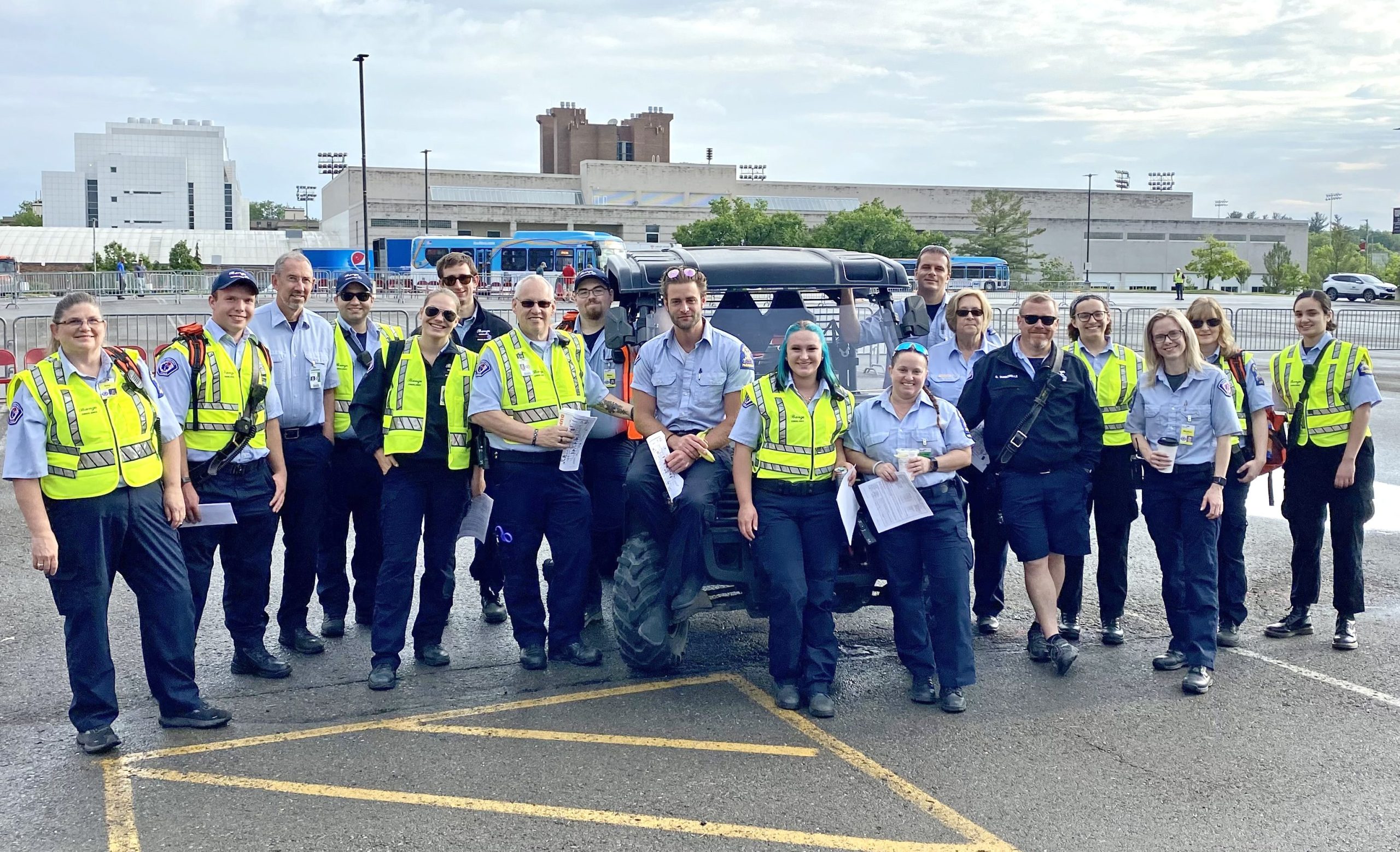
Almost universally, sources said that IPD’s officer shortage is having widespread ripple effects on other service providers. Bangs Ambulance’s Meghan Bangs, for example, shared how the shortage has affected her work.
“In recent months, the number of scenes which require law enforcement presence has increased while we are simultaneously seeing a decrease in the number of IPD officers,” she said in an email. “If law enforcement is unavailable or delayed, ambulance response times will likewise be delayed as we wait for law enforcement to declare the scene safe. This in turn [affects] our ability to respond to subsequent calls which has a domino effect on the entire 911 system.”
When asked about the reason behind these shortages, sources varied widely, with some unsure and others asserting it is at least partially the result of negative impressions some in law enforcement have of the Reimagining process. McGonigal, for example, said that “right now, people are avoiding Ithaca. They’re going to smaller, less-well-trained departments just because they’re afraid of the Reimagining.”
Several sources emphasized that the Reimagining process does not disadvantage IPD or other law enforcement officers, with some adding that the plan actually aims to make their jobs easier.
“The reality is the report essentially leaves IPD untouched,” Nguyen said. “This other narrative that we hate our police officers and don’t appreciate their work is totally false. I think despite their labor shortage, they are doing a good job of arresting people who have committed crimes, and we want to help them out by giving them an additional resource.”
In the meantime, IPD is actively working to address the shortage through a variety of measures that Joly broke down for committee members, including eliminating the residency requirement for police and fire applicants and reducing the application fee. Another of these methods has been getting more people signed up for IPD’s civil service tests, and Joly said those efforts have gone considerably well so far.
“We ended up having 86 people sign up for that test, which, we certainly had more people in the past, but when we compare it across the state, we did better than over half of the departments in the state as far as the number of people that signed up for it,” he said. “At this point, we are having success, and we’ll continue to build on that in the future.”
Several sources stressed that IPD’s efforts — just like the efforts of all others discussed previously — require buy-in and collaboration from everyone involved to be a success. And that doesn’t mean just service providers and lawmakers; sources also encouraged residents to stay involved.
“The one thing I would like to remind the community is, please visit our website, email me, phone calls, anything, any questions or concerns,” Smiley said. “[If] they have any input they would like to provide, we welcome it. It’s really about community engagement and being transparent, so utilize our website or my email or phone number, anything of that sort.”
For more information about the Reimagining process, including opportunities to contribute comments and feedback, visit publicsafetyreimagined.org.
Jessica Wickham is the managing editor of Tompkins Weekly. Send story ideas to editorial@VizellaMedia.com.
Related Articles

AmeriCU proudly connects students with annual scholarship opportunity
AmeriCU scholarship program awards $1,000 to students pursuing college or vocational education. Applications are open through March 15.
Street Beat: What’s one of the best holiday gifts you ever received?
We asked five random people. Here’s what they had to say.

5 things to do in Tompkins County this weekend
Plan your visit and discover what’s happening this weekend.