
A trip down holiday memory lane this December
T’was the week before Christmas and I was feeling nostalgic, so I thought, at the risk of mixing holiday metaphors, I would pay a visit to the ghost of Christmas past and have a look back at the decorations from my childhood that made the season special.
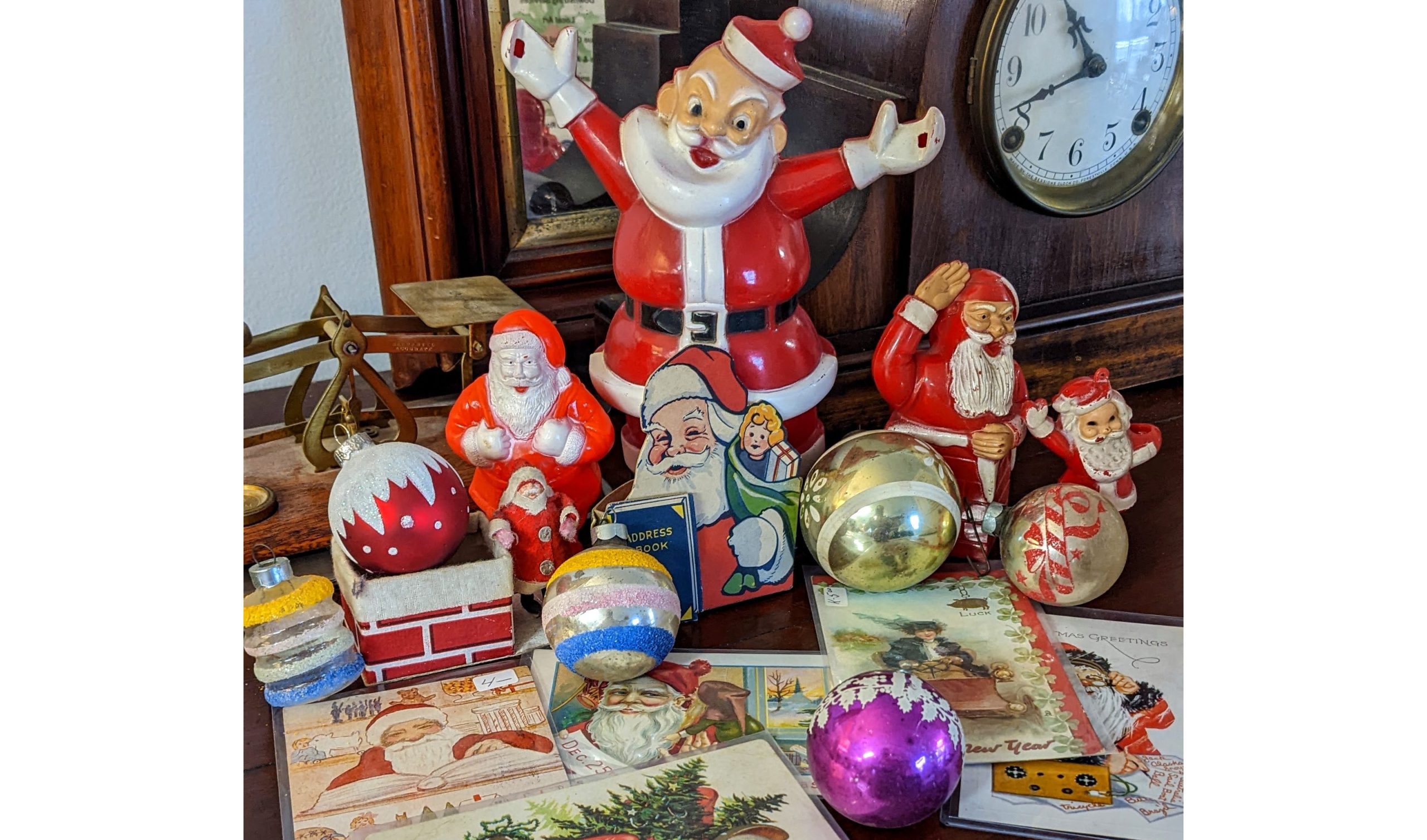
Some holiday-themed items from Steven Daly’s collection. Photo provided.
T’was the week before Christmas and I was feeling nostalgic, so I thought, at the risk of mixing holiday metaphors, I would pay a visit to the ghost of Christmas past and have a look back at the decorations from my childhood that made the season special.

By Steven Daly, appraiser
When I was a kid in the ’70s, my mom had quite a collection of beloved holiday trimmings that she had accumulated over the years. She has been gone a long time now and all but a few pieces have drifted away since, but I still get the visceral sensation of childhood Christmas magic whenever I think about them.
The first things that come to mind are the group of elves and pixies that populated our home in the month of December. They came in multiple sizes wearing either a green or red felt onesie with a matching cap and a grinning plastic head. Both arms were joined together, at the white-mittened hands, creating a loop that allowed you tuck their gangly legs up in front of them, which is why they are often referred to as “knee huggers.”
Produced in Japan starting after WWII, they were very popular and served as the inspiration for “Elf on the Shelf‘’ sensation. We also had a set of “popcorn” wall plaques made from chips of colorful plastic melted together into the figures of a waving Santa Claus, Rudolph and Frosty the Snowman that were made by the Kage Co. from Manchester, Connecticut, in the ’70s.
Santa and Frosty were also represented in plastic blow mold lamps. The hollow figurines were lit by a single Christmas bulb that clipped in a hole in the back. The ones I remember having were the 12-13-inch-high versions for indoor use. The taller outdoor versions were everywhere, and we might have had a snowman in the yard, but I can’t remember for sure.
They were sold by Empire Plastics in North Carolina, who offered a huge variety of options from angels, carolers and candles to life-sized nativity scenes complete with camels, cows and sheep. On our tree, along with the tinsel that weighed so much more than it looked like it would, the colored lights and various other baubles, there were a half dozen or so round, glittery-faced styrofoam Santa head ornaments with pulled cotton beards and felt hats. Another post-war Japanese import, they just screamed mid-century Christmas.
Of course, the highlight of the tree was the Shiny Bright ornaments: bulbs of thin blown glass that were coated on the inside with silver nitrate, to keep their shine for many seasons, and then decorated by hand. They came in many styles and colors, some with bands of glitter or designs drawn in white powdery artificial snow, and some were shaped like tops, lanterns or bells.
Originally, the Shiny Bright Company imported blown glass ornaments from Germany, but, insightfully seeing trouble on the horizon, they stopped in the mid-’30s. They decided to make their own here in America. They worked with Corning, who adapted their lightbulb equipment to mechanically blow the ornaments for mass production, and they became a ubiquitous part of post-war Christmas.
They were beautiful and quite fragile for my young hands. I can still hear the sound they made when they shattered on the floor, and I can still feel my mother’s glare from across the room.
The halls and the rest of our house was decked with all of these things plus ceramic illuminated Christmans trees, plastic Yule logs, candle-powered angel chimes and an assortment of other candles that we weren’t allowed to burn. Many of these items have become very collectable in recent years, and demand has increased for things from this time period with the resurgence in popularity of mid-century modern furniture.
With that in mind, I haven’t come across a lot of these things in my appraisal practice, so the ghost of Christmas present brought me to Kyllikki Inman, owner of East Hill Antiques in the East Hill Plaza near Cornell, to talk about what types of holiday items are in demand at her store this year.
“So far, I see people wanting 1960s and 1970s ornaments,” she told me. “Flocked plastic reindeer in hot colors have been super popular.”
Those are the ones that have a plastic coating that feels velvety to the touch.
“Handmade, hand-painted wooden ornaments, Santas, angels, camels, stars, sleighs, etc.” are also good sellers, she said.
I asked her if there are certain classic items that she gets a lot of requests for or are always in high demand.
“I’ve had people ask for Christopher Radko ornaments. They are a tad bit new for my store, but I get them sometimes,” she said.
Radko is a designer who began selling fine glass ornaments in the mid-’80s, and he quickly developed a high-end clientele of celebrities and politicians. In 2001, he bought the Shiny Bright brand and began reissuing their classic styles.
Inman continued, “Old Christmas postcards always sell well. Creches [Nativity scenes] don’t sell at all in Ithaca, but I could sell as many Menorahs as I can get. Weirdly, I can sell jingle bell earrings, but I have tons of great vintage Christmas jewelry that just sits there. Ugly Christmas sweaters are super popular and very hard to find vintage ones, but they sell instantly when I do get them, even any time of year.”
Well, that just leaves the ghost of Christmas yet to come, but I guess we will all have to wait to see what he has in store for us. Until then, we’ll have to muddle through somehow.
Thanks for coming on this nostalgic journey with me, and I’d like to wish a Merry Christmas, Happy Holidays or Bah Humbug to all, whichever suits you, and to all a good night.
Let me know if you have any items with a story to tell, holiday related or otherwise. I’d love to share it.
Steven Daly is a qualified, independent, personal property appraiser. He can be reached at steven@ithacavintage.com. Visit www.Ithacavintage.com for more information.
Related Articles
Sponsored Sponsored content A holistic approach to wellness
William George Agency offers youth recreation programs that boost fitness, mental health, and confidence through holistic activities.

Sponsored Sponsored content Can the Grid Handle EVs? Debunking the Myth
Explore how Dovi Motors is leveraging modern infrastructure and smart EV technology make charging safe, efficient, and manageable for drivers and utilities alike

Sponsored Sponsored content Tech gifts for the holidays – and why fiber internet makes them even better
Explore the best holiday tech gifts and see how fast fiber internet from Empire Access helps your new devices perform their best this season.