
Charging an electric vehicle
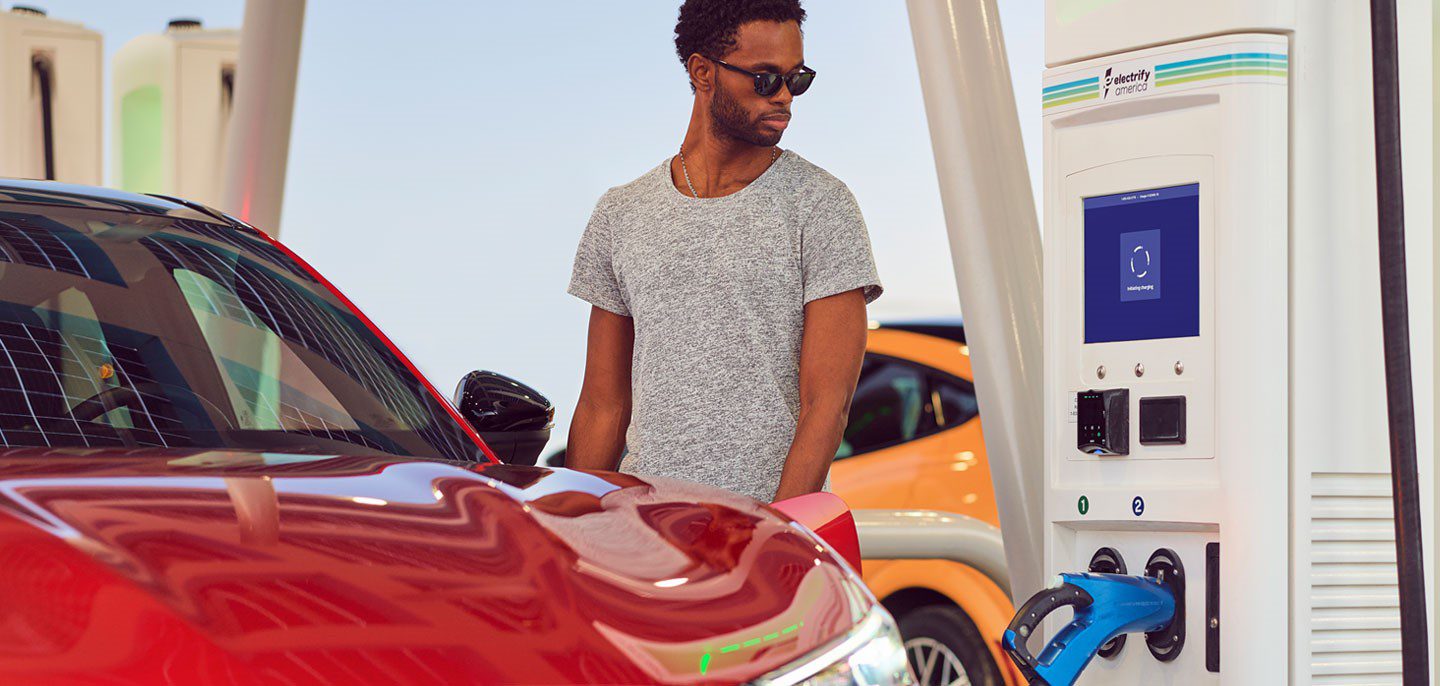
Charging, as opposed to fueling, is the trait that truly makes electric vehicles different from their gas counterparts. As you know, traditional vehicles store gas (or diesel) in a gas tank which is then ignited inside of the engine. The resulting energy is used to turn the wheels. Unfortunately, there is a bunch of heat and chemicals that are expelled into the air during this process.
Electric vehicles store energy in lithium battery cells. The electric company sells KWh (Kilowatt Hours) of electricity, which is stored in the vehicle’s battery via a charger. My all-electric Ford Mach-e has 91 KW of usable electricity storage, and this electricity is used to run the motor, climate, and other systems in the vehicle with no unwanted byproducts.
EV charging technology is rapidly evolving and there are many different charging ports, rates, and standards that you need to understand if you are going to jump into the world of EV ownership.
Chargers are hardware, just like for your laptop or cell phone, which allow electricity from the utility company to be put into your EVs battery. However, unlike your cell phone charger, these devices are dealing with high volumes of energy and tend to be fairly specific to your brand of EV.
There is a lot of terminology to learn if you really want to understand EV charging, but a general rule is the more amps, volts, kilowatts, or levels the faster you can charge. My Mach-e came with a mobile charger that can plug into a typical household outlet.
This level 1 charger takes about 15 hours to charge my car. I have a level 2 charger installed in my garage which can get the battery to 100% in about 6 hours. Level 3 chargers are very expensive to install and are only available in public charging areas, but they can take your EV battery up to an 80% charge in about 15 minutes. Most level 2 charges are around 7-14 KW where level 3 chargers can run at 120 KW or more. As I said before, the bigger the number, the faster the charge.
Ok, that was a lot of terminology and theory, but what does all this really mean for owning an EV? For me, I mostly use my Mach-e to drive back and forth to work (7 miles each way), take my kids to soccer and dance, and make an occasional run to Syracuse or Binghamton. 95% of the charging I do is at home, I can charge at work in a pinch, and I have rarely needed to use public charging as we generally take our gas vehicle on longer trips.
Charging is easy. I get home. I plug in. It is like having a gas station at my house! So much media attention for EVs has revolved around going on trips, but most of our miles are spent driving locally. That said, if your whole life is traveling, then EVs likely aren’t for you yet.
There is decent level 3 charging infrastructure developing, especially on highways and around major metro areas, but even if you can find enough charging, you have to charge much more often when using level 3 chargers. Level 3 chargers are really fast getting you up to 80%, but 80% – 90% takes longer, and that last 10% take twice as long again. Put another way, charging to 80% may take 15 minutes, but charging to 100% will take 2 hours. For people driving 300 or more miles per day, you will find charging your EVs frustrating.
EV charging has really come a long way over the last few years. Home charges are faster, and level 3 charges are getting more abundant. Today though, EVs are best for use around town or for shorter trips that can be completed on one charge. Most of my EV customers have two vehicles in the household, one of which is gas, and they take the gas vehicle on longer trips. If you are a person who really enjoys the journey, then taking trips in an EV can be a lot of fun. Next month I will share my experiences with road trips in an EV and hopefully illuminate the joy and the pain of public charging!
Related Articles

Sponsored Sponsored content A holistic approach to wellness
William George Agency offers youth recreation programs that boost fitness, mental health, and confidence through holistic activities.

Sponsored Sponsored content Can the Grid Handle EVs? Debunking the Myth
Explore how Dovi Motors is leveraging modern infrastructure and smart EV technology make charging safe, efficient, and manageable for drivers and utilities alike

Sponsored Sponsored content Tech gifts for the holidays – and why fiber internet makes them even better
Explore the best holiday tech gifts and see how fast fiber internet from Empire Access helps your new devices perform their best this season.