
From southeast China to western NY
Note from Gary Stewart, Cornell associate vice president for Community Relations: There are close to 3,000 faculty members at Cornell, including 50 Nobel laureates working in 17 colleges and schools. Many area residents don’t have the opportunity to connect with East Hill faculty on a regular basis. Thus on occasion we like to put a spotlight on some of the diverse women and men at Cornell who are teaching 26,000 of tomorrow’s leaders from dozens of nations.
Cornell faculty member Jie Shan received her diploma in Mathematics and Physics from Moscow State University in 1996 and her M.S. and Ph.D. in Physics from Columbia University in 1998 and 2001. I’ve always appreciated anyone who lived in Moscow after the fall of the Soviet Union, as I did in 1992-93 during an interesting time in newspapering.

Jie is Cornell’s Walter S. Carpenter Professor of Engineering and director of graduate studies. The text below was previously published in the Cornell Chronicle.
From 2002 – 2014, Jie Shan was an assistant and associate professor in Physics at Case Western Reserve University, and from 2014 – 2017, an associate and full professor at Penn State. She joined the Cornell University School of Applied and Engineering Physics as a full professor in 2018.
When Shan was growing up in Zhejiang Province in China’s southeast, she did not imagine her future held a career in physics. “I always liked math and chemistry and physics when I was in high school,” says Shan. “But when I chose to major in physics for my B.S. I didn’t really think I would become a professional physicist.”
Many years later, she is also a Fellow of the American Physical Society (APS).
“Initially, I liked the ability physics gave me to explain things from basic principles,” says Shan. “I also love the problem-solving approach I learned by studying physics.”
Shan’s work at Cornell focuses on the optical and electronic properties of nanoscale materials. She is particularly interested in atomically thin two-dimensional crystals (such as graphene and MoS2) and their heterostructures. Her lab develops experimental techniques to probe, image and control the internal degrees of freedom of electrons and their new phases in these nanoscale systems.
When Shan earned her Diploma in Mathematics and Physics from Russia’s Moscow State University she was drawn to experimental physics, but her thesis advisor steered her toward more theoretical work. “There was a hierarchy within the physics department at Moscow,” says Shan, “and experimentalists were viewed as a notch below theoreticians.”
Shan moved to New York from Moscow and started a doctoral program at Columbia University. “When I got to Columbia, I became an experimentalist,” says Shan. “I worked with Professor Tony Heinz on optical spectroscopy.” Shan’s work at Columbia contributed to a table-top coherent terahertz technology that could be used in imaging and for materials characterization.
After earning her Ph.D. from Columbia, Shan joined the faculty of Case Western Reserve University, where she taught for 12 years. “I found colleagues at Case Western so supportive and mentoring and the students so devoted,” says Shan. “I had access to a strong research community on biomedical and soft materials. I applied optical spectroscopes to colloids and other soft matter.”
The next step in Shan’s career took her to Penn State, where she moved into a deeper study of 2-dimensional materials. Her work at Penn State focused on collective electronic phenomena such as superconductivity and magnetism in the 2-dimensional limit. At Cornell, Shan has continued the work she started at Penn State.
“Much of our research is driven by fundamentals,” says Shan. “We work with new materials, and we are trying to discover or engineer new properties. It is very exciting.” Shan is especially excited by the possibilities opened up by the ability to integrate 2-dimensional materials of different kinds into heterostructures.
Finally, some of Professor Shan’s select awards and honors:
* Fellow, American Physical Society, 2013
* Scialog Award for Science Advancement, Research Corporation, 2010
* Marie Tharp Fellowship, Columbia University, 2008
* National Science Foundation CAREER Award, 2004
* Optical Society of America New Focus Student Award, 2000
In the community and on campus, we rarely know everyone we’re passing by any given day, and what a pleasure to know a little about Jie Shan. East Hill Notes are published the first and third Tuesdays of each month in Tompkins Weekly.
Related Articles
Meinig Fieldhouse built to protect iconic red-tailed hawks
The Meinig Fieldhouse hawks project shows how Cornell protected Big Red and other red-tailed hawks during construction.
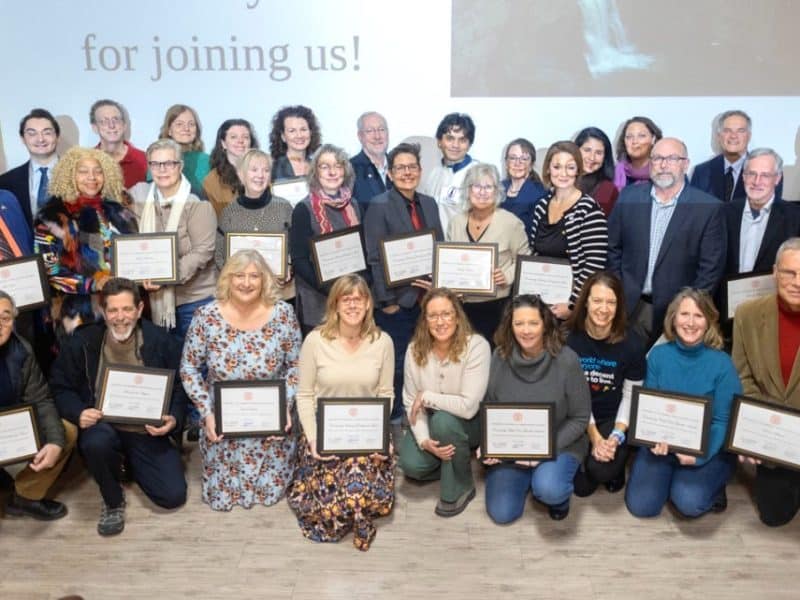
Town-Gown Awards honor housing, child care collaborations
Town-Gown Awards recognized Cornell and community partnerships supporting affordable housing and child care in Tompkins County.
Lorin Warnick to end term as Cornell Veterinary College dean
Warnick Cornell dean Lorin Warnick will step down in 2026 after leading the veterinary college through growth, innovation, and major public health milestones.