Sporks to reduce waste in Ithaca area schools
What is the answer to 268,740 problematic plastic utensils thrown away annually at Ithaca’s schools? It’s sporks, of course!
Yayoi Koizumi, founder of Zero Waste Ithaca, had been looking for a way to help reduce the amount of plastic waste generated locally by the use of plastic utensils.
Schools seemed like a natural place to start because they are such large local institutions.

MANAGING EDITOR
“It was one of the obvious places where we could reduce waste by knocking out single use in an entire school district,” Koizumi said.
With the help of Beth Krause, nutritional director of the Ithaca City School District, Koizumi calculated how much silverware would be necessary to replace the plastic silverware in all the district’s schools. It was determined that the effort would replace more than a quarter million plastic utensils annually sent to the Ontario County Landfill by the school district, according to a press release from Zero Waste Ithaca.
One of the main hurdles, though, was students’ propensity for throwing school silverware in the trash. Having always used plastic utensils, they are not in the habit of returning spoons and forks to be washed. What they needed, Koizumi said, was something special to draw attention to the silverware.
“I knew that we needed a great story, because we are in touch with organizations around the country, and every school has a problem with the loss of spoons and forks,” Koizumi said.
Then, as luck would have it, Koizumi came across the story of a local artist who held the answer—in her barn in her backyard in Dryden.
The sporks were originally purchased by the Korean American family of In Shik Lee in the 1970s.
Why did her father choose to invest in sporks?
“I think his idea was that it would save water—because it’s three things—and it would save on labor and sorting…he thought it was a great idea, Lee said.
Unfortunately, Lee’s father invested in stainless steel utensils right before the rise in popularity of plastic forks and spoons for large institutions, and he was never able to unload them. After he died, they traveled from place to place with Lee’s mother until she moved in with Lee.
“She agreed to share some sporks with us, and we got the funding and thought, ‘let’s do this,’ and here we are,” Koizumi said.
But the project did not just get funding for a few sporks; in partnership with Plastic Free Restaurants, they received enough funding to purchase 3,200 never-used sporks from Lee, which is the estimated amount needed to stock the cafeterias of the entire district.
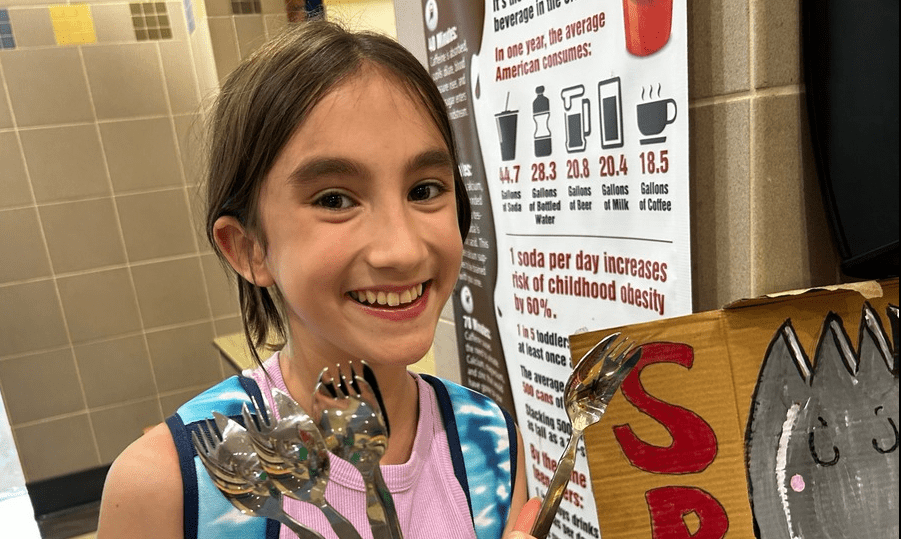
LACS (Lehman Alternative Community School), a district pioneer of reusable practices was the first to receive the sporks. Since early September, Zero Waste Ithaca members have organized educational lunch hours for LACS and Boynton Middle School. Local artist Susanne Jensen contributed a special artwork with the message “Sporks Are Happy when Returned,” to encourage students to return the sporks for washing and reuse. The hope is that students will take pride in caring for these unique sporks, passing them down to future generations of students.
It is a bit of a risky venture, introducing silverware to a generation of children who were raised on disposal dinnerware.
Before the Ithaca initiative, Lee sold some of her sporks to Lansing Central School District, where they held a contest to name the utensils. They voted to call them spoodles, with the hope that students would treat their spoodles with more respect than they might your average metal fork.
Koizumi is prepared for an uphill battle. “We have had reports about middle schoolers throwing away the lunchroom trays,” she said. “They are so used to single use, and they think that it’s cleaner. There is this mindset that’s not really right. They think single use is cleaner, but it’s really toxic.”
Single use utensils marketed as compostable are not much better, she said, adding that they can contain up to 80 percent plastic and still be sold as biodegradable.
The switch to metal sporks, along with the use of reusable trays, is an effective cost-saving measure in the long run, Koizumi said.
“Sporks are just the beginning,” she added. “It’s our hope they are all switched to stainless steel reusables, because plastic leaches toxic chemicals… we hope to make a difference just in terms of environmental justice and conservation, but it’s really for the health of the students that we move to reusables and get rid of single use, period.”
Author

Related Articles

AmeriCU proudly connects students with annual scholarship opportunity
AmeriCU scholarship program awards $1,000 to students pursuing college or vocational education. Applications are open through March 15.
Trumansburg schools consider regionalization as TST BOCES plan advances
Trumansburg school regionalization remains undecided as TST BOCES outlines goals for shared services and student learning.