
Eclipse 101: Everything you need to know about viewing the phenomenon coming April 8
Who wouldn’t want to witness the rare sight of the world going dark in the middle of the day, the moon’s shadow moving closer and closer to the sun until crickets start chirping and suddenly you can see the stars shining?
“That final stage is like switching off the lights,” said Philip D. Nicholson, professor of astronomy at Cornell University.

Managing Editor
Unfortunately, our view from Ithaca won’t be the same as seeing the full eclipse. Viewing a partial eclipse may be interesting, but the human eye adjusts very quickly to low levels of sunlight.
“Until the sun is blocked completely, you don’t notice a dramatic change,” Nicholson explained. This is why so many people are planning on traveling to view the full eclipse on April 8.
The eclipse is expected to begin at approximately 2 p.m. and end by 4:30 p.m., with the full total eclipse occurring in our region between 3:15 and 3:30 p.m. What should Tompkins County residents expect on the day of the event in terms of travel and viewing options?
“There will be thousands of people on the roads traveling for this,” Nicholson said, adding that he has heard stories of people being stuck in traffic jams for hours when they traveled to view the 2017 eclipse.
He expects that people will head our way from big cities like Philadelphia, Pennsylvania, and Washington, D.C., which are not on the path of totality but are less than a day’s drive away.
“There will be just piles of people driving north out of places like New York City to get into the eclipse zone who are just now thinking, ‘Maybe we should do this,’” Nicholson said.
But that does not mean people should just stay home. It simply means that they should plan ahead and consider viewing the eclipse from a less populated area if possible.
“The better bet is to go to a smaller town,” Nicholson advised. “You don’t want to be surrounded by trees, but other than that, you can go anywhere. But the catch is going to be going on the highway to get there.”
Leave as early as you can and make a day of it; plan on being there hours ahead of time, he recommended.
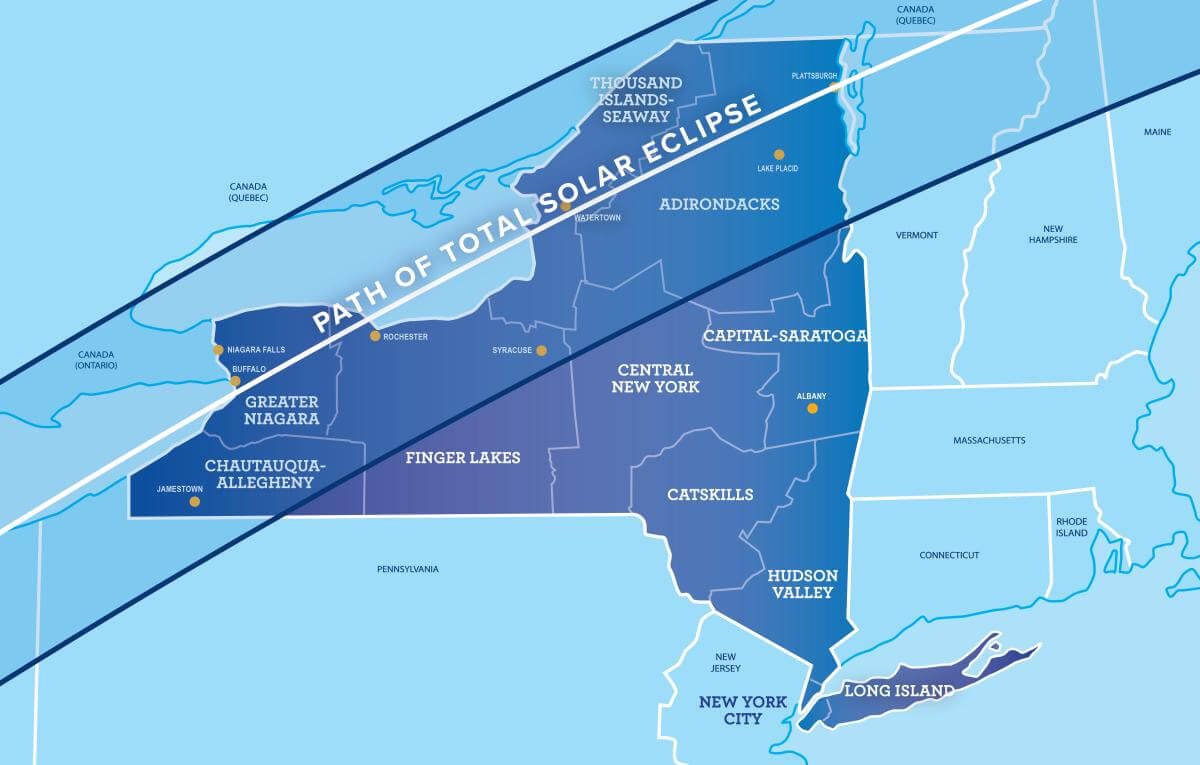
Statistically speaking, unless there is an unexpected snowstorm, skies are likely to be clearer near the Great Lakes, so just south of Lake Erie or Lake Ontario should be ideal, Nicholson said.
Anywhere just north of Syracuse is also a good bet for prime viewing, including along Onondaga Lake and Oneida Lake.
Heading in the direction of either Rochster or Syracuse is a good option, though totality will last a bit longer in Rochester — about three-and-a-half minutes, versus the two minutes viewers will see in Syracuse.
“If you’re lucky enough to get a spot on a high hill, then you can actually see the shadow of the moon moving toward you [at] over 2,000 miles an hour,” Nicholson said. “I’ve read descriptions from mountaintop sites that are quite spectacular. There’s a big shadow that moves more like a freight train than an astronomical event.”
For more information about the eclipse, Nicholson recommends visiting eclipse2024.org for everything you need to know.
There are important things to know regarding safe viewing. Tompkins County Whole Health is alerting the community to important safety guidance regarding the eclipse.
Do not look directly at the sun during the eclipse. During the limited time of totality when the sun is completely covered by the moon, it can be looked at with caution. However, Tompkins County is not within the “zone of totality,” so we will only see a partial eclipse and the sun will not be completely covered by the moon.
Sunglasses will not protect your eyes. Use International Organization for Standardization (ISO) 12312-2 certified eclipse glasses from a trusted source. Further information about safe viewing, including a list of eclipse glasses suppliers, can be found on the American Astronomical Society website.
Certified eclipse glasses are available for free, while supplies last, at all Tompkins County libraries. Call or visit your local library to pick up free certified eclipse glasses and find out about upcoming eclipse-related events and activities.
There are techniques for viewing the eclipse indirectly. With the sun behind you, you can cause sunlight to pass through a small opening (for example, a hole punched in an index card) and project a solar image onto a nearby surface (for example, another card, a wall or the ground). One of the best ways to view a solar eclipse is through a pinhole projector, where you look at a projected image made through a pinhole in cardboard paper. Or even easier, grab a colander from the kitchen (not the mesh kind, the one with holes in plastic or metal).
If you’re outside watching the eclipse for an extended period of time, be sure to wear sunscreen as you would on a sunny day, as the sun’s rays can still cause damage in a partial eclipse.
While Tompkins County falls outside of the zone of totality, the safety guidance remains the same, as the impact of looking at the sun during a partial eclipse will still be damaging to the eyes without proper safety equipment. Exposing your eyes to the sun without the appropriate protection can cause “eclipse blindness,” which can temporarily or permanently damage your eyes.
In the event of disruptions in cell phone service due to high volume of cell tower use, it is recommended you take a paper map with you if driving to unfamiliar areas, in case service disruptions impact your ability to rely on a mobile GPS system.
If you’re heading out on the trail to see the eclipse, check hiking trail conditions, which can have snow, icy or muddy conditions, depending on elevation.
Wildland fire season in grass and brush in New York can begin in February and last through May. Grass and brush that have dried and cured (yellowed) during the winter months along with dry weather patterns in the spring can be just the right combination for a wildfire if there is an ignition source. Clear at least three feet of burnable material from around any outdoor fire. Ensure that any outdoor fires are extinguished and are cold to the touch.
If you will be camping or hiking, be aware of ticks, mosquitoes and plants like poison ivy that can cause skin irritation. Remember the two adages: “Leaves of three, leave them be!” and “don’t be a dope and touch the hairy rope.” Cover your skin as completely as possible when in woods or fields. Wear shoes and socks, long pants and a long-sleeved shirt when outdoors in a tick habitat.
For additional information about the solar eclipse in New York state, visit https://www.iloveny.com/events/eclipse-2024. And don’t forget to reach out to your local library for eclipse events and free certified eclipse glasses.
Author

Related Articles

AmeriCU proudly connects students with annual scholarship opportunity
AmeriCU scholarship program awards $1,000 to students pursuing college or vocational education. Applications are open through March 15.
Street Beat: What’s one of the best holiday gifts you ever received?
We asked five random people. Here’s what they had to say.

5 things to do in Tompkins County this weekend
Plan your visit and discover what’s happening this weekend.