
East Hill News: Rev – Ithaca Startup Works puts new entrepreneurs through their paces
Inventing a new product that you can hold in your hands and bring successfully to an eagerly awaiting market is sometimes likened to childbirth: If we knew from the outset how hard it was going to be, fewer of us would do it.
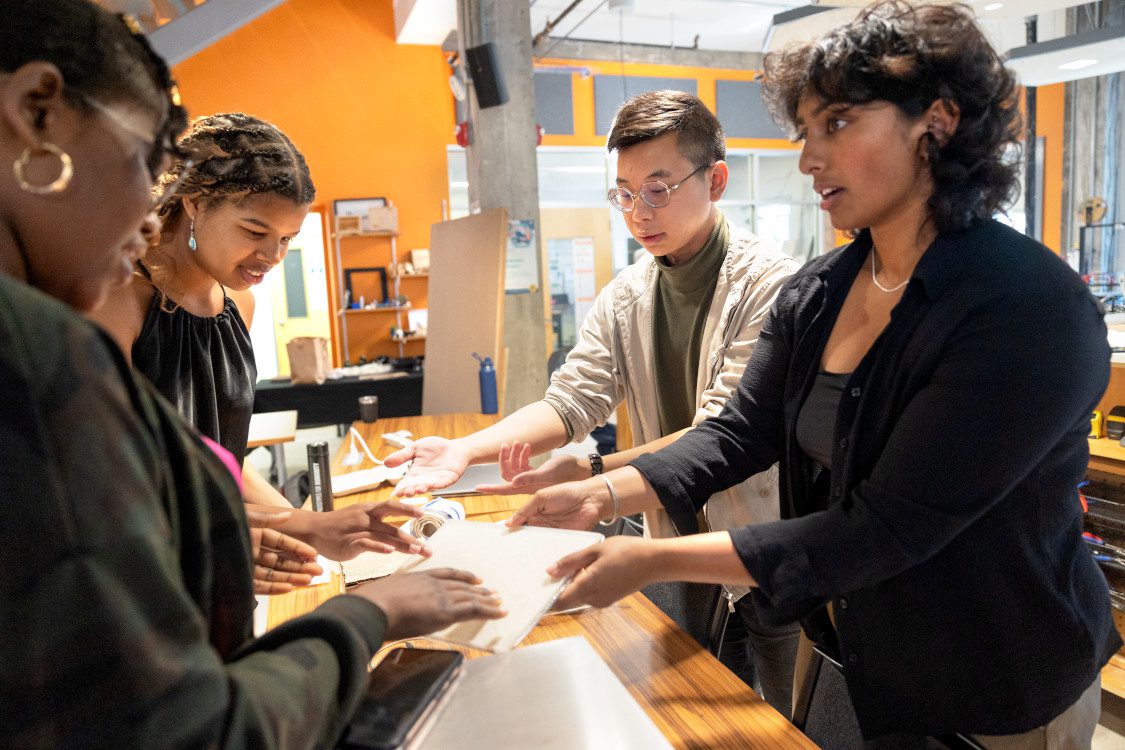
Over 10 weeks this summer, Rev’s Prototyping Hardware Accelerator guided product teams from back-of-the-napkin ideas to fully-fledged startups. In categories from climate technology to agricultural innovations, and with projects that ranged from canoe racing tools to improved tea dispensers, teams gained access to experts in their industry’s field, working together to figure out if their concept might be commercially desirable, technologically feasible and economically viable.
What unified this year’s 22 teams is a deep desire to fix a problem, right a wrong or make elegant solutions equitably accessible. It’s personal.
“For Christmas, I was spending time trying to find Cantonese-speaking toys for the children in my family,” said Annie Hua, founder of Babel Blocks, an interactive stuffed animal toy that allow parents to customize language settings via an app. “I’m not a parent, but I’ve talked to parents raising bilingual or multilingual kids, and they say it’s hard to find toys in their languages.”
Each startup in the accelerator was paired with an experienced entrepreneur and had access to a team of hardware engineers to assist with developing physical products. For Hua, this meant thinking through what kind of toy would be a beloved “keeper.”
“The toy industry creates a lot of waste, and plastic toys are not held onto as long. A stuffed animal is something with the potential to last longer than a plastic toy, and what I’ve created is washable and may be customizable,” said Hua.
For Bryan Wong, Pooja Patel and Sanjana Gurram, the team behind EquiPad, an eight-month journey began with a similar question of how best to make an impact on people at every income level.
“We decided that we don’t need to boil the ocean to make an impact,” Gurram said of their idea: a roll-format dispenser for menstrual pads that can be made of cellulose from any plant waste. Their aim is to debut dispensers for the product in American schools, universities and workplaces, but creating pads that are more affordable, accessible and discreet has significant applications in developing countries where girls and women may miss school or work because of lack of access to menstrual aids.
AnalytiTech founder Christopher Cilip and his teammates Tony Kariuki ‘25, and Sasha Logunov ’25 harnessed AI to give athletes real-time feedback on learned and refinable motions like golf or batting swings using a computer vision program that monitors joint positions. The low-cost technology has applications for coaching and performance improvement in golf schools or other sports academies, but long term there are myriad possibilities, said Cilip.
“There are applications for physical therapy and sports rehab, where you want people to go from 30 degrees of motion to 90 degrees,” Cilip said. “It would be a good tool for remote medicine because it’s inexpensive to utilize. And with pose detection, it’s applicable for animals and veterinary analysis. The opportunities are boundless.”
Some of this year’s accelerator teams aim to solve a single small problem with huge implications. For the High Tunnel Titans, anchored by Joanna Tan, a rising junior in mechanical engineering at Cornell, a regional farming problem is under the microscope. Rolling high tunnels – hoops that function like portable greenhouses that can be moved to shield plants from rain, sun or cold – are costly, unwieldy, or both. What if they were made lighter and more flexible, bending with the wind like a lightweight backpacking tent?
She’s refining an affordable solution that helps create a controlled environment that can extend the growing season.
“What I have in mind is aiming this at small-scale organic farmers. But it could be more broadly applicable,” she said. Like a metaphor for Rev’s Prototyping Hardware Accelerator itself, her project is about finding new ways to shield and nurture seedlings until plants are strongly rooted and able to flourish.
Related Articles
Town-Gown Awards honor housing, child care collaborations
Town-Gown Awards recognized Cornell and community partnerships supporting affordable housing and child care in Tompkins County.

Lorin Warnick to end term as Cornell Veterinary College dean
Warnick Cornell dean Lorin Warnick will step down in 2026 after leading the veterinary college through growth, innovation, and major public health milestones.
Cornell ash trees aim to beat back borer insects
Cornell plants ash trees with potential resistance to emerald ash borers, advancing statewide restoration through the Trees in Peril project.