
Lansing asks state to reconsider Cargill permit modification
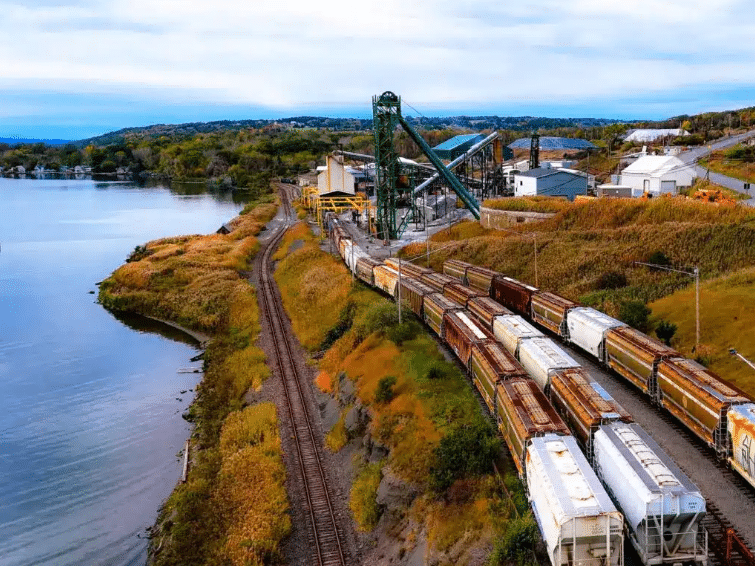
At a recent meeting, members of the Lansing Town Board voted to send a letter to state officials asking them to rescind its approval of a permit modification for the Cayuga Salt Mine.
The town of Lansing has gotten behind a call from environmental advocates and ecological scientists for state authorities to reconsider their approval of a permit modification at the Cayuga Salt Mine that would allow Cargill, the mine’s operator, to store brine in a different part of the mine, which could destabilize Cayuga Lake.

The town board sent a letter to state officials and environmental authorities with the New York State Department of Environmental Conservation (DEC), voted on at the board’s Jan. 15 meeting, asking for DEC to rescind its approval of the company’s application — often referred to as a “negative declaration.” The resolution came ahead of the Jan. 20 deadline for public comments.
The board’s resolution also calls for the DEC to require the preparation of a comprehensive and publicly accessible Environmental Impact Statement (EIS) to assess all potential environmental risks associated with the activities proposed by the company in its permit modification.
Additionally, the town asked for a public hearing to be conducted by the DEC, to allow for community input by residents and stakeholders on the EIS.
That resolution was submitted to the DEC and the following state officials:
- Office of General Services Commissioner Jeanette Moy
- DEC Interim Commissioner Sean Mahar
- DEC Region 8 Administrator Tim Walsh
- DEC Region 7 Administrator Dereth Glance
- DEC Region 7 Assistant Permit Administrator Jonathan Stercho
- New York State Senator Lea Webb, a Democrat representing the Senate’s 52nd District, which includes portions of Tompkins County
- New York State Assemblymember Anna Kelles, a Democrat representing the Assembly’s 125th District, which includes Tompkins County
- Cargill Mine Manager Shawn Wilczynski
Along with the permit modification, Cargill is asking for a five-year renewal of its mining permit. The multinational agricultural company and its only remaining salt mine in America have found themselves in a perplexing situation since 2023, when a business news website started circulating reports that Cargill was looking to sell the mine and divest from the salt mining business altogether.
“A broad-based multi-stakeholder request to the DEC by Jan. 19th could be our final chance to hold them accountable for the long-term impacts that a subsiding salt under the lake may have on lake water quality and on shoreline properties,” advocates from the Cayuga Lake Action Network wrote in a blog post, encouraging public participation. “Cargill’s proposal to flood the abandoned S3 Zone of the mine beneath Cayuga Lake with wastewater poses significant risks to our communal resources. It is crucial that we voice our concerns to prevent potential pollution and ensure the stability of the mine and our environment.”
Specifically, the group argues that the brine Cargill proposes to store in the S3 zone is not fully treated for safe subsurface disposal. That action would be in violation of DEC’s regulations and is likely to degrade the stability of the S3 zone.
The S3 zone, the group writes, was abandoned for mining by Cargill shortly after potential instability was identified in the area in 2011.
Officials with Cayuga Lake Environmental Action Now! (CLEAN) claim that the company has conducted an incomplete study to make its case for flooding S3.
“The analysis that DEC is relying upon for its conclusion that the flooding will not destabilize the mine did not account for the presence of pore water in the rock layers above the mine and
its potentially destabilizing effects,” they wrote in a blog post.
John Denis, a founder of CLEAN, spoke at the Jan. 15 town board meeting, addressing board concerns and urging the board to pass the resolution.
“Good environmental laws often don’t get enforced by underfunded and understaffed regulators unless local stakeholders speak up and say, ‘Hey, we’d like you to look at the situation here and enforce the rules,’” Denis said.
DEC Spokesperson Dennis Slattery said protecting water quality in Cayuga Lake is a top priority for New York state and that DEC subjects applications for environmental permits to “a transparent and rigorous review process to protect public health and the environment.”
The agency is “currently reviewing public comments on the proposed application and will closely review all input received prior to making a final decision,” Slattery said. “The modification request does not include changes to existing and approved mining operations and methods, nor does it include a proposed expansion of the previously permitted life-of-mine area.”
At the Jan. 15 meeting, not all board members were on board with the resolution. Board member Judy Drake voted against the measure. Drake was the only “no” vote.
“I’m going to vote no for this, because the first part of the ‘resolve’ clause is to rescind the negative declaration,” Drake said. “I don’t think that is our call. DEC has a role and responsibility, and I think they have fulfilled their role and responsibility. It’s not that I don’t care about the lake. I certainly do, but I just disagree with this resolution.”
Author

Related Articles
AmeriCU proudly connects students with annual scholarship opportunity
AmeriCU scholarship program awards $1,000 to students pursuing college or vocational education. Applications are open through March 15.
Street Beat: What’s one of the best holiday gifts you ever received?
We asked five random people. Here’s what they had to say.

5 things to do in Tompkins County this weekend
Plan your visit and discover what’s happening this weekend.