
With compliance deadline looming, officials ponder impact of Ithaca’s new short-term dwelling rental law
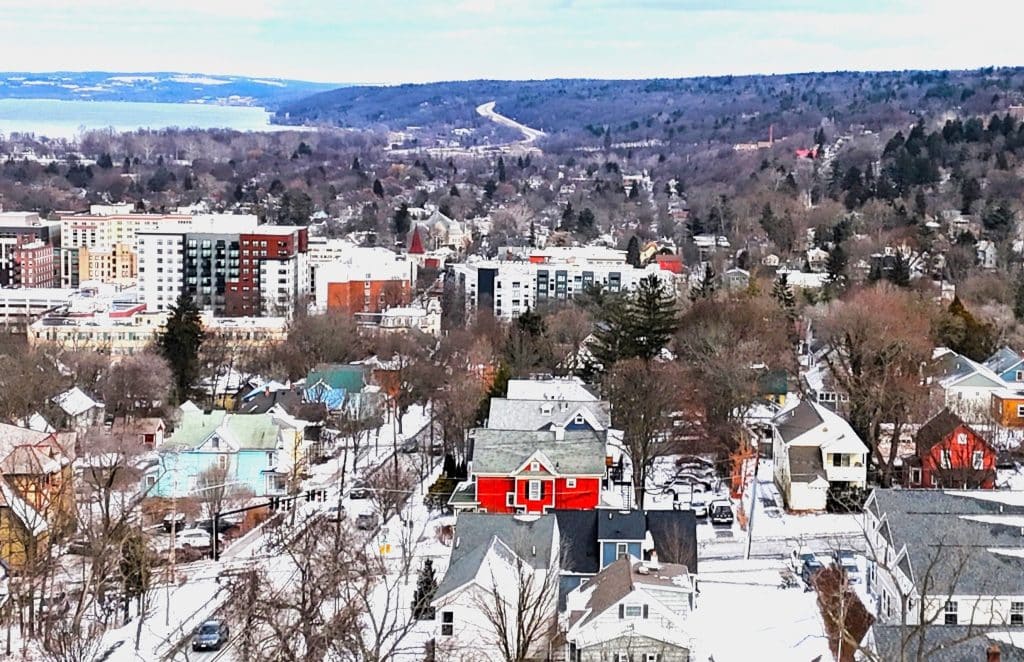
The City of Ithaca’s South Hill neighborhood, the home of many short-term rentals, looking down South Aurora Street toward Downtown Ithaca and Cayuga Lake.
Enforcement of the city of Ithaca’s new short-term rental ordinance begins June 1, and applications for operating permits are now available. Permits will be issued only for properties that are the primary residence of the host, eliminating the significant portion of the city’s short-term rentals that are not the main residence of the owner.

Currently, there are just over 300 short-term rental units in the city of Ithaca, according to Megan Wilson, deputy director of planning & development for the city. She added that most of these are not the primary residence of the owner or host.
Short-term rentals, or STRs, most of which are listed on websites such as Airbnb and Vrbo, are permitted in single-family homes, two-family homes and any owner-occupied unit in the city of Ithaca.
Owners of identified short-term rentals within the city have received a letter about the new regulations and the steps they must take to apply for a permit. The city will continue to send information and answer questions through the end of May, Wilson said.
Renters must have permission from the property’s owner to offer their primary residence as a short-term rental.
To avoid any violations, a property owner or rental host must obtain a short-term rental permit or stop offering the property as a short-term rental by June 1, 2025. The permits are valid for one year.
Some people who are considering putting their place of residence on Airbnb may be surprised to learn how long it will take to obtain a permit, as any units intended to be rented out as short-term rentals must be inspected and issued a certificate of compliance.
The implications of the law when it comes to the city’s rental and hotel landscape are yet to be seen. The City of Ithaca Common Council passed a resolution instituting the ordinance last spring.
“I just very much wanted to support this from the beginning,” said David Shapiro, City of Ithaca Common Council member representing Ward 3. “A lot of work had been put in behind this.”
But since being elected to the Common Council in 2023, Shapiro said he has come to appreciate the complexities of the issue. Some concerns have come up for him within the last year, he said. For one thing, he said, he would have liked to see more data before the resolution was passed.
“There was this understanding that we want to [pass this law] to protect the housing stock, but … it was like, ‘Wow, we’re passing a law essentially putting the short-term rental business in Ithaca out of business. It’s going to be very limited now.’”
Wilson said that the city currently has what she describes as accurate, up-to-date information about short-term rentals in the area – at least the ones that are listed on rental websites, which is the majority of them.
Nick Helmholdt, Tompkins County principal planner/tourism program director, said that so far there seems to be a strong correlation between the law going into effect last year and a dip in the number of stays available in the city of Ithaca on sites like Vrbo and Airbnb.
“We expect that folks who are currently operating short-term rentals in the city, some of whom aren’t going to be able to comply with the law as written, will put [their properties] into the long-term market or sell, and actually we are seeing some of the data for that showing up in KeyData, which tracks the number of nights available — the supply operating within a given area,” Helmholdt said.
“We started to see a downward trend starting in April of last year,” he said, and though there was a slight uptick in September, overall that trend has been continuing, according to KeyData.
As of March 2024, Tompkins County had 43,644 nights available, Helmholdt said. That shrank in April to 34,174, or by about a fifth. As of November, it has gone down to 30,512. A look at the numbers for the city versus the county on KeyData shows that the majority of the contraction occurred within the city while the rest of the county remained basically unaffected, he said.
“However, we’re seeing that the remaining supply is able to absorb the demand for short-term rentals,” Helmholdt said. “We’re not seeing on our side yet any contraction in room occupancy collection. Those other units are picking up the demand, or they’re picked up by hotels.”
Helmholdt said that the data does not show a significant increase in the price of the average stay in the city. “I think there is a possibility that folks will raise prices to start managing demand, but that doesn’t appear to be happening yet,” he said.
Tom Knipe, Deputy Director for Economic Development for the city of Ithaca, said short-term rentals make up a significant component of local lodging supply, and many visitors like staying in short term rentals.
“Overall local lodging supply may be reduced a bit by the new law in the short term, which is one of the trade-offs with a policy designed to support housing availability for long-term owners and renters,” he said. “That said, the new law may also lead to increased demand and occupancy for permitted STRs and hotels, motels, and inns.”
“I think that while the new law may have a slight short-term dampening effect on the city’s tourism industry, in the medium to longterm, I see it having a neutral effect or even a positive effect if it ends up inducing new hotel development, which is a possibility,” Knipe added. “I also would expect it to lead to increased occupancy and revenues for permitted STRs.”
Shapiro said that during public forums held on the topic before the law was adopted, at least one person described buying and fixing up properties specifically for the purpose of renting them on Airbnb, a business model that will no longer legally exist in the city.
“The most consistent thing we heard was that [the owners] weren’t wealthy but were skilled and had the ability to leverage one property into two or three by being able to put their own sweat equity into it and produce some of the renovations using their own skills,” Shapiro said.
“Now, then, the other side of me is thinking that we don’t actually have a lot of businesses in Ithaca, and tourism is a big one,” he added. “I’m sure I would have still voted for this because protecting housing is, at this time, really the most important thing for folks, but I’m curious over time to see what kind of impact [the law] has on tourism,” he said.
Shapiro, who lives in a four-bedroom house in Ithaca’s Belle Sherman neighborhood, said that he has rented out his house a few times during Cornell University’s graduation weekend, though he has not done it recently. Houses in his part of Ithaca are highly sought after, especially when they are within walking distance of the university, he said, recalling that he was able to get upwards of $1,000 per night for his house.
“And you can get your permit and still do that,” he said of renting out a primary residence for graduation weekend. “But there were a percentage of people who live locally but don’t live in properties they owned. Those folks now need to have long-term tenants in what previously were short-term rentals.”
Andre Gardiner, owner of APG Enterprises and several rental properties in downtown Ithaca, said he knows “a lot of people” who took their apartments offline as short-term rentals because of the new law.
He currently rents out his father’s residence as a short-term rental from time to time because his father likes to travel, and he said that with the added cost of applying for the permit and the stricter enforcement of occupancy taxes, he is not sure how he will proceed with renting the apartment after this year.
Gardiner said that he will continue business as usual for one year, but if prices don’t go up for short-term rentals due to added demand, he will likely take his properties off the short-term rental market in 2026.
“We’re kind of expecting a large jump in price, just because there is going to be a lot taken offline,” Gardiner said. “But if not, with all the fees, we will probably stop doing it.”
Gardiner said he has heard that some people are selling houses they had purchased as investments.
“It’s a lot easier to have an Airbnb than a rental,” Gardiner said. There are many local property managers who can look after the property for you, he said, and having short-term guests puts much less wear and tear on the residence than bringing in full-time renters, “assuming your price point is high enough and they’re not coming in and partying.”
For an owner looking to sell a property, using it as a short-term rental means that the unit can essentially stay staged all the time; often an occupied space, which would include the renters’ furniture, can prove a harder sell, Gardiner said.
He added that some people may find compliance with the current law daunting. For some, it could require completing updates to the property before the owners can continue using it as a short-term rental.
With the new regulations, it is no longer possible to make a last-minute decision to put a home on Airbnb while away on vacation without breaking the local law, Gardiner pointed out.
As someone who rents out restaurant space downtown, he said that he has a vested interest in seeing his tenants do well and, therefore, he takes an interest in the vitality of the city’s tourism industry as a whole. The new law has given him pause.
“The health of our local economy is very much related to the success of our restaurant tenants,” Gardiner said.
“We instituted Airbnb regulation without having much of a conversation about what impact taking 300 hotel rooms offline would have on our local tourism economy. We never really had that conversation as a city,” he added. “If we sat there and said we were going to take the Marriott Hotel and Hotel Ithaca offline and turn them into apartments, we would definitely have that conversation: What is that going to do to tourism?”
“I think the regulation is really working as intended,” he said. “I just think we didn’t spend enough time thinking about what it’s going to do to the tourism industry and sales tax revenue.”
New York state regulations also go into effect later this year
A new statewide short-term rental law goes into effect as well on Sept. 22 of this year.
“There is time for people to register and to get into compliance,” said Peggy Coleman, interim president of the Tompkins County Chamber of Commerce and Convention and Visitors Bureau.
The purpose of the law is to create a unified system across the state, she said, adding that it does not apply to New York City, which already has a separate short-term rental law.
The registration happens on the local level. The hosts are required to register with their county municipality and their city.
In Tompkins County, a host in the city of Ithaca would be required to register with both the city and the county, Coleman said.
Counties in New York have the opportunity to opt out of the legislation if they so choose; the period for opting out is Sept. 22, 2025 through June 30, 2026, and municipalities have the option to opt back in.
“I haven’t gotten any indication that there is the desire [by Tompkins County] to opt out,” Helmholdt said. “That would forfeit the county’s ability to collect occupancy tax from platforms like Vrbo and Airbnb, and that would have a pretty significant impact on the tourism program and the overall county budget, frankly.”
Local laws already allow for the collection of room occupancy tax for short-term rentals, but the new law provides for the collection of an additional 5% sales tax, as well. This would be new revenue for the county.
There is also a significant health and safety component to the state law.
“There have been a number of very serious and fatal accidents that have happened in short-term rentals where there have been no health and safety measures in place,” Coleman said. “This law creates a more level playing field and protects the traveling public. It’s more for health and safety than anything else.”
Coleman pointed to the 2022 case of a family whose Airbnb in Long Island caught on fire. The parents escaped, but the two of their three children died. According to published reports, the fire began in an outdoor kitchen, which the property owners constructed on their own without a permit or an electrical inspection. Their smoke and carbon monoxide detectors were not connected properly, and no battery backup existed. The owners of the property were sentenced to probation and community service.
As the state moves through the amendment process in regard to the law, the county’s intention, said Coleman, is to work with partners at the county and city to formulate a list of frequently asked questions and disseminate more factual and accurate guidance as the details of the law are finalized.
“I think this is a good move, collectively, for everyone, [which will] provide visitors a safe and reliable experience. … I’m looking forward to all of us working together toward that goal,” Coleman said.
Author

Related Articles

AmeriCU proudly connects students with annual scholarship opportunity
AmeriCU scholarship program awards $1,000 to students pursuing college or vocational education. Applications are open through March 15.
Street Beat: What’s one of the best holiday gifts you ever received?
We asked five random people. Here’s what they had to say.
5 things to do in Tompkins County this weekend
Plan your visit and discover what’s happening this weekend.