
Invasive species and toxic blooms pose challenges to summer fun on Cayuga Lake
Cayuga Lake Health Watch monitors HABs & invasive species at 14 sites, led by CSI, to ensure safe swimming & protect the ecosystem this summer.
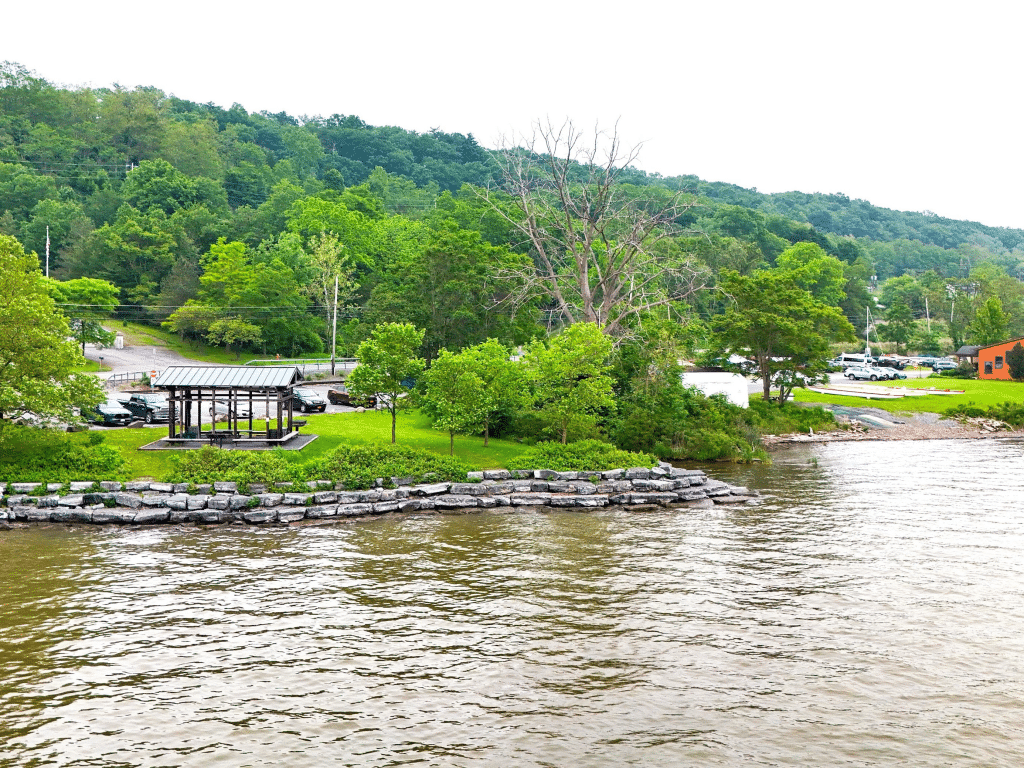
Cayuga Lake’s East Shore Park in Ithaca, a popular swimming destination, has been named a priority area for collecting water samples for the Community Science Institute to test for harmful algal blooms this summer.
Editor’s note: This is Part 1 of a two-part series about the health of Cayuga Lake and the resulting impact on the humans who use its waters and shores for recreation. Look for Part 2 in our June 18 edition, which will focus on how those who use the lake can do so safely this summer and be effective guardians of the environment.
As the weather heats up, local scientists and environmental stewards are urging residents and visitors to stay alert for harmful algal blooms (HABs) as Cayuga Lake is increasingly threatened by rising global temperatures and invasive species.
“Cayuga Lake is one of our region’s greatest treasures, and this summer we want everyone to enjoy its beauty safely while safeguarding the ecosystem,” said Liz Kreitinger, steward and executive director of the Cayuga Lake Watershed Network. “HABs can develop quickly, especially on hot, calm days, producing toxins that are dangerous to people, pets and wildlife.”
“When it comes to HABs — know it, avoid it and report it,” Kreitinger said. “Steer clear of any green, blue-green or paint-like scums on the water. If you spot a suspicious bloom, keep children and animals away. You can take a photo and report it through CSI’s [Community Science Institute’s] Cayuga Lake HAB reporting hotline. And always follow posted advisories.”
After a record number of blooms confirmed in the longest season on record for CSI in 2024, Alyssa Johnson, Cayuga Lake Harmful Algal Bloom Monitoring Program Coordinator for CSI, is anticipating Cayuga Lake’s first harmful algal bloom report of the year. She said that this is almost certainly due to a relatively cold winter and spring, as HABs thrive in warm temperatures.
“We had a real, true upstate New York winter with regular snow, so the water temperatures are just not there yet; however, there are many shallow parts of the lake where water warms up quickly, so with a string of 80-plus [degree] days, it could happen any day,” Johnson said June 5. “I’ve been holding my breath the last 36 hours waiting to hear from one of my volunteers, and I’m surprised I haven’t yet.”
In 2024, CSI had its first reported HAB on June 3.
“We’re past that 2025 now, and to my knowledge there are not blooms anywhere in the Finger Lakes, but there were some in [other parts of] New York state as early as May,” said Johnson.
“There is a central database that everyone around the state reports blooms to, where I report what we see,” she explained. “I’ve been looking at the map every couple of days, and we’ve started off the season with no blooms, as far as I know.”
This year marks a change in strategy for CSI.
“We have switched up our monitoring program this year, so all of our volunteers are still monitoring the shoreline all around the lake and submitting a report, including pictures, when we see suspected HABs,” Johnson said. “In the past, for every single one we would collect a sample, as well. Last year was such a horrendous year, with the most on record, that the logistics of getting all the samples to the lab was a huge undertaking.”
This year, CSI workers spoke with their funders and Tompkins County Whole Health to come up with a new strategy.
“We talked with them and said, ‘We’ve been collecting great data; however; we’ve kind of learned what we could learn, and we’re seeing the same trends year after year.’”
CSI presented several options to the county and settled on a new protocol. Instead of testing every suspected HAB, CSI would collect and test samples from 14 priority sites, chosen mostly because their popularity for recreational purposes increases the likelihood that HABs there could pose a health risk to humans.
Johnson declined to share all 14 of the proposed testing sites because CSI is still awaiting confirmation for access permission, but she was able to share some of them. They are:
Tompkins County: Ithaca Yacht Club, East Shore Park and Southern Cayuga Lake Intermunicipal Water Commission at Bolton Point
Cayuga County: Harris Park, Frontenac Park and Long Point State Park
Seneca County: Town of Seneca Falls water treatment plant, Sheldrake Point and The Spotted Sandpiper
“The priority sites are spaced pretty equidistantly around the lake,” Johnson noted, adding that volunteers are still monitoring other areas around the entire lake.
“People will still be able to use our database to report conditions,” Johnson said. “It’s just the analysis and sample collection we’re cutting back on, because the process is very burdensome, and it’s very expensive to do the analysis.”
In order to test the samples, a plate with 30 wells on it must be used, which means that CSI tries not to test fewer than 30 samples at one time.
“It’s a huge waste of materials to run the test if [the plate] is not full,” Johnson explained, “so we have to strategize as it’s happening.”
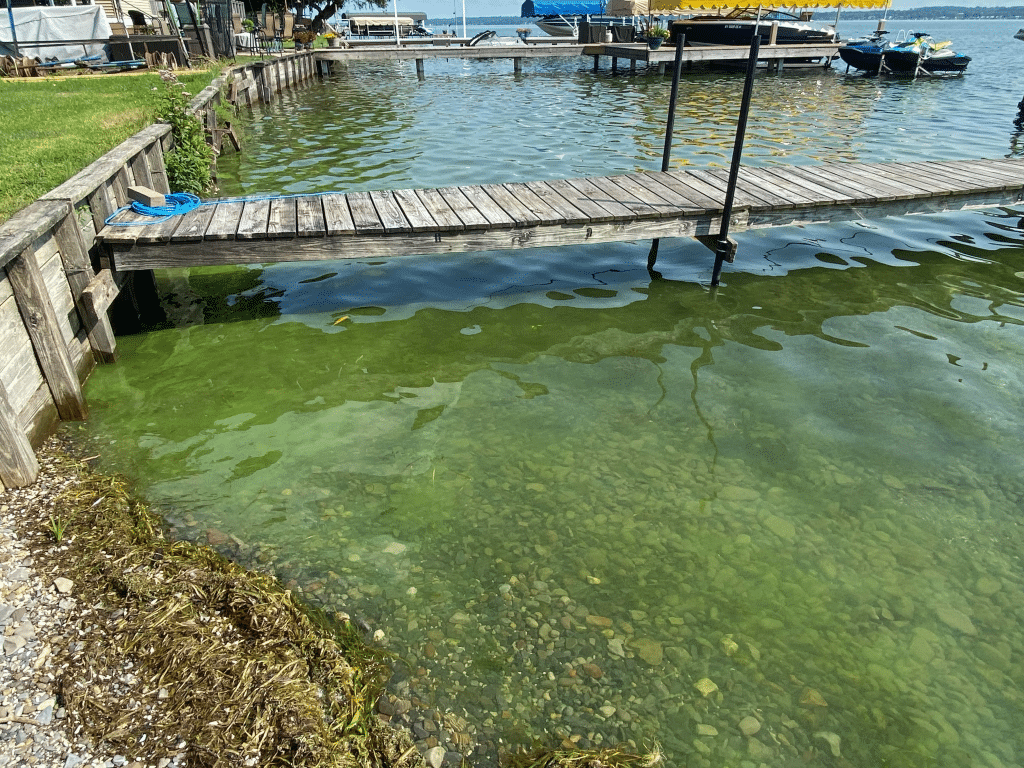
A harmful algal bloom (HAB) spotted in August of last year on Cayuga Lake between Schuler Creek and Canoga Creek in Seneca County. HABs can look like frothy chartreuse paint spilled on the water’s surface. A HAB will often be very bright green, but because it is composed of living bacteria, its appearance is likely to change as the bacteria moves through its lifecycle.
Cayuga Lake’s invasive species and other wildlife
Besides the tiny microorganisms that play a huge role in the lake ecosystem and food web, Cayuga Lake is home to more than 90 species of fish, eight species of mussels, 25 species of crustaceans and 43 species of aquatic plants.
“And that’s just in the water!” Kreitinger said. “It’s an amazing ecosystem.”
There are also a number of invasive species living in the lake, Kreitinger added, explaining that an invasive species is a plant or animal introduced into an ecosystem outside of its native range, which establishes, spreads and causes harm.
Hydrilla is a particular concern because it can grow in dense mats, crowding out native plants, altering oxygen levels and making boating or swimming difficult.
“This species, listed as a federal noxious weed since 1976, is widely considered by experts to be one of the world’s worst invasive aquatic plants,” Kreitinger said. “Given the potential for hydrilla to rapidly spread throughout the expansive network of lakes and waterways in the northeastern U.S., including the Great Lakes, it is actively managed by the NYS Department of Environmental Conservation and U.S. Army Corps of Engineers in partnership with members of the local Hydrilla Task Force.”
Hydrilla is currently actively managed in six sites across Cayuga Lake. Two sites, one in the “Northern Aurora Area” and another in the “Cayuga Lake Inlet Area,” are managed by the U.S. Army Corps of Engineers. Management of the remaining three sites is overseen by the NYS DEC Regional Aquatic Invasive Species Coordinator and the DEC Invasive Species Control Section. These sites include Ladoga Bay in Lansing, the South Aurora area and Long Point State Park Area in Aurora and the Sheldrake area in Ovid.
“We need all lake users to understand that once fragments of hydrilla break off, they can hitch a ride on boat propellers, anchors or fishing gear and quickly colonize new areas,” Kreitinger said. “To do your part to stop the spread of invasive species, including hydrilla, to new areas in our lake and other water bodies, we need everyone to inspect your boat, trailer and equipment for any plant fragments before leaving a launch.”
This means cleaning off mud, plants, and debris and leaving them at a designated disposal area or on dry land, draining all water from bilges, livewells and motor cavities and drying everything before visiting another water body.
“By staying informed about HABs and practicing ‘clean, drain, dry,’ everyone can help protect the health of our lake while out enjoying everything it has to offer this summer,” Kreitinger said.
Staying healthy and utilizing local resources
Kreitinger encourages people to use the information made public by many local organizations to stay educated about the ever-changing lake conditions this summer.
In partnership with CSI, Cayuga Lake Watershed Network publishes weekly HABs trend updates by email and on Facebook and Instagram (@cayugalakewatershed), she pointed out.
“Anyone can subscribe to our email list stay up to date on HABs as you plan your weekend and learn more about this issue and actions being taken locally and across the Finger Lakes to promote and advocate for solutions to address the complex causes of HABs, including nutrient pollution,” Kreitinger said.
Learn more and find links to resources about hydrilla and its management in Cayuga Lake on the cayugalake.org Hydrilla Information and Action webpage.
“There is some great information about the biodiversity of our lake on the Cayuga Nature Center’s website, cayuganaturecenter.org,” Kreitinger recommended.
Volunteer on Cayuga Lake with Community Science Institute
Community Science Institute offers many ways that you can volunteer your time to make a difference in our watershed.
“We understand that everyone has different interests, availabilities, and rhythms in their lives,” the CSI website states. “That shouldn’t stop you from participating in community science! Whether you are itching to wade into a stream to collect a water sample or prefer to help from the comfort of your own home, we have options for you to support our work.”
There are four different ways to volunteer, and those interested in volunteering are asked to send CSI an email at info@communityscience.org.
Please see Tompkins Weekly’s next installment of our Cayuga Lake Health Watch series to learn more about the different types of volunteerism needed at CSI and how one of them might be right for you.
On June 17, CSI is inviting the public to a free event: “HAB-by Hour” at Cayuga Shoreline in Interlaken. Doors open at 5:30 p.m. for an evening where CSIs knowledgeable staff and volunteers will be available to answer questions, debunk misconceptions, and interpret the data CSI has been collecting since 2018. For more information, contact CSI by phone at (607) 257-6606 or by email at info@communityscience.org.
Author

Related Articles

Holiday traditions bring community cheer
Tompkins County holiday traditions light up homes, farms, and schools with festive cheer and community spirit.

The gift of an experience: Local businesses offer hands-on holiday fun
Holiday experience gifts in Tompkins County include candle making, gourd crafts, and pottery workshops for creative seasonal fun.
Code Blue shelter opens amid praise, concerns and ongoing debate
Ithaca’s Code Blue shelter opens with larger space, showers, and case management to help residents during cold weather.