
Signs of Sustainability: Turning climate attitudes into action in the Southern Tier
Southern Tier climate action inspires residents to tackle climate change locally, with surveys showing strong belief and personal responsibility for sustainable solutions.
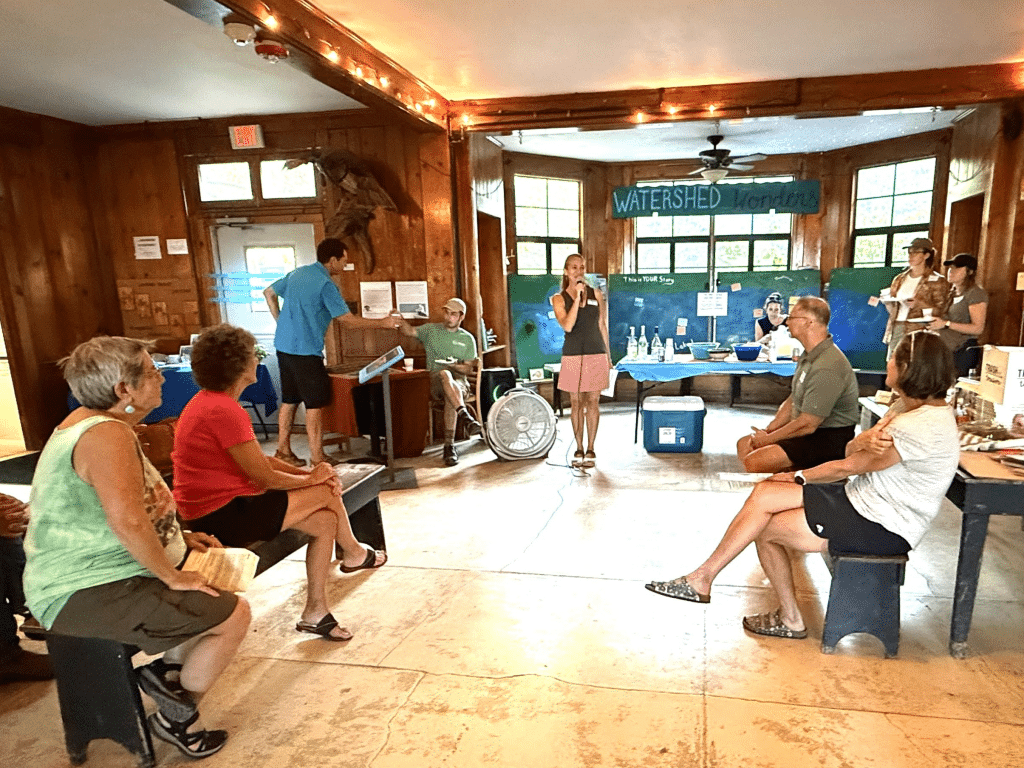
Photo by Robert Ross
Astrid Jirka from Discover Cayuga Lake speaks to the audience at the Watershed Internship Program Final Event: Love Your Lake Fest.
By Emily La
When conversations about climate change make headlines, it tends to be dominated by national or global voices, overlooking perspectives closer to home. Not only can this lead to feeling overwhelmed when it comes to taking climate action, but a 2022 Pew Research study found that some Americans also discredit the national news media as a credible source for climate information. When I had the chance to work with the Clean Energy Hub, I knew this would be a great opportunity to survey residents about climate change and have them share their thoughts directly. In New York’s Southern Tier, a largely rural region with rising average temperatures, we found that the majority of respondents agreed that climate change is happening. Now, the question becomes: how can they be part of the solution?
The Clean Energy Hub developed a Regional Assessment and Barriers Analysis (RABA) to understand barriers and opportunities to clean energy for disadvantaged communities. To carry out this task, Community Energy Educators conducted outreach and surveyed residents across eight Southern Tier counties: Steuben, Schuyler, Chemung, Tompkins, Tioga, Broome, Chenango, and Delaware. In helping out with the survey, I also included questions about people’s beliefs, concerns, and what their personal responsibility was when it came to climate change.
The survey showed that 88% of respondents believe climate change is happening. In follow-up interview responses, many noted tangible changes they’ve observed over the years. These included shifting weather patterns, such as warmer winters and unpredictable seasons. Although there was a consensus about these changes, respondents differ on whether or not the causes are human-driven or natural.
Following belief in climate change, 70% of respondents expressed that they are concerned about climate change. Some voiced worry for their own lives and well-being, but many emphasized concern for future generations, such as one respondent sharing, “[I] worry about [my] grandchildren and [feel] frustrated [that I] can’t do much”.
Optimistically, the survey also reveals a sense of personal responsibility among respondents. Nearly 70% agreed, either strongly or somewhat, that their actions can influence climate change. This might mean that most people don’t see climate change as just a distant problem, but they recognize that they can have an impact, whether through smaller daily habits or broader community involvement.
These findings offer a snapshot of our region, pointing to both opportunities and challenges. It seems that many residents are not only noticing climate change but also care about its impacts and feel a sense of responsibility to act. At the same time, those who disagree that climate change is happening or that their actions could make a difference remind us that it is important to first meet people where they are.
To move forward, we need more conversations to understand both the level of preparedness and the willingness people have to act. A good place to start is by focusing on unifying concerns, such as protecting the well-being of future generations. More avenues for participation should be created where people can make connections between their values, daily lives, and related policies.
I hope that these findings, and more importantly, the conversations that were had as part of these outreach efforts, can help broaden how we talk about climate change. Similar research from the Nicholas Institute for Environmental Policy Solutions has found that while rural voters are often reluctant to discuss climate change due to political polarization and are skeptical about its human causes, they are still open to acknowledging its impacts and engaging in dialogue. In our own outreach, even when participants were given the option to skip questions, many still chose to share their views, even if they did not believe climate change is happening. Perhaps it’s time to drive this willingness to talk toward shared, practical solutions. Climate change will affect communities differently, from rural to urban, and local to the national level. It is important to keep having these intentional and, at times, challenging conversations within our community.
Emily La is a communications and outreach coordinator with Sustainable Finger Lakes and an adjunct professor at Ithaca College. Signs of Sustainability is organized by Sustainable Finger Lakes, if you’d like to contribute an article, email: signsofsustainability@gmail.com.
Author

Related Articles
Signs of Sustainability: Growing trust and resilience in Danby
Danby community resilience grows as neighbors build relationships, share resources, and create supportive local networks.
Signs of Sustainability: The GrassRoots Festival grows greener
GrassRoots Festival sustainability grows with Dish Truck’s reusable dishes and state-backed waste reduction initiatives.

Connecting the dots on AI and electric bills
Sustainable Finger Lakes highlights impacts of AI data centers on electricity prices, climate, and local communities.