
‘Weaponizing hunger’: County residents, nonprofits and officials brace for federal SNAP, Medicaid cuts
SNAP and Medicaid cuts may affect thousands in Tompkins County as demand for services rises.

Ithaca resident Dwane Smith at Loaves and Fishes, a community kitchen located in St. John’s Episcopal Church in Ithaca. Smith is one of about 7,200 people in Tompkins County who rely on the Supplemental Nutrition Assistance Program, or SNAP, among other social services, to support their basic needs.
The longest federal government shutdown in American history ended last week, which was a period of anxiety and confusion for thousands of Tompkins County residents who rely on federal food assistance to make ends meet.
The 43-day shutdown jeopardized funding for the Supplemental Nutrition Assistance Program, or SNAP, causing delays in the monthly funds that about 42 million Americans, including nearly three million New Yorkers, use to buy groceries and other food-related expenses.
Although President Donald Trump signed legislation ending the shutdown on Nov. 12, which will fund SNAP until September 2026, his administration is set to implement deep cuts to programs that residents, nonprofits and elected leaders across the county say could irreparably harm the region’s social safety net for years to come.
The Republican-backed One Big Beautiful Bill Act (OBBBA), which was signed into law in July, will cut Medicaid by more than $1 trillion and SNAP by more than $186 billion over the next decade. The landmark legislation also institutes new eligibility requirements for both programs, including making certain recipients spend at least 80 hours each month working, volunteering or in school.
The shutdown also froze funding for the federal Home Energy Assistance Program, or HEAP, which about 1.5 million New Yorkers from low-income backgrounds use to help cover their heating bills. After HEAP applications were originally scheduled to open on Nov. 3, the date to apply has been postponed to Nov. 17, but it could be delayed further due to the impacts of the government shutdown.
“The federal government is attacking us,” Tompkins County Legislature Chair Dan Klein said, noting that earlier this year the Trump administration threatened to withhold federal funds from Cornell University, the county’s largest employer, and the county government for its status as a sanctuary jurisdiction. “These policies are going to affect everybody, and therefore there’s a chance we can stop them because more people want to stop them. If Trumpism is triumphant and we’re now in this state forever, then we’re cooked and we’re not going to survive.”
But, Klein added, “If we’re just in a four-year nightmare, then my strategy is we need to weather this storm by keeping our local institutions as strong as possible.”
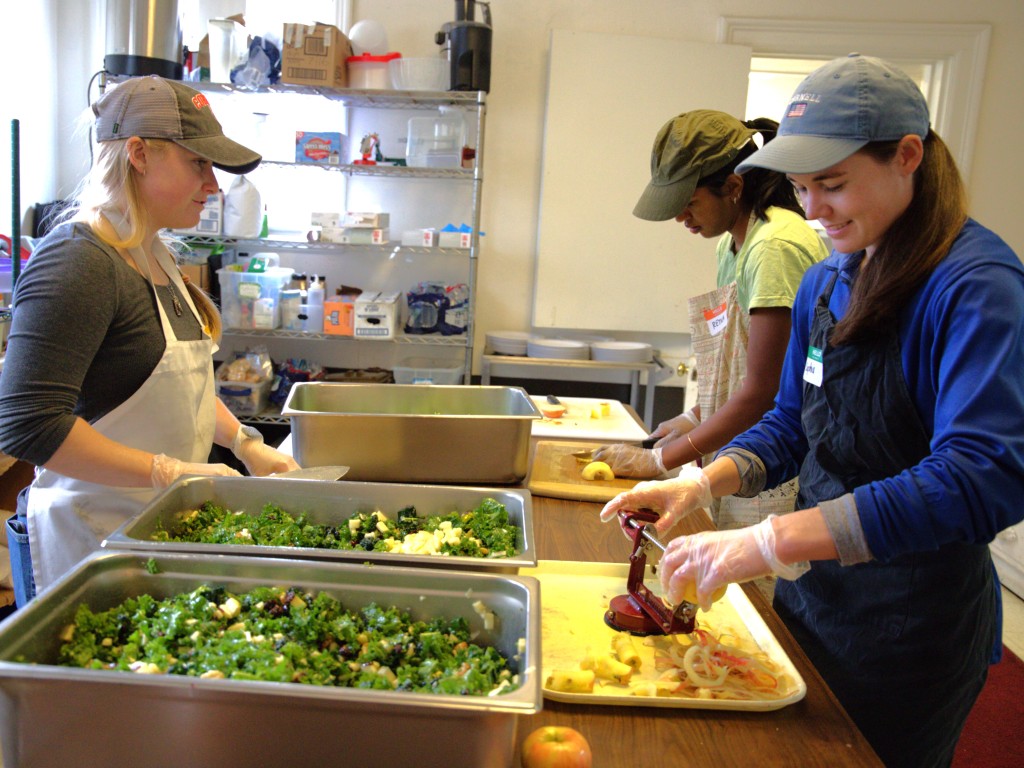
From left to right: Loaves and Fishes volunteers Anna Hardy, Retina Arun and Sophia Devling prepare food on Nov. 14.
SNAP and rising food insecurity
SNAP’s new work requirements took effect at the beginning of this month at the direction of the U.S. Department of Agriculture (USDA), the federal agency that oversees the program. Dozens of states, including New York, had planned to implement the new work requirements early next year, but now social service departments across the state are scrambling to accommodate the swift change.
The new work requirements are expected to result in about 300,000 New Yorkers losing their SNAP benefits next year, according to a July statement from Gov. Kathy Hochul. USDA Secretary Brooke Rollins also announced last week that SNAP recipients will have to reapply for the program to prove that they still need the benefits. The average SNAP recipient receives about $6 a day in benefits.
In response to the government shutdown, Tompkins County Administrator Korsah Akumfi issued an emergency order last month that authorized up to $50,000 in county funds to purchase and distribute food to county residents impacted by the pause in SNAP benefits. Approximately 7,200 county residents, about 7% of the county’s population, rely on SNAP, with many being children or adults who are disabled or elderly, according to the emergency order.
Dwane Smith, who was previously unhoused after losing his job, moved to Ithaca four years ago and frequents the city’s food pantries to support himself. Smith, 68, said that he receives just under $300 in SNAP benefits every month, and that his benefits for this month were delayed by about a week amid the government shutdown.
“The federal government has given $40 billion to Argentina, but we can’t afford SNAP,” Smith said, referencing a controversial spending package Trump announced last month to stabilize the South American country’s economy. “I’ve seen the U.S. government do a lot of suspicious things, but weaponizing hunger for cheap, political, immediate goals is something that I wouldn’t expect any country on Earth to do. The fact that the United States is doing it makes me think that we might be the biggest shithole country on the globe.”
William Reap, 62, another Ithaca resident who receives SNAP benefits, said that the program can mean life or death for some community members.
“You shouldn’t cut people off of food or their basic essentials because then they’ll starve,” Reap said. “Some of these people have to have SNAP. I’m on disability and Social Security income, and I still need to use SNAP sometimes.”
Loaves and Fishes, a volunteer-based community kitchen located in St. John’s Episcopal Church in Ithaca, has been serving free meals since its founding in 1983.
Mary Webber, the kitchen’s community relations and development manager, said that the nonprofit has increased the number of meals it makes by about 30% annually for the past three years to keep up with growing demand. Last year, the kitchen served about 60,000 meals and has already served more than 54,000 meals this year.
Webber said that Loaves and Fishes usually sees an increase in patrons toward the end of the month, when people’s SNAP benefits run out, but that the pantry saw more hungry individuals than usual during the government shutdown.
“With the need continuing to grow, our space and what we can produce here is starting to reach a limit where the kitchen isn’t big enough or we don’t have enough freezer space,” Webber said. “But our community has beautifully come out to support everyone in this moment.”
Webber said that the kitchen purchases most of its food from the Food Bank of the Southern Tier and runs on an annual operating budget that’s between $500,000 and $1 million. While the nonprofit receives government grants, including through the state Hunger Prevention and Nutrition Assistance Program, Webber said that about 80% of its revenue comes from community donations.
Not only does SNAP provide food assistance to vulnerable populations, but Webber added that the program contributes significantly to the local economy. The approximately $7.4 billion in state SNAP benefits that are issued every year generates about $11.5 billion in economic activity, particularly at local grocery stores and other food providers, according to state estimates.
Another food provider in the county that’s seeing greater need is the Trumansburg Food Pantry, located in the Trumansburg United Methodist Church. The nonprofit has served about 16% more meals so far this year compared to last year, with more seniors and families with children coming, according to the pantry’s coordinator, Donna Holzbaur.
Holzbaur said that nearly 10% of families in the village of Trumansburg rely on SNAP benefits to put food on the table, and that the pantry anticipates a surge in need over the coming months as residents begin navigating the new SNAP eligibility requirements.
The pantry, which runs every other Monday with about 40 volunteers per day, serves about 100 households and is operated by six community churches that rotate duties. Its last event was the annual Thanksgiving pantry, where staples like turkey and pie were served, which Holzbaur said is typically the best attended pantry of the year.
“There are many reasons why someone might need a food pantry,” Holzbaur said. “They might be seniors; they might have a disability. Maybe they’re not getting enough hours at their job to support all of their expenses as costs are increasing. I’ve heard a lot of people who will come in for the first time and almost apologize and say that they’re just having a tough time.”
To provide additional food relief during the government shutdown, Holzbaur said that two pantry volunteers delivered 225 emergency food boxes from the Food Bank of the Southern Tier to locations around the county last week. Each box contained nonperishable items like canned goods, pasta, rice and cereal, and was meant to provide enough food for one person for up to three days.
In Enfield, the town’s food pantry, which about 35% of residents rely on, reported facing a $30,000 funding shortfall at the end of October, making it harder to continue supporting families through the end of the year.
Medicaid and ACA subsidies
Along with food insecurity, affording adequate health insurance is a growing concern among residents.
About 1.3 million New Yorkers are expected to lose Medicaid coverage due to new eligibility and verification barriers under the OBBBA, which are set to go into effect in January 2027.
Affordable Care Act enhanced subsidies, which have made health care premiums more affordable for millions of middle-class families, are set to expire at the end of this year. The tax credits were approved during the Biden administration as part of the 2021 American Rescue Plan Act. Extending the subsidies was Democrats’ main sticking point during shutdown negotiations, although they ultimately failed to secure these when the government reopened.
Senate Majority Leader John Thune promised to hold a Senate vote on extending the subsidies by the end of the second week of December, although the chances of a bill clearing both chambers of Congress and receiving Trump’s signature are slim.
More than 24 million Americans get their health insurance through the ACA, also known as Obamacare, and many people could see their monthly premiums double or even triple next year.
“Someone who makes $65,000 this year would have received about $500 a month to go toward their health insurance premiums, and next year, if these extensions aren’t renewed, they’ll receive nothing,” said Nicole Zulu, director of health planning at the Human Services Coalition of Tompkins County.
Instead of tax credits gradually being phased out, people exceeding 400% of the federal poverty level would immediately become ineligible for any ACA tax credits, unless lawmakers chose to renew the enhanced credits. The 2025 federal poverty level in most states for a household with one person is $15,650 yearly and for a household with four people it’s $32,150 yearly, according to the U.S. Department of Health and Human Services. Someone earning 400% of the 2025 federal poverty level would make $62,600 yearly.
Zulu said that county residents will see an increase between 11% and 21% in their ACA premiums next year. This represents the monthly premiums for the Qualified Health Plans available through the NY State of Health Marketplace, which vary depending on the metal level (such as bronze and gold) and the insurance carrier.
Open enrollment for ACA 2026 coverage is underway and people must enroll by Dec. 15 to receive coverage starting on Jan. 1.
“I know there’s projected to be a [Congressional] vote in December to extend these subsidies, but this needs to happen as soon as possible because people are making decisions now based on these tax credits going away,” Zulu said. “So, they’re going to either choose to be uninsured or they’re going to get a really high-deductible plan, like a bronze plan, or maybe they would’ve chosen a silver or gold plan because they would’ve gotten additional tax credits to go toward those premiums. Essentially, people are going to be uninsured or underinsured because of the substantial high cost.”
Zulu added that New York’s Essential Plan is currently available to people who are at 250% of the federal poverty level who don’t qualify for Medicaid. However, due to significant funding cuts, Zulu noted that the plan will cap eligibility to those who make 200% of the federal poverty level at the end of June 2026, which is expected to make about 450,000 people lose access to the plan. This plan provides comprehensive medical coverage, low cost sharing and no premiums or deductibles.
In Tompkins County, there are about 16,000 residents enrolled in Medicaid, about 1,000 children enrolled in Child Health Plus and about 3,700 people enrolled in the Essential Plan, according to Zulu.
Tompkins County Legislators Shawna Black and Deborah Dawson, both Democrats, expressed concern over the steep federal cuts to Medicaid. Dawson said that these cuts will put more pressure on the county legislature to fund Medicaid, a program that the county already pays about $1 million a month to support, despite having no control over its eligibility and services.
Black worried that cuts to Medicaid would lead to hospitals around the region losing significant funding and that rising premiums would push people off health insurance plans altogether.
“Come January 2026, you’ll have people that at one point might have been spending $700 for a family plan who are now being asked to spend $3,000 for a family plan,” Black said. “It’s absolutely not sustainable.”
Reap is one of the thousands of county residents enrolled in Medicaid. He said that his health insurance plan proved vital when he was hit by a car two years ago, resulting in him fracturing his neck and ending up in a coma.
“Without Medicaid, I wouldn’t have been able to pay for my hospital bills or get prescriptions or see doctors,” he said.
HEAP and utility funds
As the temperatures get colder, more people will need assistance staying warm inside their home.
Established in 1981, the federal Home Energy Assistance Program, known as HEAP, has helped eligible households with their heating and utility costs, especially families, the elderly and individuals with disabilities.
Smith said that he’s struggled to afford his utility bills ever since he’s lived in Ithaca, but that HEAP “has always been a lifesaver for me to get through the winter.”
Black said that county residents could see an increase of between 26% and 40% in their heat and electric bills this winter.
“Even for someone who is middle class and has two working people in the household, our heat and electric costs are unaffordable,” Black said. “For someone that makes minimum wage, there’s no way that they can survive.”
Dawson echoed these concerns, noting that many residents often feel inundated with overwhelming costs across the board, leaving them to make impossible decisions.
“The cold weather didn’t hold off until the government shutdown was over, and it promises to be a particularly cold winter,” Dawson said. “We’ve got people at the moment who are forced to choose between heating and paying their rent and getting their medicine and buying their food. So, every program that reduces the costs of those essentials helps those people balance their budgets without depriving themselves significantly.”
While the new date to apply for HEAP remains uncertain, United Way of Tompkins County is partnering with the Human Services Coalition to assist residents with their heating bills. The United Way/211 ALICE Program, which reopened on Nov. 17, allows people to call 2-1-1 to see if they qualify for United Way to cover a utility shutoff or to fill a fuel tank to ensure they have utilities and heat until those funds become available from the government.
Earlier this year, United Way of Tompkins County published its biannual Community Needs Assessment, which found that access to food, health care and housing were some of the biggest issues residents face.
“Fifty percent of households in the county do not have adequate resources to cover rent, food, health care, child care, and it’s proven that an interruption of their budget of just a few hundred dollars, for say a car repair or a higher fuel bill, will put them in a situation where they’ll have to make very difficult choices between those needs,” said Gail Belokur, United Way of Tompkins County’s chief development and operating officer. “Many of these households are working people who do not earn a living wage, so government programs, even when fully functional, are still not sufficient to meet these needs.”
If you or someone you know needs immediate food, utility or heating assistance, you can contact the Tompkins County Department of Social Services at 607-274-5680.
“We’re all on a basic level human, and our foundational needs are food, water and shelter,” said Webber, Loaves and Fishes’ community relations and development manager. “But if those three things aren’t taken care of, then there’s no way you can achieve the rest of your hierarchy of needs. Food and water should be a natural human right and why would we ever withhold it from anyone?”
Author

Related Articles
Street Beat: What’s one of the best holiday gifts you ever received?
We asked five random people. Here’s what they had to say.

5 things to do in Tompkins County this weekend
Plan your visit and discover what’s happening this weekend.

Mental health well-being and substance use resources and support during the holiday season
Holiday mental health support is available through Tompkins County Whole Health, offering crisis care, counseling, and substance use resources.