
Guest opinion: The new face of New York housing: Affordable, energy-efficient, and upstate
Village Grove in Trumansburg, NY combines affordable housing with energy-efficient, Passive House and NetZero-certified design.
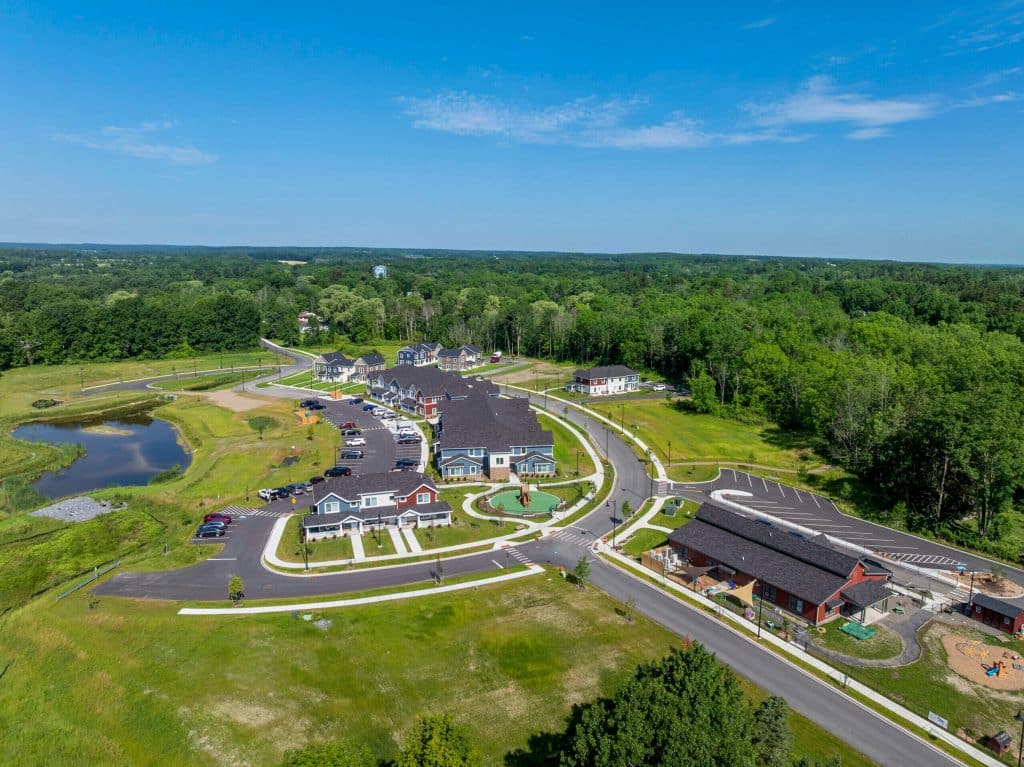
Village Grove in Trumansburg.
By Carlina Rivera, president and CEO of the New York State Association for Affordable Housing
The path to decarbonization and the path to housing affordability are intertwined. Nowhere is that more true than in Upstate New York, where the need to ensure that low- and moderate-income households aren’t left behind in the clean energy transition is particularly challenging. Fortunately, one local project is showing what’s possible when sustainability and affordability come together.
Village Grove – located near Ithaca in Trumansburg, NY – made an exemplary move in the industry, aligning closely with Ithaca’s Green New Deal, targeting carbon neutrality by 2030, and requiring all new buildings to meet net-zero energy requirements by 2026.
As one of the first affordable housing communities in the state to achieve both Passive House and NetZero certifications, the project is a mixed-income community combining deep affordability and geothermal and solar systems that cut energy use by 80 percent, keeping long-term operating costs low for residents and owners.
In that sense, Village Grove serves as a prototype for how upstate communities can meet both climate and housing equity goals simultaneously. Importantly, it demonstrates how smaller communities in the state can – and have been – leading the way in building a more equitable and energy-efficient future, even in smaller markets with limited resources.
But the ripple effects of Village Grove go way farther than just its impact on the sustainability front.
Recently awarded Upstate Project of the Year by the New York State Association for Affordable Housing, it is also showing the industry promise of what’s possible within the limits of a disparaged funding system that divides New York’s housing investment unevenly between regions.
For years, the story of New York’s housing crisis has centered on New York City. But that framing misses the full picture. Across upstate communities, affordability is also tightening. Resources are thinner, and the tools to build new housing are far less accessible.
To put it all into perspective: In 2024, Ithaca’s Fair Market Rent for a one-bedroom jumped a staggering 12.4%, according to HUD, while wages increased just 4.7%.
Over half of Ithaca’s renters are rent-burdened, and new listings have plummeted since 2020. Even Mayor Robert Cantelmo made note of the housing crisis in his 2025 State of the City address, emphasizing housing as a top local priority.
Yet policy and funding still skew heavily toward downstate; and upstate communities are competing for a smaller slice of already very limited housing dollars, even though their affordability challenges are equally significant.
That’s what makes Village Grove stand out. Projects like Village Grove don’t come easily or emerge by coincidence.
They depend on local expertise, community commitment, flexible and creative financing, and a policy environment that recognizes the unique barriers of building in upstate New York. But that last piece is still a work in progress with much needed catching up.
With the next state budget now looming, this is the time to boost capital funding to balance, for the first time, resources evenly between upstate and downstate.
We must empower developments like Village Grove to remain operational and viable by
funding operating reserves for struggling developments, while also lowering the costs of creating these projects in the first place, easing the costs of development where we can. Especially for the benefit of cost-burdened Upstate New Yorkers.
If Albany is serious about housing affordability, the next phase of the housing plan needs to reflect that in both funding and structure.
Projects like Village Grove are already showing the level of impact that awaits us should we unlock the proper incentives for developers needed to do so.
Author

Related Articles

The Life and Legacy of Former Assemblymember Martin “Marty” Luster
The Marty Luster legacy includes lasting impacts on mental health, education, and environmental policy in New York.

Local mismanagement, statewide failures: A warning for the year ahead
Ithaca government failures expose financial mismanagement and raise concerns about leadership, accountability, and state-level governance.
Guest opinion: Why accessibility is not an option, but a responsibility
TCAT accessibility in Ithaca leaves disabled residents struggling. Community advocacy is essential to improve public transit for all.