Trumansburg schools begin early budget talks
Trumansburg Central School District begins planning its 2026–2027 budget, reviewing enrollment trends, state aid and program priorities.
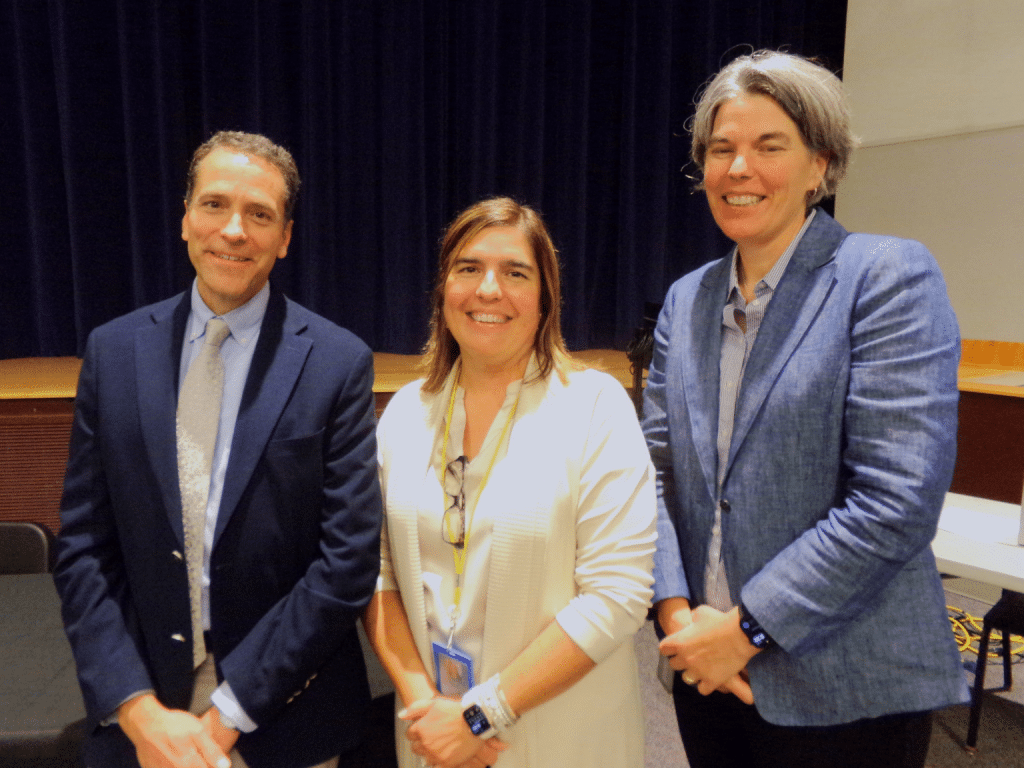
From left to right: Christopher Glaubitz, vice president and senior project architect with Tetra Tech Architects & Engineers, with Trumansburg Central School District School Business Executive Amanda Verba and Superintendent Megan Conaway at Charles O. Dickerson High School during a meeting unveiling the district’s 2025 capital project.
As the Trumansburg Central School District (TCSD) prepares to draft its budget for the 2026-2027 school year, district administrators and TCSD Board of Education members say they want to keep a focus on education programming and personnel.
The road to the next budget includes several monthly check-ins between the board and the district’s administration to present district priorities and projections on salaries, benefits and other budget drivers.
Officials are set to review state aid proposals and the eventually finalized figures at Board of Education meetings. They will also host presentations and public hearings for district residents to gather more information before a May 21 vote.
For the first pit stop, TCSD officials reviewed enrollment data and district budgeting priorities at the district’s Board of Education meeting on Jan. 13.
“We are absolutely student-centered, but we are also looking at the needs and supports of all our staff that are here in the district, as well,” said TCSD Superintendent Megan Conaway. “We are having conversations with our admin team and beyond, and supervisors — looking at our needs that we have and how we can get that support in our budget.”
Last spring, voters approved the current $32.1 million budget for 2025-2026. That budget signified a 3.2% increase in spending.
Verba said that 48% of the district’s revenue comes from state aid. Another 44% comes from property taxes, and the remainder is a combination of “other revenue” and reserve accounts.
About 64% of the funding goes toward educational programming. Another 24% goes to covering employee benefits, 7% goes toward debt service, and the remaining 5% is used on other operating expenses.
Verba said that the district is already anticipating increased expenses related to employee benefits. The employee retirement system rate, for instance, will increase from 16.5% to 17.6%, Verba said. There is also an anticipated increase of 8% to insurance premiums, which amounts to an extra $534,000.
As for revenues, the district expects projected state aid figures to be released by the end of January. The district also uses reserve accounts to balance its budgets. For this school year, the district is using $1.26 million, Verba said.
“[We are] trying to be mindful, looking at our high-quality learning, ensuring we are not in a mode of just surviving here at Trumansburg,” Conaway said. “We want to ensure we are thriving.”
Looking to the future, the district also factors enrollment numbers into future budgets. Not only do these numbers inform programming needs, but they also help determine how much money in state aid TCSD will receive.
TCSD is preparing for slight enrollment growth from 2024 to 2028. Enrollment numbers will grow from between 900-1,000 students in 2024 to just over 1,000 by 2028. The district is recovering from a loss of students since 2020. The enrollment numbers in 2020 were at around 1,050 students, decreasing to less than 1,000 in 2024.
Enrollment, Verba said, is difficult to track and predict.
“We use cohort data, we look at live birth data from the county and track the population into some sort of predictability,” Verba said. “We have no idea what the real estate market holds for us, or who is moving in or out of our community, what opportunities for housing will be developed here. Those are all the things we try to think about.”
Sustainable and predictable growth are the best measures to help track need in the long term, Verba added.
“We are trying to avoid large peaks and valleys for the long term. Whether that is around members of teaching staff or sections, we really want to look for predictability. It is easier to think forward in the next three years.”
Author

Related Articles
Newfield Town Hall’s $1.4 million renovation project nears completion
Newfield Town Hall renovation adds ADA-compliant bathrooms, expanded meeting space, and improved access to town offices and services.

Dryden native tapped as new Le Moyne women’s soccer coach
Dryden native Taylor Van Fleet has been named head coach of Le Moyne College women’s soccer after a standout playing and coaching career.