Cayuga Lake: locals work to protect crucial water source
Jennifer Wells Miller, founder and owner of Paddle-N-More, has had a love for outdoor and water recreation for most of her life, a passion she used to create her business, which offers rentals, lessons, camps and more centered around paddle activities like kayaking and paddle boarding.
While Paddle-N-More has been around for about a decade, it wasn’t until just a few years ago that it faced a significant challenge related to the water quality of Cayuga Lake.
“We were getting shut down, especially at our Taughannock location, for blue-green algae,” Miller said. “I invested a lot of money into my business and then all of a sudden had a huge drop in revenue due to blue-green algae. And I just remember standing on the shore, and I’ll be honest, I was crying.”
Miller and her team found ways to adapt to the new challenge: securing relationships with local organizations that monitor and study water quality on the lake and educating themselves on water quality issues like harmful algal blooms (HABs) and invasive species. With this, Miller implemented strategies to help keep the business successful, while also protecting the health and safety of her staff and patrons.
Despite the pandemic, Paddle-N-More has experienced an incredibly successful 2020 season thanks to pent-up demand, but that doesn’t mean that water quality isn’t still a concern.
“I have future concerns about blue-green algae and how it might impact our business still,” Miller said. “It does shut us down. And if we have a really large bloom, it can shut us down for a week, and that’s a lot of revenue.”
Miller isn’t the only local who is concerned about the water quality of Cayuga Lake and other surrounding waterways. Leaders and organizations dedicated to monitoring and studying the water quality reported that issues like HABs and invasive species aren’t going away. And with our bodies of water providing everything from drinking water to a great place to take the boat out, protecting water quality is crucial for the county’s future health.
Most of Tompkins County (over 350 square miles) is in the Cayuga Lake watershed, according to the Tompkins County Water Resources Council’s 2019-2021 Water Quality Strategy. Surface water provides drinking water for over half of county residents, and three water treatment facilities in the county use surface water as their source: Bolton Point, which uses Cayuga Lake; Cornell University Water Filtration Plant, which uses Fall Creek; and City of Ithaca Water Treatment Plant, which uses Six Mile Creek.
According to Roxy Johnston, watershed coordinator for the City of Ithaca Water Treatment Plant, no HABs have been found in the city’s reservoir nor has the invasive species hydrilla. Hydrilla, discovered in Cayuga Lake by a Discover Cayuga Lake intern, grows from the bottom of the seabed all the way to the surface, and mass amounts of it can provide conditions conducive to the growth of blue-green algae, according to the Water Quality Strategy.
As for Cayuga Lake, Nathaniel Launer, outreach coordinator and Cayuga Lake HABs Monitoring Program coordinator for the Community Science Institute (CSI), reported that there have been 27 algal blooms on the lake so far this year, with about 10 of those having unsafe toxin levels.
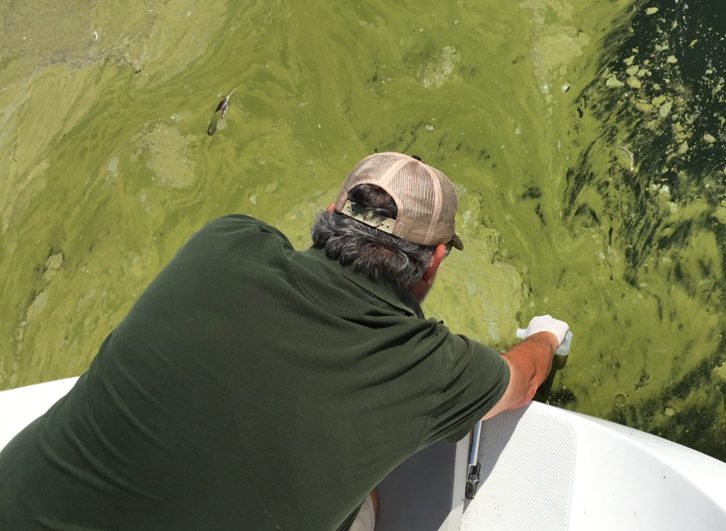
While it is difficult to solidify whether algal blooms have been increasing in Cayuga Lake in the past years, Launer said what is clear is that the blooms are becoming increasingly toxic and are arriving earlier in the year in 2020 than previous years. Though the exact cause is unknown, Launer said there is one large factor to consider.
“Climate change could certainly have a role to play, for instance, in the increased temperature of fresh surface waters but also the increased unpredictability or uncertainty of storm events and the increased intensity of those storm events leading to these big runoff events that might load nutrients or sediment into our streams,” Launer said.
Hydrilla reports are also increasing, with the plant absent from Cayuga Inlet and Fall Creek from 2015 to 2018 thanks to monitoring and treatment but arriving at the south end of Cayuga Lake last year, according to Hilary Lambert, steward at the Cayuga Lake Watershed Network. And this year, hydrilla was found even farther north than last year.
Patches offshore of Stewart Park and around the Merrill Sailing Center, as well as a major infestation of the Finger Lakes Marina, were treated in 2019 and are currently being monitored for possible further treatment. Monitoring and treatment continue for the dredged and treated area at Don’s Marina in King Ferry and along the shoreline in the village of Aurora and at Payne’s Creek, according to the summer 2020 edition of the Cayuga Lake Watershed News.
Addressing water quality issues like HABs and hydrilla can be quite a challenge, Lambert said.
“There’s three counties, there’s 45 municipalities in the watershed, … so it’s very hard to get everybody to work together to focus on the lake,” she said. “That’s been the main challenge, to get people to overcome their local boundaries and think of the lake as a unified thing.”
The pandemic, for some, has created more challenges related to water quality. Most organizations and groups interviewed for this story — including CSI, the City of Ithaca Water Treatment Plant, the Tompkins County Planning and Sustainability Department, the Tompkins County Health Department and the Soil and Water Conservation District — said the largest change the pandemic caused was a switch to virtual conferences and socially distanced monitoring.
“The casual conversations you have with people when you’re doing things in person, whether it’s at a meeting and those before- and after-meeting chats, on Zoom, you don’t necessarily [have that],” said Darby Kiley, associate planner for the Planning and Sustainability Department. “There’s a little bit of that lost collaboration, and trying to track people down is a little harder since we’re not in offices. … [We’re] getting some things accomplished in a different way now.”
For Discover Cayuga Lake, formerly known as the Floating Classroom, it’s a different story. Executive Director Bill Foster said the nonprofit, which brings about 3,000 students out onto Cayuga Lake each year to educate about water quality, struggled considerably due to the pandemic.
“We lost our entire spring semester. Kids aren’t going to be able to come out and get hands-on experiences in the fall either,” he said. “We’ve only been on the lake now for three weeks. So, [we’re] missing a lot of time.”
The work these and other organizations do to protect the county’s water is centered around the mindset that water quality matters for all residents, even if it’s not always on people’s minds.
“In terms of the harmful algal blooms, they do affect different things,” said Mikhail Kern, public health sanitarian at the Tompkins County Health Department. “You don’t want to be swimming in them because they may release toxins, for example, … and they also have effects on other living things that use the lake as well that people might use for recreation such as fishing.”
Water quality also affects drinking water, though Scott Freyburger, county public health engineer, said the county’s drinking water has historically been safe for all residents.
Jon Negley, district manager of the Soil and Water Conservation District, said he has seen increased awareness of water quality thanks to past experiences.
“We’ve seen the devastating effects to not having any water or clean water,” Negley said. “There was a drought year a couple years ago. And there’s some nervousness across the community of, is there enough water for us? So, I think people realize the unique, the precious resource that we have and plentiful amount of water to work our way through that drought.”
Sources interviewed for this story offered a few strategies to address these and other water quality issues moving forward.
“There’s a lot more that could be done to make that more effective to reduce the introduction and spread of invasive species into our waterways,” Johnston said. “And there are a lot of folks working on climate change policy. I think that needs to continue to be a real priority for all governments to implement anything they can to reduce emissions.”
Freyburger said another beneficial move would be to prioritize municipal water over individual water treatment systems at residential homes.
“Our stance overall is that the people putting in individual water treatment systems at their homes is not a good solution to the issue,” he said. “People living at their homes, they buy these things and they don’t keep them up. … The solution to this problem as we move into the future will be more people joining municipal water systems.”
Foster added that addressing these issues will require putting everything into context and looking at things from a broader scale.
“We’re going to have to learn to live with changes in the lakes,” he said. “My biggest concern would be that we fall into the habit of saying ‘this is the way the lake was, and we’re trying to put it back’ because that’s not really going to be a realistic approach. It’s a matter of understanding where the lakes system is going and working with that.”
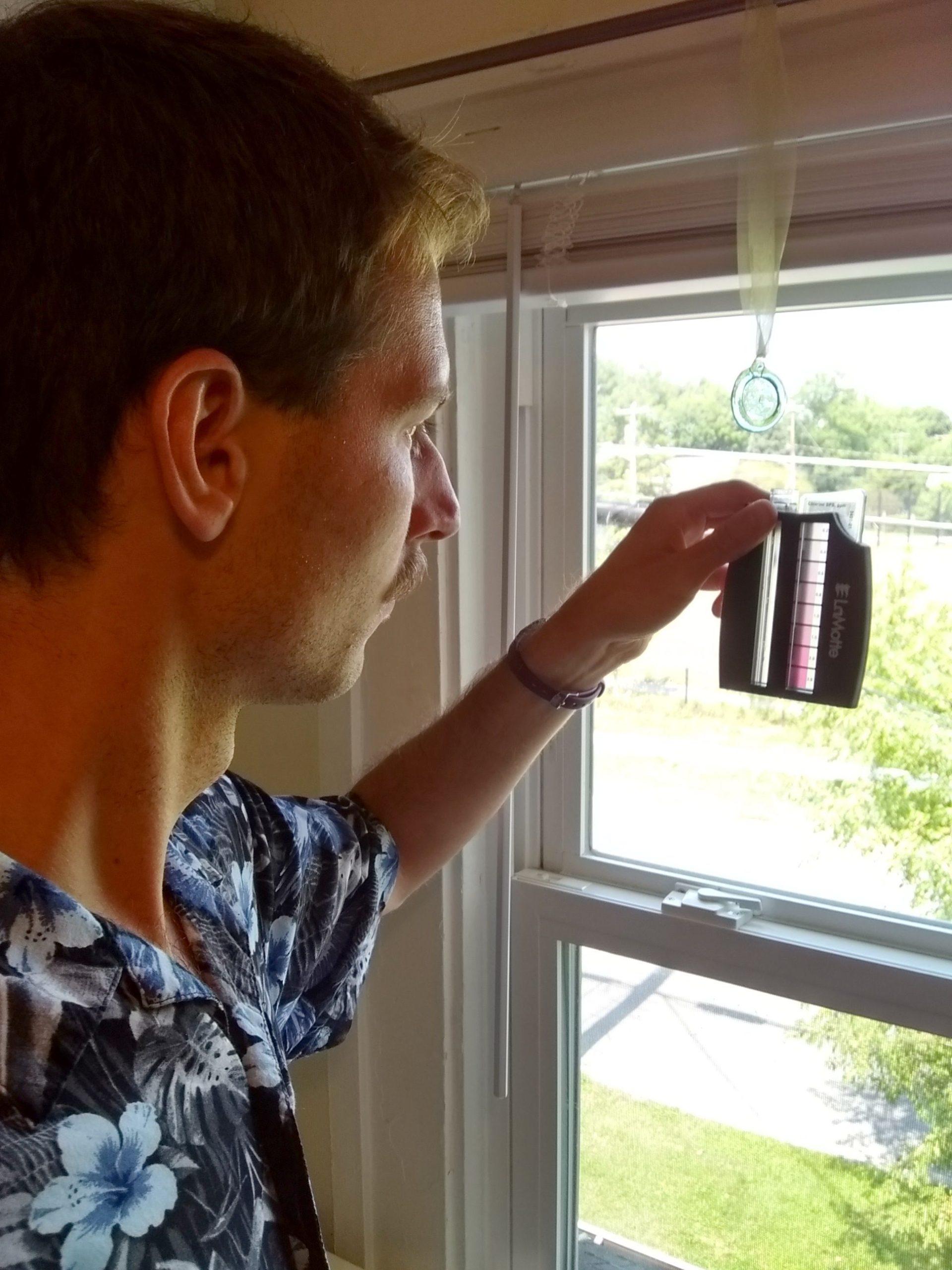
Launer said that residents can get involved with water quality efforts by looking out for and reporting things like HABs and hydrilla to CSI and others interviewed for this story. Residents can also volunteer with CSI to help collect data and track trends.
“Residents can also help out by just taking part in being stewards of their local streams and their local watersheds and just really helping out with making sure that those streams and rivers stay healthy and that the water quality remains good,” Launer said.
Sources expressed that the future of water quality for our county’s water systems is uncertain, and HABs, hydrilla and other issues require further research to understand and address. And addressing these issues, sources said, requires collaboration between residents and researchers alike.
“My hope is that in 50 years or 100 years, people here will still be able to enjoy free, abundant water,” Lambert said. “We can make sure that our kids and our grandkids also enjoy [the water], but it’s going to take a lot of us.”
Related Articles
AmeriCU proudly connects students with annual scholarship opportunity
AmeriCU scholarship program awards $1,000 to students pursuing college or vocational education. Applications are open through March 15.
Trumansburg schools consider regionalization as TST BOCES plan advances
Trumansburg school regionalization remains undecided as TST BOCES outlines goals for shared services and student learning.