
Advocates: Light needs to be shed on Cayuga Salt Mine in Lansing
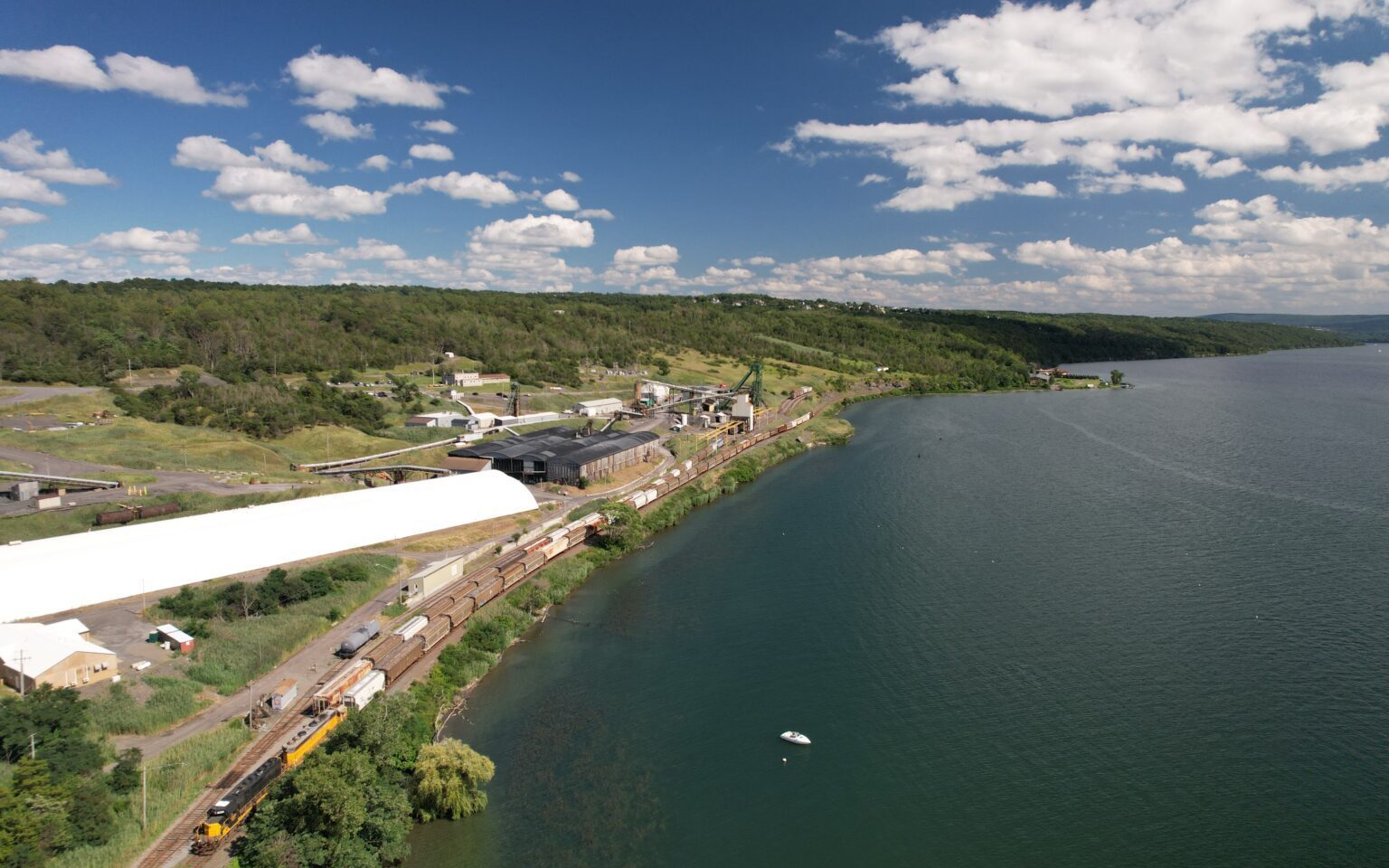
Environmental advocates spearheading the fight for more transparency regarding Cayuga Salt Mine have circled April as an important month in their push for securing the safety of the mine and Cayuga Lake.

Cargill, the multi-national company that owns and operates the mine, has a mining permit with the State Department of Environmental Conservation (DEC) that expires April 23. The expiration of the permit comes also at a time when the company has reportedly looked to exit the salt mining business. Last year, The Deal, a business news site, reported Cargill is looking to sell the mine, but Cargill has not yet made an official announcement.
A company spokesperson told Tompkins Weekly they will not comment on the reports.
“Our official statement is that, in line with our company policy, we do not comment on industry speculation,” said Chuck Miller, Cargill’s senior communications manager.
Stephanie Redmond, the program manager for the Cayuga Lake Environmental Action Now (CLEAN) advocacy group, said advocates will monitor the expiration of the permit as and other recent developments in the interest of preserving the lake, its public utility, and other natural features.
Part of those efforts include calling on state lawmakers and environmental regulators to secure an environmental bond to ensure Cargill is held to account for any environmental impacts caused by a potential sale or decommissioning of the mine.
Cayuga Lake and its watershed are the largest in the region, spanning seven counties and covering 860 square miles, with more than 140 streams that flow into the lake. The lake itself supplies drinking water for about 100,000 residents in the nearby area and supports a robust tourist economy.
State Sen. Lea Webb, a Democrat who represents Lansing in Albany, has said in the past that the lake’s water is saltier than other nearby bodies of water. If the salinity levels in the water continue to rise, she noted, the viability of the lake’s water for household use could be in peril.
Webb introduced a bill in the senate last fall that would require salt mining permits to be subject to State Environmental Quality Review Act (SEQR) review procedures, as well as require mining entities to cover any damages directly or indirectly resulting from their operations beneath a water way.
CLEAN has gotten behind Webb’s legislation, also calling for Cargill to be on the hook for a $10 billion environmental bond.
“As we go into the future, this water is just going to become more and more precious,” said Redmond, who is also one of CLEAN’s leading researchers. “We are probably going to be seeing more climate change refugees coming into the area. They’re going to come here, and they will be so disappointed that we are squandering this amazing freshwater resource. So $10 billion sounds like a lot, but not when you put it into perspective of generations of damage happening to one of the biggest freshwater resources in the world.”
Advocates will also be looking out for an opportunity to submit public comments on Cargill’s permit modification request submitted to the DEC last June. The company requested a permit modification with the DEC that would establish additional water storage areas to contain groundwater and prevent it from leaking into the mine.
That permit modification would have a 30-day public comment period, but Redmond said the public is largely kept in the dark regarding the impacts of this modification due to state laws that prevent environmental studies and reports from being subject to public information laws.
“A lot more transparency is really important,” Redmond said. “We also need a lot more public input.”
The plan submitted along with the application indicates the company will designate an unused section of the mine dubbed S3, as well as the two deepest portions of the mine to store the leaking water, according to reports from independent journalist Peter Mantius of Waterfront Online.
“That could take the next 15 years to fill up,” Redmond said.
More details on the permit, as well as studies on seismic studies conducted by the company have been hard to come by for advocates. Redmond said CLEAN has filed Freedom of Information Law requests with the DEC to very little success.
“We can’t get any of their seismic studies, for example,” she said. “That’s all considered trade secrets.”
The seismic studies would prove valuable for advocates seeking to gauge the possibility and the consequences of a potential mine collapse. Redmond noted advocates would like to know if a potential collapse could create a vortex that drains the lake into the salt mine. She referenced the sinkhole at Lake Peigneur in Louisiana as an example of a similar event.
“We’ve talked about hiring our own hydrologist or consultant to do an analysis of that, but it’s nearly impossible without having the kind of information that Cargill has from the seismic studies,” she added.
Lansing at Large appears every week in Tompkins Weekly. Send story ideas to editorial@vizellamedia.com. Contact Eddie Velazquez at edvel37@gmail.com or on X (formerly Twitter) @ezvelazquez.
In brief
The Lansing Community Library is hosting its “Book Club for Adults” April 9 from 7 p.m. to 8 p.m. at the community room.
The subject of this month’s club meeting will be “Between the World and Me” by decorated author Ta-Nehisi Coates. First published in 2015, the book was written as a letter to Coates’ teenage son, and recounts the author’s experiences growing up in Baltimore’s inner city and his growing fear of daily violence against the Black community. The narrative explores Coates’ bold notion that American society structurally supports white supremacy and was adapted into a programming event for HBO.
The book club, organizers say, is a great opportunity to engage with other book enthusiasts and discuss Coates’ inspiring book.
For more information on “Book Club for Adults,” interested parties may contact Bobbie Weaver at bobbiew@lansinglibrary.org
Author

Related Articles
Local representatives push HEAP as winter nears
Lansing HEAP program applications are now open, helping low-income households cover heating costs and access energy assistance this winter.
Lansing’s $17M capital project advances amid construction challenges
Lansing Central School’s $17M BOBCAT capital project upgrades schools, athletic facilities, HVAC, and infrastructure.