
Agrivoltaics could be the future of county solar energy sites
Nexamp, a solar energy generation facility developer in Lansing, has moved to an agrivoltaics model of site maintenance at their Lansing Renewables facility, which they say has synergistic benefits for local farmers, solar developers and the host community.

The agrivoltaics model consists of integrating farm animals into their solar energy generation facility on Jerry Smith Road. Lansing Renewables, which is host to around 18,000 solar panels, went live in late 2020 and generates about 6.8 megawatts of energy, enough to match the needs of 1,100 average homes. The facility serves individual residents, area businesses, nonprofits and schools in the New York State Electric and Gas (NYSEG) area. The company also opened a 10MWh battery energy storage system in 2021, which feeds back into the NYSEG grid during times of high demand.
Tompkins Weekly recently visited the site and toured the facility with Nexamp Communications Manager Keith Hevenor and local farmer Caleb Scott, both of whom highlighted the benefits of the agrivoltaics model.
Bringing grazing livestock, Hevenor and Scott said, helps reduce mowing and other other site upkeep costs, as well as boost local agriculture and reduce carbon emissions that would stem from traditional methods of landscaping.
Agrivoltaics plans have been a successful move for Nexamp, Hevenor said, noting that the company is hosting grazing livestock at more than 40 of their 300 solar energy sites. Hevenor added that the company plans to increase that number every year.
“For us, solar grazing just makes sense,” he said. “It is more environmentally friendly, in most cases it is safer than mechanical mowing, it ensures an agricultural application for the land in addition to renewable energy generation, and it provides a source of income for a local farmer. It really is a win all around. The problem is that so few people know this is happening and are unaware that the land is being put to good use.
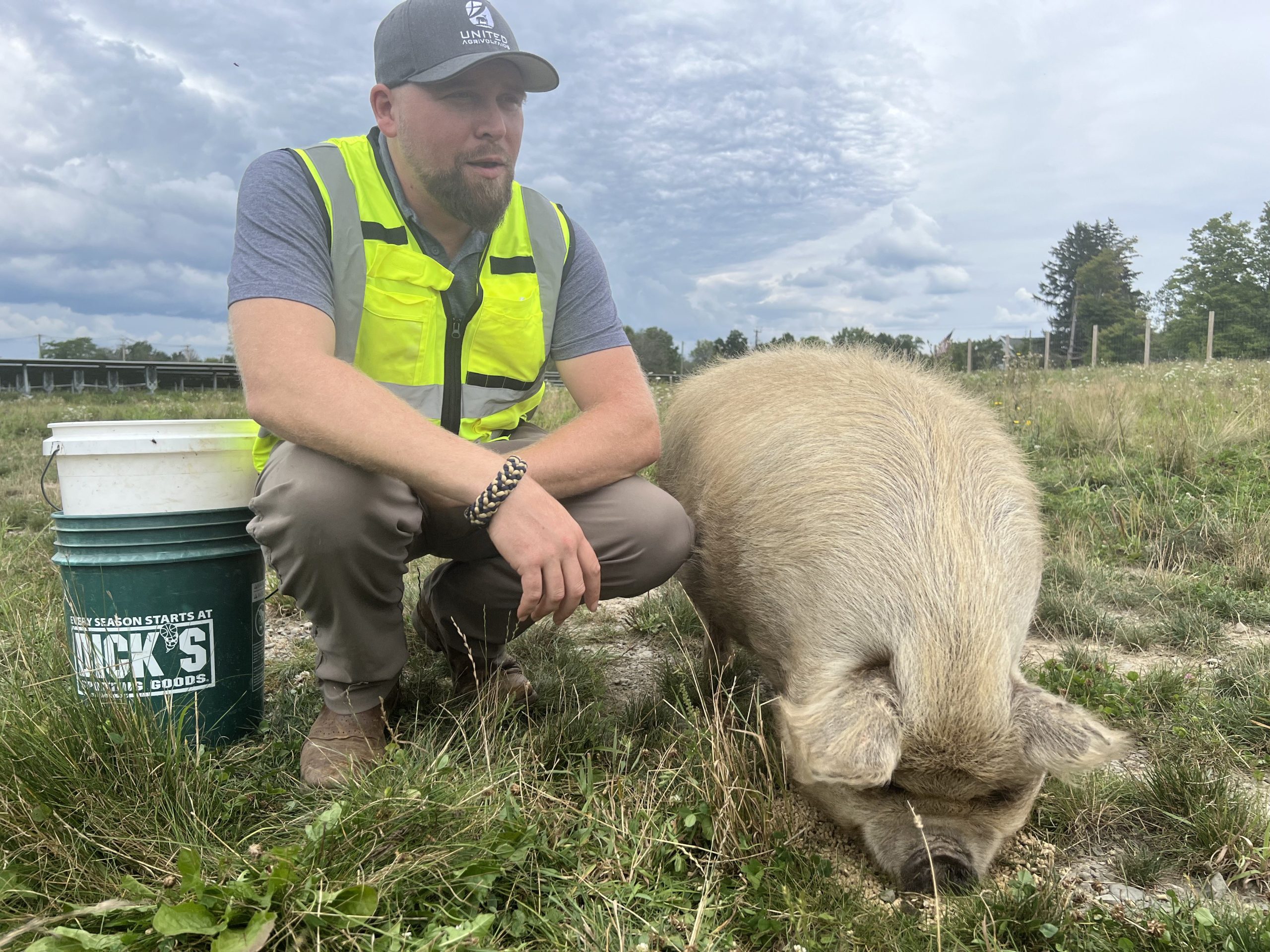
Scott, an Ithaca-based farmer, has lent nine pigs and 75 sheep to the site. He noted that there are three sheep per acre. Nexamp has been working with Scott and his company, United Agrivoltaics, since the site opened. Both Hevenor and Scott noted that this was the first site to feature pigs and sheep grazing together.
“On this site, because it’s a pollinator site, we’re doing a low-impact, sustained grazing,” he said. “That way, we keep the pollinators blooming year-round. The grass doesn’t get so short that the sheep pick up parasites. We keep it looking like a meadow, as opposed to the extremes of bouncing back and forth. This is all in compliance. The accessibility is nice. The flowers are still blooming. It’s really the most ideal method for this particular type of site.”
Some of the sheep on site, Scott said, are genetically modified for a specific type of grazing work that suits the Lansing Renewables site.
“This is a browsing breed of sheep,” he said. “We have genetically modified and bred browsers. So these sheep are going to eat a little more like a goat than an actual sheep.”
Grazing sheep tend to consume more protein-dense foods, while browsing sheep tend to graze this particular type of site more uniformly, Scott added.
The number of animals on site varies depending on the season and temperature, Scott said, but the benefits all around are tangible.
A study from Cornell University published in 2021 notes that vegetation management with sheep is an emerging industry in New York since 2017. Based on estimates by the American Solar Grazing Association, the study notes, 900 acres were under vegetation management with grazing sheep in New York that year. The industry grew from 79 acres grazed in the state in 2018 to 1,700 acres anticipated to be grazed in 2021. Vegetation management contracts between sheep farmers and solar power plant operators result in diversified, taxable service income for sheep farms of between $300 and $500 per acre of solar site per year, up to $450,000 in 2020, per the study.
Scott noted that there are environmental benefits to grazing solar sites, as well.
“It’s certainly better than mechanical mowing,” he said. “That’s pretty caustic to the environment. Cornell has a study that suggests there is almost a metric ton per acre of carbon reduction. That’s significant when you look at the multitude of acres that are coming online.”
United Agrivoltaics empowers farmers nationwide – whose inventory totals around 15,000 – and helps them come up with action plans for specific renewable energy sites.
“Right now, we’re grazing on over 100 sites,” Scott said. “We graze on site from Hawaii all the way to the East Coast.”
Ultimately, the main goal of agrivoltaics is maximizing land. Scott said his work and that of other farmers runs counter to popular narratives suggesting that solar sites are taking up prime agricultural land.
“Purely from a farming standpoint, there’s no reason not to do this,” he said. “This is the best, most effective farming. Grazing the sheep is one thing – you can graze the sheep and lose a little money in the United States right now because winter costs in the northeast don’t outweigh the costs of feeding the animals.”
The money paid by companies like Nexamp for the grazing services allows farmers to become profitable.
“I’ve been doing this for 10 years, and what we’ve done with United Agrivoltaics is created in essence… a farm partner group that works with developers to build a narrative for their towns and communities,” he said.
On the operations and maintenance side of things, United Agrivoltaics helps farmers with insurance costs that would otherwise be an impediment to conducting business on a site like Lansing Renewables. Scott’s company also helps farmers with accounting, onboarding and training, as well as advertising.
“We now make this very easy for the farmers,” he said. “They have rights to our name, they wear our shirts and logos, but they’re independent contractors. That has allowed us to expand our operations and open up solar to literally hundreds of farmers and change hundreds of families’ lives around the country.”
Lansing at Large appears every week in Tompkins Weekly. Send story ideas to editorial@vizellamedia.com. Contact Eddie Velazquez at edvel37@gmail.com or on Twitter/X @ezvelazquez.
In brief
The Lansing Carnival and Community Celebration is fast approaching. The event will run from Thursday, Sept. 7, to Saturday, Sept. 9 at the Lansing Fire Department. It will feature carnival-like attractions, including rides, talented performers, a fireworks display and a food pavilion.
Here are the times for the carnival:
Sept. 7: 6 p.m.-10 p.m.
Sept. 8: 6 p.m.-10 p.m.
Sept. 9: 1 p.m.-10 p.m.
Author

Related Articles
Local representatives push HEAP as winter nears
Lansing HEAP program applications are now open, helping low-income households cover heating costs and access energy assistance this winter.
Lansing’s $17M capital project advances amid construction challenges
Lansing Central School’s $17M BOBCAT capital project upgrades schools, athletic facilities, HVAC, and infrastructure.