Ancestors of the Cayuga Valley: part two
Although at least four distinct cultures existed in and around Lansing between the end of the most recent Ice Age and the first permanent European settlement of the area in 1788, it is believed that the people of each period were generally ancestral to those of the next.

Last week, we covered the Paleoindian and Archaic periods. This week surveys the Woodland and Haudenosaunee periods.
About 3,000 years ago, the people who lived in Lansing transitioned from passive gathering to active harvesting with the onset of domesticated agriculture, marking the start of the Woodland period.
Scott Stull, Ph.D., is a lecturer in sociology and anthropology at SUNY Cortland. He said this was “the time of the Mound Building societies, the Adena and Hopewell cultures and related groups. There was a burial mound in the area of Cornell’s Ag quad, discovered during construction over 100 years ago and collected by one of the workmen.”
Stull said that the defining characteristic of the early, middle and late Woodland period was an increasing reliance on agriculture.
“This is where we get the domesticated versions of maygrass, little barley, goosefoot, and knotweed fields and gardens,” he said.
The Woodland people developed the “Three Sisters” crops of corn, beans and squashes, which were planted together to sustain one another.
By the early Woodland period, copper tools and decorations made in Michigan began showing up in upstate New York, not as currency but as trade items, according to Stull. Locally, people began to work with clay to make ceramic vessels, figures and other useful things.
Then, between 1,000 and 500 years ago, the Haudenosaunee created a powerful confederacy of five, and then six, Indigenous nations that, at one point, controlled territory throughout present-day New York, into Pennsylvania, around the Great Lakes and into Canada.
Each nation consisted of between one and four villages, surrounded by palisades and sometimes a ditch, leading arriving Europeans to call them “castles.” The people lived in longhouses from 15 to 150 feet long and up to 25 feet wide, built of layers of bark on a frame of rafters.
Between two and 20 families lived in a longhouse, and villages likely contained 20 to 30 longhouses.
At its height, the Haudenosaunee Confederacy had a population of about 20,000 people. Smallpox introduced by invading Europeans in the 17th century reduced the Haudenosaunee population by more than half.
“When we first see evidence for the Cayuga Nation, there were two groups, one cluster to the north and one to the southwest,” Stull said. “Both clusters moved after a couple of generations, as firewood and soils became depleted, though longer-lasting resources would be preserved and returned to.”
Larger communities are easier for archeologists to find, he said. There is a well-documented site in the town of Ulysses.
“Hunting and farming camps were scattered throughout the region, connected by trails, many of which are the basis for our modern roadways,” Stull said. “One site was found along Route 13 between Dryden and Ithaca that had deer, maize, sunflower seeds and berries. Another site on Salmon Creek was a farming camp, and it seemed that people from other parts of the Confederacy came and assisted with the harvest. This is why we have the current road named Indian Field Road since that is where the farms were located.”
Expanding European settlement efforts forcibly removed Indigenous people from their homelands.
“In the 18th century, two groups moved into Tompkins County from Virginia, driven out by the colonial wars,” Stull said. “The Tutelo people established a village somewhere near the Ithaca [Beer] Company called Coreorgonel, and a group of Saponi people settled south of Newfield in the flat farmland. Neither of their villages have been archaeologically confirmed, though there are hints.”
In 1779, in response to a series of frontier raids by British Loyalists and allied Haudenosaunee individuals, Gen. George Washington sent Major Gen. John Sullivan and about 4,400 soldiers into the Finger Lakes with orders to carry out “the total destruction and devastation of [Haudenosaunee] settlements, and the capture of as many prisoners of every age and sex as possible. It will be essential to ruin their crops now in the ground and prevent their planting more.
“You will not by any means listen to any overture of peace before the total ruinment of their settlements is [affected]. Our future security will be in their inability to injure us and in the terror with which the severity of the chastisement they receive will inspire them.”
Col. William Butler and the 500 soldiers of the Fourth Pennsylvania Regiment crossed through Lansing in late September, moving south after the destruction of Goiogouen (Cayuga Castle) on Sept. 22.
The soldiers followed the “Warriors Trail,” roughly aligned with Route 34B, and camped on the hill north of Salmon Creek before fording the creek near Ludlowville and marching up what is now Brickyard Road.
“The campaign destroyed the existing villages and settlements all through the Finger Lakes, including Coreorgonel near Buttermilk Falls and the scattered houses along the lake and the larger villages to the north,” Stull said. “Some native people remained in the area while others moved west and north.”
And, in 1791, Andrew Myers and his family settled on Myers Point.
Thanks to Kurt Jordan, of Cornell University’s American Indian and Indigenous Studies Program, for providing information for this story.
Related Articles
Village of Lansing wins more than $500K for new sidewalks
Lansing sidewalk funding exceeds $500K as the village earns state support through New York’s Climate Smart Communities program.
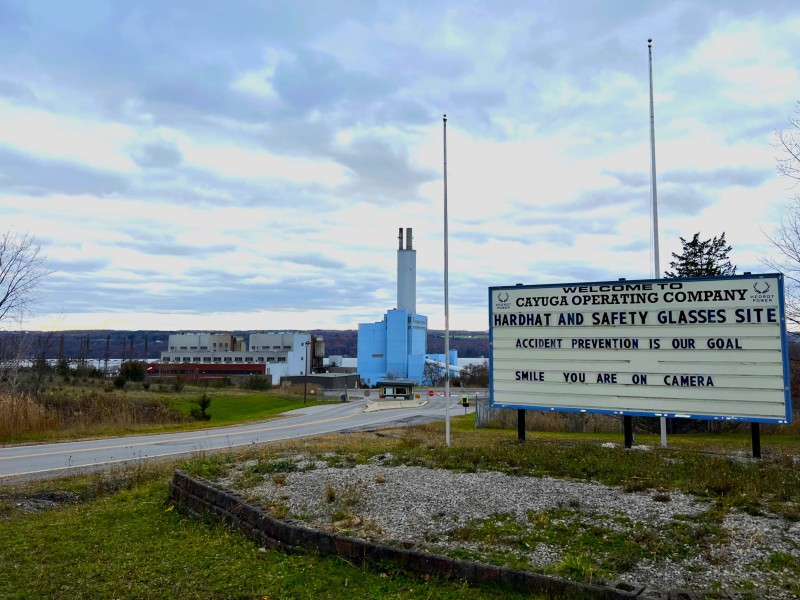
TeraWulf AI data center wins zoning appeal in Lansing
TeraWulf’s proposed AI data center at the former Cayuga Power Plant site in Lansing moves forward after winning a key zoning appeal on Dec. 22.