
Another stride on the Underground Railroad
Too often the words “legendary” or “inspirational” get tossed around like a Frisbees, but in terms of the Underground Railroad, there are few words more applicable.
As detailed on this site, https://voicesontheurr.cornell.edu/about-this-site/ “Voices on the Underground Railroad” is a collection of short narratives that Cornell University students have written, with maps that documented and rumored underground railroad stations and safe houses in Central and Western New York.
From that site: “The freedom seekers who narrate these stories are fictional and should not be considered actual testimonies. Instead, they are a sincere attempt to inhabit and explore the lived experience of freedom seekers — their fear and resilience in transit to a new life.
“These fictionalized voices – honed after careful study of the classic slave narratives and the history of the Underground Railroad – permit us to imagine the thoughts and experiences of freedom seekers on their paths to liberation.”
As a native of Canandaigua two lakes over, and a 30-year Ithacan, I was also impressed how students answered a myriad of questions, including, “Did writing the story change your perspective in any way? Do you see this area of NY State differently now? If so, how?”
One student responded, “I am honored to go to school in a region with such a rich history of progressive thought. The antislavery movement, Seneca Falls, the Great Awakening, and other reform movements of the 19th century were centered here, and Cornell was founded out of that same spirit of progressivism and reform.
“We tend to think of Ithaca as a sleepy town and Cornell as a rural university, but at its founding it was at the heart of this relevant and dynamic region and exemplified the important conversations taking place there.”
Some representative components of the site:“Perhaps the most famous and certainly one of the most resourceful rescuers in Ithaca was George Johnson. In his barber shop on State Street Johnson gave the fugitives haircuts and new clothes in order to change their appearance. He reportedly arranged their voyage on the steamer The Simeon DeWitt which took the refugees to Cayuga Bridge at the northern end of Cayuga Lake.”
Information compiled by History Center volunteers. 2005.
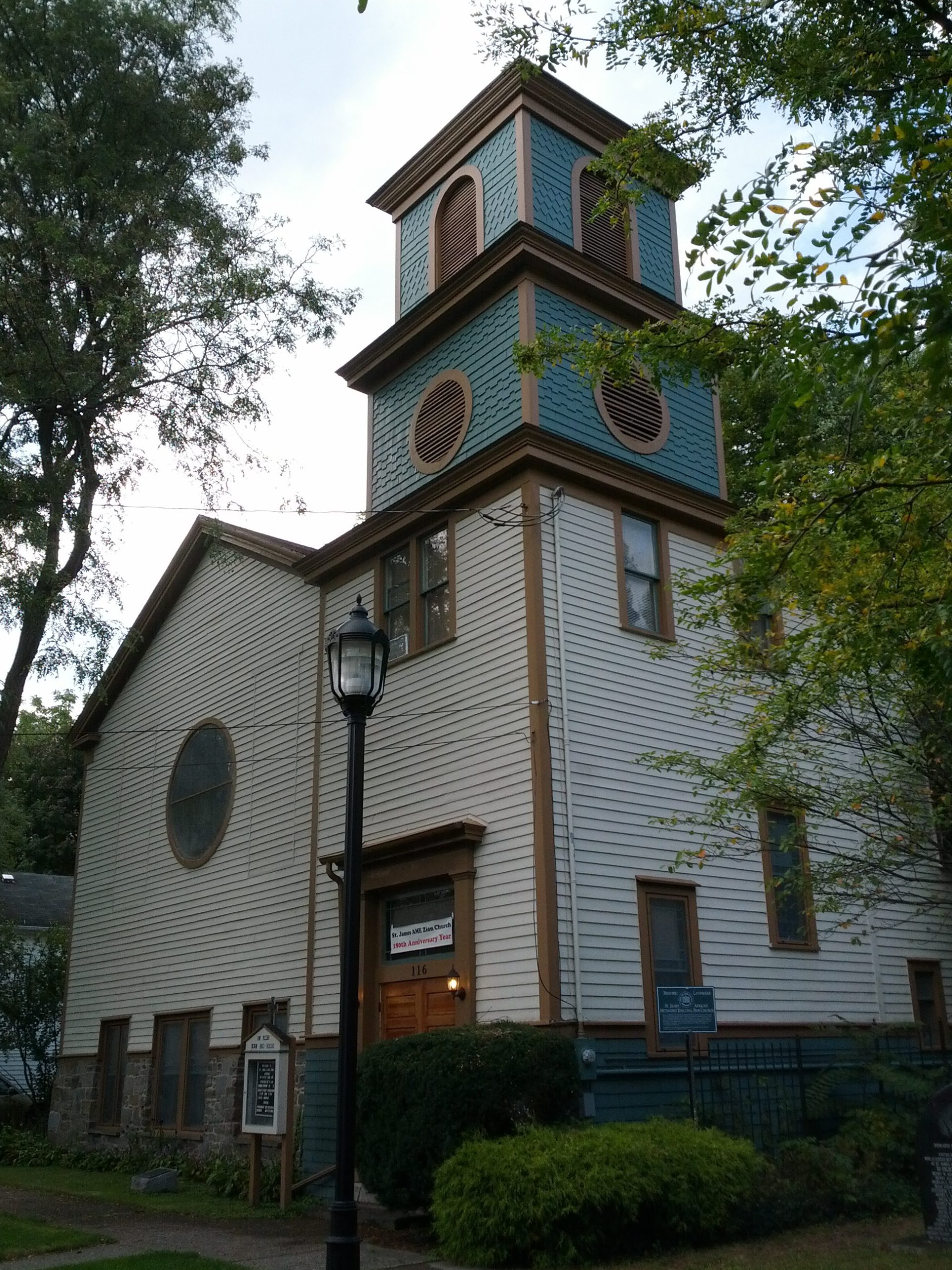
“In1833, St. James AME Zion Church was organized by Ithaca’s African American community as the home of its first pastor, the Reverend Henry Johnson. The two-story frame church with a two-story tower was built in 1836 on Wheat Street, which was later renamed Cleveland Avenue. The marker in front of the church notes, ‘It became the religious, political, and cultural heart of the community and, in 1841, the site of a school for black children. It was the home to Pastors Thomas James and Jermain Loguen and host to Harriet Tubman and Frederick Douglass. The church was the site of many abolitionist meetings and was a station on the Underground Railroad between Elmira and Auburn/Syracuse, according to oral traditions.’ ”
Walter Gable – “Uncovering the Underground Railroad in the Finger Lakes”
There is rarely a day that I am not grateful for being a Finger Laker, (even when thinking about January.)
That gratitude is always underlined and fortified by the history that went before us, and the courage that led with vision and inspiration. This includes railroads of every kind, which opened a region and nation to their possibilities at a myriad of levels.
East Hill Notes are published the first and third Wednesdays in Tompkins Weekly. Gary Stewart is associate vice president of Community Relations at Cornell University.
Related Articles
Town-Gown Awards honor housing, child care collaborations
Town-Gown Awards recognized Cornell and community partnerships supporting affordable housing and child care in Tompkins County.

Lorin Warnick to end term as Cornell Veterinary College dean
Warnick Cornell dean Lorin Warnick will step down in 2026 after leading the veterinary college through growth, innovation, and major public health milestones.
Cornell ash trees aim to beat back borer insects
Cornell plants ash trees with potential resistance to emerald ash borers, advancing statewide restoration through the Trees in Peril project.