
Back to school updates from the hills and community college
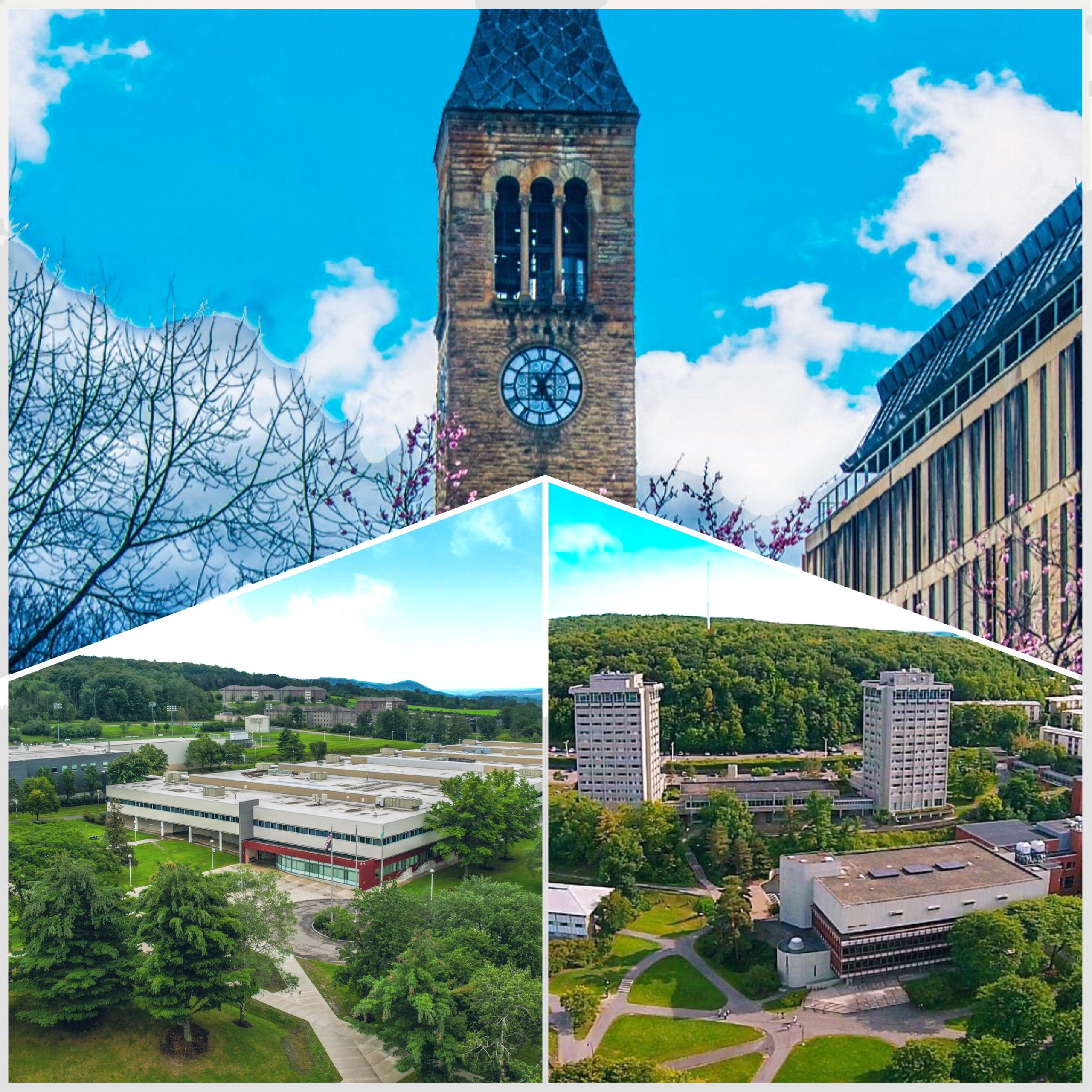
The county’s higher education campuses are lively with students, and classes are just beginning for the new academic year. Each school – Tompkins Cortland Community College, Ithaca College and Cornell University – has exciting updates in academic programs, campus construction and faculty news to kick off the school year.
Tompkins Cortland Community College (TC3)
What used to be a small community college housed in an old high school is now an integral part of both higher education and the community. The school is located on 220 rural acres close to the Tompkins County line in Dryden and serves students throughout the state.
TC3’s website describes the school’s mission: “The College is one of 30 community colleges in the State University of New York, and offers degrees, certificates, and microcredentials in more than 40 academic programs. The College is known for constantly expanding the boundaries of what is possible for a community college: recent innovations include a restaurant, organic-practices farm, and 10-acre solar array powering campus.”
This year, TC3 is excited to announce new microcredential programs that were developed based on the community’s needs and expanding technologies. The new programs include Direct Service Provider One and Two, Chemical Dependency Counseling Assistant, Geographic Information Systems (GIS), Electrical Engineering Technician, Civil Engineering Technician, Geotechnical Lab Technician, Survey Technician and Micro-Nano Fabrication Safety.
“We received a grant that allowed us to update our curriculum and also our facilities with a focus on the Applied Science and Technology program, which I lead,” said Sophia Georgiakaki, professor of mathematics and leader of the Micro-Nano Fabrication Safety microcredential. “So far, we have created the base curriculum directly targeted to the needs of local industry, and to do this we had our industry partners help and support the initiatives.”
Georgiakaki also explained that TC3 is partnering with Cornell University for the Micro-Nano Fabrication Safety microcredential. Cornell has a state-of-the-art clean room, which is necessary for hands-on experience in micro-nano technology. The university will be sharing this space with TC3 students. Georgiakaki added that professors within Cornell’s micro-nano program have offered curriculum consultation so that students are prepared to use the facilities and get the most out of the microcredential program.
Professor of Human Services and chair of the Human Services and Chemical Dependency Counseling programs, Patty Tvaroha ’98, discussed the new human services microcredentials, as well.
“Our newest microcredential is for direct service providers [DSPs], people who work with individuals with developmental disabilities – specifically, those who work in agencies that are funded by the Office for People with Developmental Disabilities. We obtained a grant that has allowed us to provide these microcredentials to folks who work with people with disabilities at absolutely no cost to them, which is really exciting because being able to offer education, completely free, is quite a rarity,” Tvaroha said. “We are actually one of the 10 schools across the SUNY community colleges chosen to provide these microcredentials. We are currently working with Unity House, so all of the people that we have signed up for the current cohort are direct service providers from Unity House, which is pretty cool.”
She added that one of the exciting things about the DSP microcredentials is that they can both be completed within one semester. Courses are offered in seven-and-a-half week classes, so they can complete each microcredential in one semester. This way, students will have completed both microcredentials by the end of the spring semester and earned 30 badges through the National Alliance of direct service providers.
In addition to the new microcredential programs are some laboratory upgrades on campus that directly benefit both the degree track and microcredential students.
“We knew that our lab spaces needed significant work and we also needed some work in our curriculum to make sure that we were up to date with what the labor market wanted. So, back in 2019, we started on our new lab project by looking for funding sources and talking to a lot of local employers to find out what they needed and wanted,” said Provost and Vice President of Academic Affairs Paul Reifenheiser. “When the pandemic started and the state started pulling back grants, the process took even longer. It wasn’t until 2021 that the grant was fully approved and we received the $3.4 million to upgrade our labs.”
The labs that were reconstructed or upgraded include a new physics lab, a chemistry lab, an updated electrical technology lab and a construction lab, and there is also a new space for drafting and GIS. Reifenheiser said these last two are learning labs to help pull all of the aspects of each program together, especially since some of the degrees and microcredential programs share lab spaces.
“We tore the facility down to the bones and rebuilt from there. It’s been a big hole on our campus for a few years, but now we’re talking about brand-new everything. All the storage facilities, counters, Lecture Capture simulcast equipment – it’s all new,” Reifenheiser said. “This way, students can learn remotely as needed, but it’s also so that if, for example, one of our faculty went to grad school with somebody in California, that California person could come in virtually and interact with our students, and we can do it in a really nice, high-end way.”
Ithaca College
The South Hill school has a handful of new academic programs that the incoming class of students are the first to be enrolled in. These programs include the Bachelor of Arts in education studies and a new doctoral program in occupational therapy. These programs were created out of the local, and broader, state demand for workers in both fields.
“The B.A. in education studies is an interdisciplinary program that introduces students to the broader field of education for those who may not be interested in a traditional K through 12 classroom setting as a teacher, but they’re interested in working somehow in the field of education,” said David Maley, Ithaca College’s director of public relations. “In our School of Health Sciences and Human Performance, we’re launching a new doctoral degree program in occupational therapy; we’re launching a second doctoral program, which is six years. Students first complete their Bachelor of Science degree in four years, and then in the next two they will earn their Doctor of Occupational Therapy.”
The college is also taking steps to further carry out its Five Year Strategic Plan. Part of this plan includes the creation and implementation of the Center for Diversity, Inclusion, and Belonging.The center is led by a three-person team: one person focusing on faculty, one on students and one on staff.
“Another thing that started over the summer and is temporary – but temporary for at least the next two years – is a partnership with the Coddington Road Community Center as a portion of their childcare operations on campus,” Maley said. “They’re doing an expansion project and will be losing some of their space during construction. The leadership of the center reached out, and we realized there was underutilized space in our Circles Community Center. This is where a portion of their daycare and afterschool programs will be located. It’s helping a local business, and it’s a great opportunity for our students in childhood education to gain experience, so we’re working that out right now.”
For the fall 2023 semester, students will receive free Tompkins Consolidated Area Transit (TCAT) passes, made possible by the college, in response to TCAT’s “pardon our dust” announcement. Students can contact TCAT or visit https://tcatbus.com/college-students-2023 with questions.
Cornell University
This will be the first year that Cornell has a “themed year” with corresponding events and speakers through the year. That theme is “freedom of expression” and can be fully reviewed at https://www.cornell.edu/expression/.
“We felt like this is a critical time for us as an academic community to really try and do all we can to learn, engage with and model the respectful and productive discourse from which we and all parts of the global society can benefit from,” said Vice President of University Relations Joel Malina. “To encourage this discourse, we have a series of events, performances and speakers planned throughout the year to provide an array of opinions and experiences to engage with students on.”
One of the newest and most exciting construction-based projects that Malina also mentioned is the expansion of the Bowers Computer Information Sciences building. Formerly housed in Gates Hall, the program will now be housed in a new, enlarged facility on the site of the old baseball field, Holy field. The new field is located off the main campus on Game Farm Road.
Malina added that on Tower Road, another construction project will become the home of Atkinson Hall. Here will be the Center on Sustainability, in addition to other numerous programs such as the Masters of Public Health program and veterinary program.
Additionally, Cornell is continuing its journey to carbon neutrality by 2035, with various ongoing initiatives such as the floating solar panels, which is also an educational research project for faculty and students.
“We are the only university in the world that has achieved a platinum rating four years in a row from the Association for the Advancement of Sustainability in Higher Education (AASHE), which is an international entity for sustainability, and we are leading the way,” Malina said. “We’re very proud of it, but there’s a lot more work to be done here, in the county and around the world. It’s going to be a process, but we’re proud to be a local university with that kind of recognition.”
Each school has many exciting things happening on campus as new programs are added, old ones are updated and new facilities are completed. We wish all the students, faculty and staff success in this academic year.
Related Articles
Cayuga Medical Center nurses’ vote for unionization approaches
The Cayuga Medical Center nurses union vote approaches as nurses cite workplace concerns, leadership changes, and national labor issues.
Holiday traditions bring community cheer
Tompkins County holiday traditions light up homes, farms, and schools with festive cheer and community spirit.