
Broadband access sees progress, more projects in the works
Last year, Tompkins County made some major strides to improve broadband access for its residents (tinyurl.com/2eb5y4xb), and this year, that effort has only increased. Between a new survey and various expansion projects in the works from internet service providers (ISPs) and local leaders alike, there’s a lot of progress to highlight, so we’re taking a look at what’s changed and what is still left to do.
County releases survey
Last fall, the Tompkins County Legislature voted to launch a county-led, on-the-ground study into broadband access across the county, and recently, county officials launched a countywide access survey as part of that study (tinyurl.com/2hp4jlz6). This came concurrently with the creation of a new website, tompkinsbroadband.com, to collect and compile the survey data. Those interested can visit the website for information on filling out the survey.
County Principal Planner Nick Helmholdt explained that there have been some notable changes to the plan since our last coverage of it. First, shortly before the county started the process to get a survey up and running, New York state administration announced that it was launching its own statewide survey into broadband access (tinyurl.com/2f7ul68n). The resulting map is available at mapmybroadband.dps.ny.gov.
After the state’s announcement and survey launch, Tompkins County leaders decided to pivot, Helmholdt explained.
“We’ve switched course a little bit from just trying to collect the data to figure out what to do with it,” he said. “And what we’re doing right now is validating [the state’s data] with the experiences and knowledge of folks who live in the county.”
Now, the county has partnered with ECC Technologies, which will take the survey results and “determine what types of solutions we need to be looking at in terms of the technical capabilities and what the offerings could be,” Helmholdt said.
“Those [solutions] could look like anything from financial incentives for ISPs to expand, or it could be any other directions for the county to consider in terms of building out networks where there are gaps,” he said. “There’s a variety of ways to approach it, and that’s what we’re going to be looking at later this fall and then bringing that to the Legislature for action and funding to make it happen.”
Helmholdt said the county plans to keep the survey open until late November and that there are paper versions available at local libraries for those who can’t access the survey online.
Lansing partners with IAED, Point Broadband
Another new development since last year is a collaborative project between Ithaca Area Economic Development (IAED), Point Broadband (point-broadband.com) and the Town of Lansing. According to those involved, the project’s early stages began just before the pandemic hit, and COVID-19 significantly impeded progress from there.
“We wrote an [Appalachian Regional Commission] grant to simply … run 17 miles of dark fiber broadband from Lansing — the proposed terminus closest to us would have been the Guthrie health care facility up there on Brown Road — and run it out to the old coal plant, the former coal plant up there on Cayuga Lake,” explained IAED Director of Development, Operations and Strategy Kurt Anderson.
In late 2020, the grant was finally approved, “and we realized that we had caught lightning in a bottle with this one, and we thought, ‘Boy, we better leverage what we got,’” Anderson said.
“We tapped the brakes here internally and revisited what was possible with what we had and how we could leverage it to maximum extent and ultimately came up, after some trial and error, to the project where it stands now,” Anderson said.
What started as a 17-mile plan soon expanded, with the current plan being to run about 56 miles of fiber all told. But where those 56 miles will be is still being finalized, as Lansing leaders explained.
“The last we left it is there’s two different proposals [that have] been put forward,” explained Joe Wetmore, a member of the Lansing Town Board and co-chair of the Lansing Broadband Committee. “One essentially ran … from somewhere in the town of Ithaca up the lake, and the other one routed through Dryden and back out somewhere else, so it became a loop. … We know where there’s this gap up in North Lansing. And so, the idea was to route this cable through that. And so, it gives us two things. It gives us redundancy, so if one end of the cable isn’t working, the other end might be. And it helps people who aren’t getting cable at all to have the ability to hook into this somehow.”
Town Supervisor Ed LaVigne explained that a townwide assessment of access will ultimately determine which option the town pursues.
“The grant’s been approved, and the progress so far is that we’re facilitating trying to do all the soft costs and all the legwork to eventually get it in here,” LaVigne said. “A lot of that has to do with all the … work that has to be done for preparation. And that’s where we are right now — do the inventory of who has broadband and which areas don’t, try to get into them as best we can, as economically as we can and go from there.”
Dryden Fiber
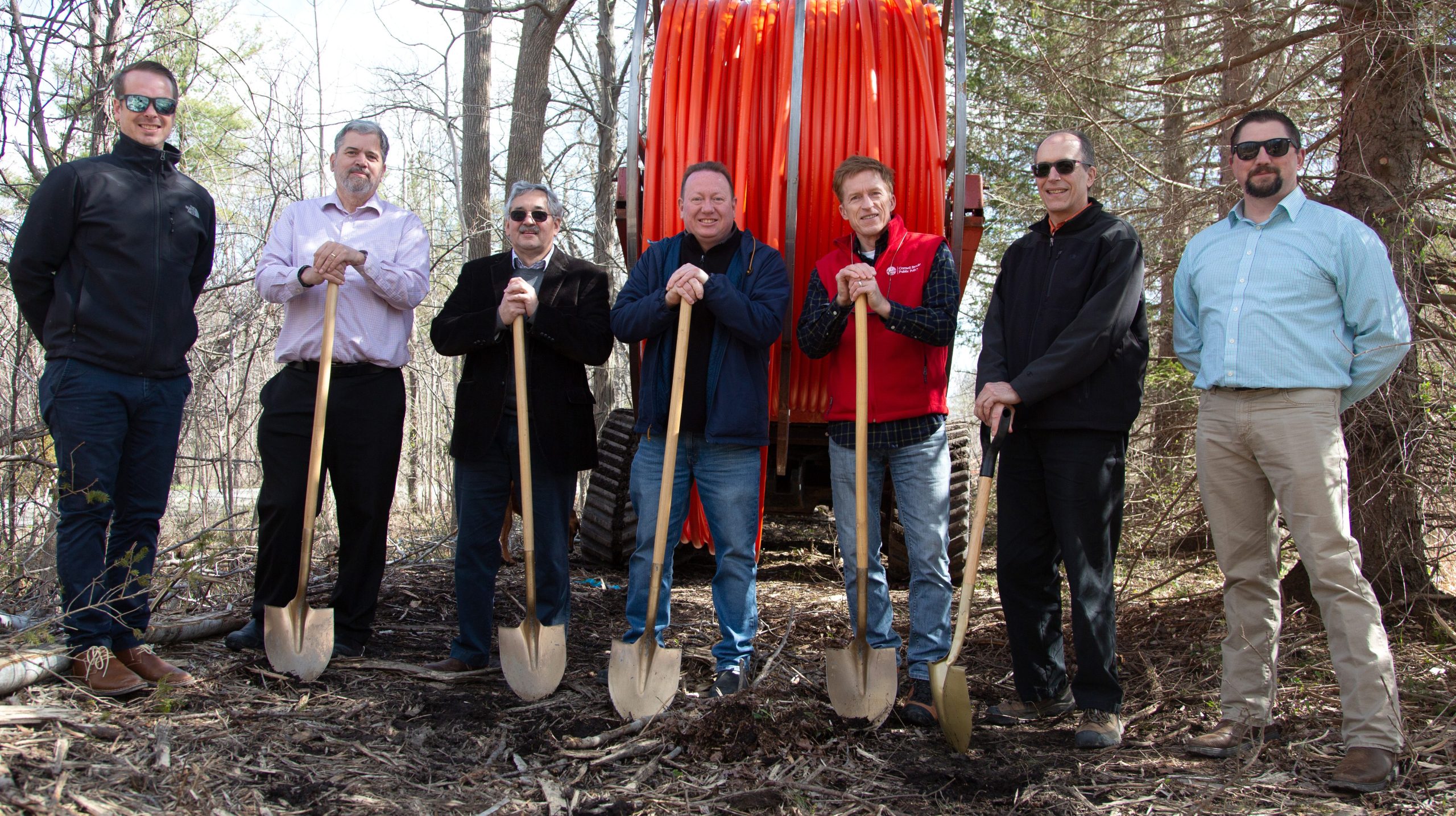
The Dryden Fiber project (drydenfiber.com), as Tompkins Weekly has covered before, is working to establish a municipally owned broadband provider service. This May (tinyurl.com/2gw8lmsf), the project finally broke ground, and Deputy Town Supervisor Dan Lamb explained what’s happened since.
“We’ve continued to meet as a group every other week,” he said. “We’re not adding people to our payroll to do this; we’re finding the best technicians and vendors to provide the service, whether it’s billing or maintenance or access to the internet. These services that we’re using to make this project possible are an accumulation of vendors, and we’re pretty happy about how we’ve been able to get really good service providers to work with us, I think, because we’re interesting to them. Groups want to work with us.”
While the project has a high price tag — over $14 million — Lamb said that the town has been fortunate to have plenty of funding sources to back the project. For one, the town has dedicated its full award amount from the American Rescue Plan — about $1.2 million — to the project, which is covering “all our initial costs right now,” Lamb said.
The town also has a grant from the Appalachian Regional Commission of $640,000, and Lamb is expecting more aid to come through the latest infrastructure bill that passed Congress last year, which allocated significant funding for improving broadband access (tinyurl.com/26yywe7y).
“That legislation had about $65 billion for broadband,” Lamb said. “And so, we haven’t even gone after that funding yet because it hasn’t made its way out through the grant application process. And for us, we’re watching very closely.”
Lamb said the U.S. Department of Agriculture (USDA) is leading the new program, and the Town of Dryden is expecting the department to release a Notice of Funding Availability by this fall.
“The rural development folks at USDA have told us all along, going back two years ago, that this project would be a nice fit for the reconnect program,” he said. “And I just think if it was a nice fit before all this capitalization of funds came along, it’s an even nicer fit now because we have all our mechanics lined up for running this program, and we’re doing it in stages.”
ISPs continue expansion efforts
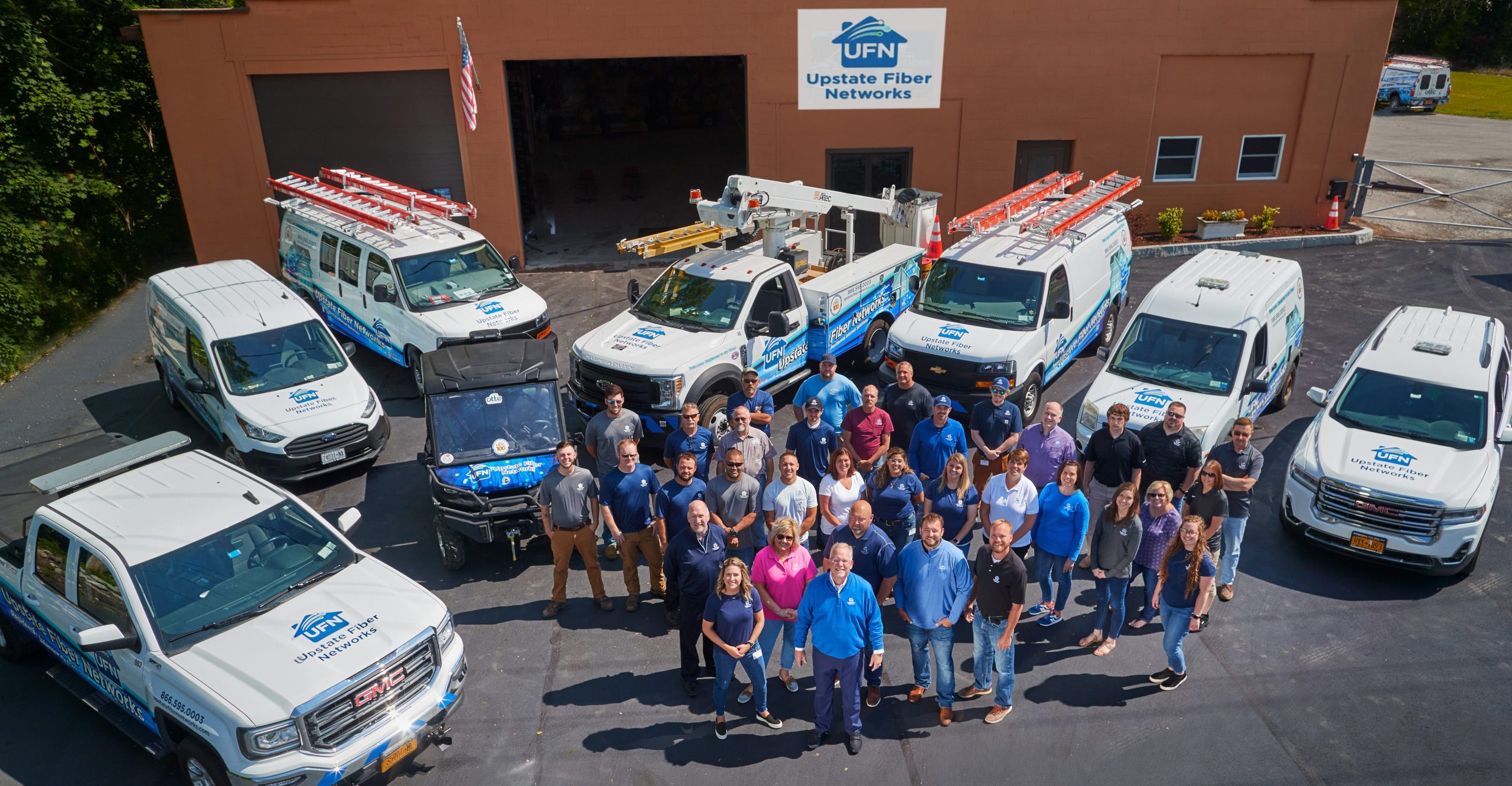
Tompkins Weekly also checked in with two ISPs that shared expansion efforts in previous coverage — Point Broadband and Ontario & Trumansburg Telephone Companies (OTTC, ottctel.com). Point’s Chuck Bartosch said that Point’s expansion efforts are progressing well.
“We’re finishing up mid-Newfield,” he said. “We were going to do more overbuilding in downtown Newfield, but those are not people who don’t have service. So, for now, we’re putting that off and mainly just getting service to people who don’t have service.”
Bartosch said much of Point’s efforts right now are focused on the aforementioned Lansing project, with work expected to start this fall. Bartosch explained that while it hasn’t slowed progress greatly, there have been some challenges making expansion efforts complicated. For one, “materials are really hard to get,” he said.
“If we run out of something, it’s eight weeks before we get more,” he said. “Luckily, we’ve got other divisions [so] we can borrow from other divisions, but the whole company’s facing this issue.”
Bartosch said there’s also a lot of rigmarole around getting onto or replacing telephone poles.
“You have to do an application to be on the telephone poles that exist,” he said. “After a number of months, they approve it. The problem is you don’t know ahead of time what it’s going to come back at. You may have to replace the telephone pole, … which means you have to do what’s called electrical make-ready, and electrical make-ready can be $15,000 a pole or even more if the pole has multiple transformers on it and there’s multiple directions that the lines are going, on a street corner for example. And that can be really expensive.”
Bartosch is calling on New York state administration to ease some of that process by taking over the make-ready portion.
As for OTTC, President and CEO Paul H. Griswold explained that OTTC has finished its efforts to build out fiber to “all the areas that we possibly can” in its current markets, though it does have plans to further expand into new markets.
“Our other company, Upstate Fiber Networks, … we’re expanding that network,” he said. “That’s going down into Ithaca now. And then, we’re in Buffalo right now. We’re going to be going into Lockport. So, we’ve got a whole different build going on out in the Buffalo area. And then the Finger Lakes region, we’re finishing up [and] will be opening up Canandaigua really soon. We’ve already got Geneva, Waterloo, Seneca Falls, and then we’ll have Palmyra, Macedon opening up.”
Griswold shared that expansion efforts at OTTC are steadily progressing, though not as fast as some would like. He explained that’s mainly because “we have to replace so many telephone poles.” Not only does the survey and repair process take months per pole, but also, up until very recently, OTTC had a hard time getting any new poles.
“We couldn’t get them anywhere,” he said. “We’ve remedied that finally, but that took weeks off of our timing to try to find suppliers again for all these utility companies to give us those big poles. … So, we’re almost through that now, but that’s slowed us down.”
Staffing shortages are also slowing progress, Griswold said.
“Trying to find people is tough, and then you’ve got other staff and other companies that are paying more now because they’re trying to steal staff to go over,” he said.
Leaders highlight access importance
Sources interviewed for this story explained that all of these efforts are continuing in earnest because broadband is still a necessity. Legislator Anne Koreman, for example, said that, even though many of the pandemic restrictions have been lifted, “A lot of people, such as myself, we’re still doing a lot more hybrid than we were doing before.”
“A lot more people are working at home,” she said. “Where before, [school] was mostly in the classroom, now that they’ve done hybrid, if a child is sick, a lot of times, they can participate remotely, or a lot more of their homework is now going through some electronics, whether it’s the internet or they have tablets or laptops. So, it’s just being used much more broadly. And I think people are also doing telehealth more than they were before. So, those are things that happened because of the pandemic, but they’re not going away.”
Newfield Public Library (newfieldpubliclibrary.org) Director Sue Chaffee said she and other library staff have seen that need throughout the pandemic and even now. That’s why the library has worked to do what it can to help, like providing free Wi-Fi, computers (when open) and mobile hotspots available to borrow. Chaffee added that all of the library’s mobile hotspots are still being borrowed frequently.
“High-speed internet, it’s critical for community members to stay connected with each other and just the wealth of information and services that are out there,” she said. “All that said, the library serves as that resource point for people who don’t have high-speed [internet]. We welcome anybody who needs information about anything to come in. They can use our computers, or we can find answers to the questions that they have using our computer and high-speed internet.”
Jessica Wickham is the managing editor of Tompkins Weekly. Send story ideas to them at editorial@VizellaMedia.com.
Related Articles

Holiday traditions bring community cheer
Tompkins County holiday traditions light up homes, farms, and schools with festive cheer and community spirit.
The gift of an experience: Local businesses offer hands-on holiday fun
Holiday experience gifts in Tompkins County include candle making, gourd crafts, and pottery workshops for creative seasonal fun.
Code Blue shelter opens amid praise, concerns and ongoing debate
Ithaca’s Code Blue shelter opens with larger space, showers, and case management to help residents during cold weather.