
Local governments, including Ulysses, launch coalition for park at former Camp Barton
Camp Barton State Park coalition launches in Trumansburg. Learn about plans for the 90-acre park on Cayuga Lake!
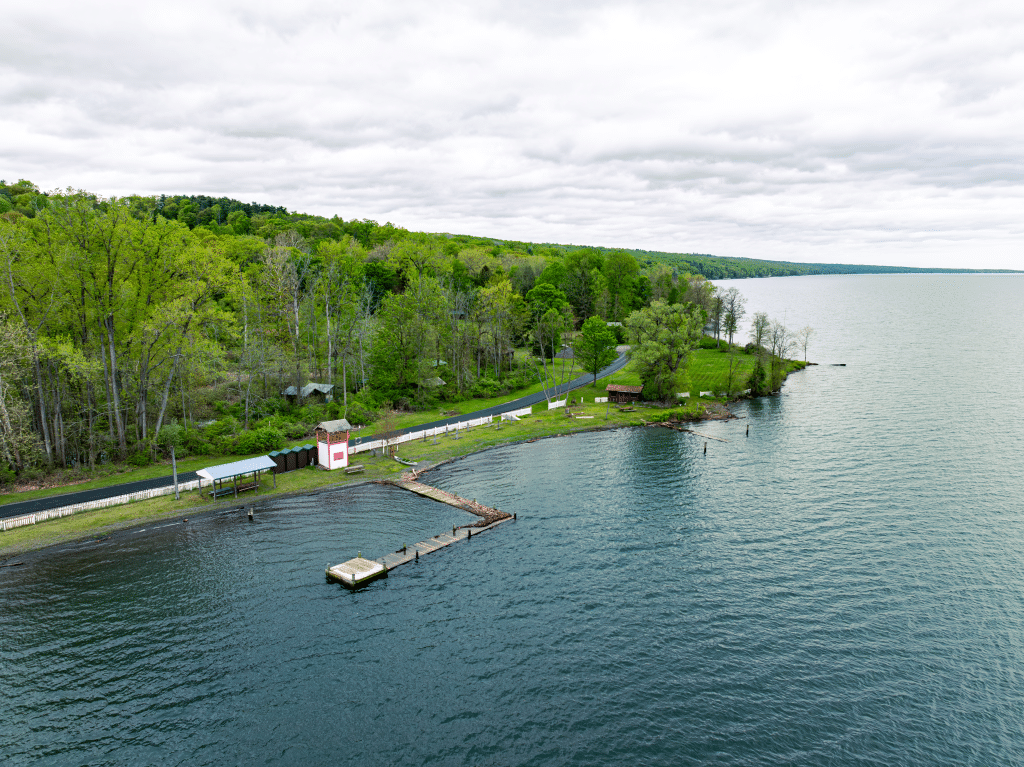
A coalition of three local governments was recently formed to manage the 90-acre park where Camp Barton was formerly located.
On July 1, a coalition of three local governments — the village of Trumansburg and the towns of Ulysses and Covert — hosted the first meeting to inform the public about the new state park being built on the shores of Cayuga Lake at the site of the former Boy Scout Camp Barton property.
The coalition, dubbed the Three Falls Local Development Corporation (LDC), is in charge of managing the new 90-acre state park located in Trumansburg at 9640 Frontenac Rd. on Frontenac Point on the western shore of Cayuga Lake. Two members of each participating municipality, along with the regional director of the New York State Office of Parks, Recreation, and Historic Preservation (OPRHP), make up the LDC’s board.
The new park has not yet been named, but LDC officials said at the July 1 meeting that decision will likely be made by the governor or other state leaders.
OPRHP acquired the property from the Baden-Powell Council of the Boy Scouts of America, which had operated the facility as Camp Barton, in 2023. The property includes a half-mile of Cayuga Lake shoreline, dockage, bathrooms and a caretaker’s residence. The property, several miles north of Taughannock Falls State Park, also includes the 128-foot Frontenac Falls.
To kickstart management, OPRHP awarded the LDC a $100,000 grant to develop a comprehensive plan and facility assessment strategy for the park. At the July 1 meeting, Trumansburg Mayor Rordan Hart, who chairs the LDC, said that the coalition had picked out a firm to help with the development of the plan, but the LDC would not make any announcements because no contract had been signed yet.
“For us, there are some things we know that need to be done. Infrastructure is essentially, I won’t say ‘non-usable,’ but close,” Hart said.
Hart noted that the village has licensed water operators as part of its Department of Public Works. None of them, he noted, wanted to turn the water system at Camp Barton back on, Hart said.
“[That’s] because it is in such disrepair,” Hart noted. “Half of the village’s water supply comes from a well down at Camp Barton. Water infrastructure, as the village knows very well, is not cheap. So, we know we’re going to have to replace that.”
The LDC will also have to look at the existing buildings at the camp and decide what to do with them.
“Which buildings are we going to keep? Which buildings are we going to renovate? Which buildings are we going to tear down? That is part of the planning process,” Hart said. “All of that has to be approved by [OPRHP] because we don’t own the buildings. We’re simply the site manager. So, you can imagine that it’s going to be a multi-year process before we get to whatever the finished product ends up being.”
OPRHP’s Regional Director in the Finger Lakes Fred Bonn said that the park is a blank slate with heaps of history. He noted that the park might end up being one of the best things he has worked on at OPRHP. Once the comprehensive plan has been finalized by the consultant, Bonn said, the LDC will be able to apply for grants from the state and its Empire State Development Foundation.
“We are going to have that document in place, saying, ‘This is where we are; this is what we’re reaching for,’” he said. “I’m very confident that we’re going to see strong support for building this up.”
One thing the LDC and OPRHP will have to account for is revenue to be able to maintain park operations.
“If there is the opening of the dining hall or a wedding that’s taking place, or the collection of vehicle usage fee, the entrance fee or rentals of any of the cabin sites, that revenue will remain with the LDC,” Bonn said. “The LDC can go through sort of the business plan to figure out how they can monetize the property. That’s … one of the calculations that you’ve got to go through with a park, is to figure out: what can you generate for revenue to take on and run those operational costs.”
Author

Related Articles
Ulysses Town Board recognizes retiring officials
The Ulysses Town Board recognizes retiring officials for years of public service and leadership at its final meeting of the year.
Holiday traditions bring community cheer
Tompkins County holiday traditions light up homes, farms, and schools with festive cheer and community spirit.
Trumansburg schools consider regionalization as TST BOCES plan advances
Trumansburg school regionalization remains undecided as TST BOCES outlines goals for shared services and student learning.