
East Hill News – Campus grasslands grow environmental solutions
Santi Tabares Erices ’25 peered through binoculars on a sunny morning in late May, hoping for an increasingly rare sight: a grassland bird nesting in a dew-covered hayfield.
As grassland bird populations decline, he and other Cornell researchers are testing whether birds such as Eastern meadowlarks and bobolinks that nest in grasslands produce more fledglings when hayfields are mowed later than usual.
He spotted a savannah sparrow flying above the field.
“She has a worm; she has a worm,” said Tabares Erices; the wriggling meal might mean she had a nest of hungry babies in the field, part of Cornell’s Mount Pleasant Farm in Dryden, New York, about six miles east of campus.
The project is one of several exploring how Cornell’s grasslands – from hayfields to campus lawns – can protect birds, encourage biodiversity and fight climate change. Ultimately, researchers hope these efforts can be scaled up statewide to effect real environmental benefits.
“If it’s good for the state, it’s good for the region. If it’s good for the region, it’s good for the United States,” said Mark Schrader, MLA ’22, assistant director of the Cornell University Agricultural Experiment Station in the College of Agriculture and Life Sciences (CALS). “That’s part and parcel of why experimentation plays such a critical and important role – because it’s a catalyst for scalability.”
Delayed mowing benefits birds
Many North American bird populations have been disappearing, with no groups decreasing more quickly than birds that nest in grasslands.
Economic forces, changes in farm practices and reforestation have decreased the grasslands that support birds.
A small study in in 2023 found grassland bird populations decreased in Cornell-managed hayfields mowed in June compared with Dunlop Meadow Natural Area, which is managed specifically to support grassland birds.
This year, Tabares Erices and David Benvent ’25, both environment and sustainability majors in CALS, rose before dawn to search for and monitor nests in a 17.5-acre unmowed field and adjacent mowed fields throughout the nesting season.
Fewer nests made it all the way to fledging in the mowed fields, where David Bonter, senior extension associate in the Cornell Lab of Ornithology, said he hadn’t expected to see any reproductive success.
But they found savannah sparrows build their nests very close to the ground, giving them a chance to survive being mowed over.
“If it’s enough to sustain populations, who knows. But it wasn’t all tragic,” Bonter said.
The birds need approximately three weeks from nest building to fledging. Delaying mowing a few weeks is a slam dunk for helping grassland birds get off a clutch of eggs, Bonter said, but farmers are working with very small financial margins, and just a week of delay can make a big difference.
But “farmers do not like mowing down grassland birds,” Bonter said. “I think if they knew that following certain practices would be effective in helping grassland birds, while at the same time having limited impact on the economics of the situation, that nine out of 10 farmers would choose to change what they’re doing.”
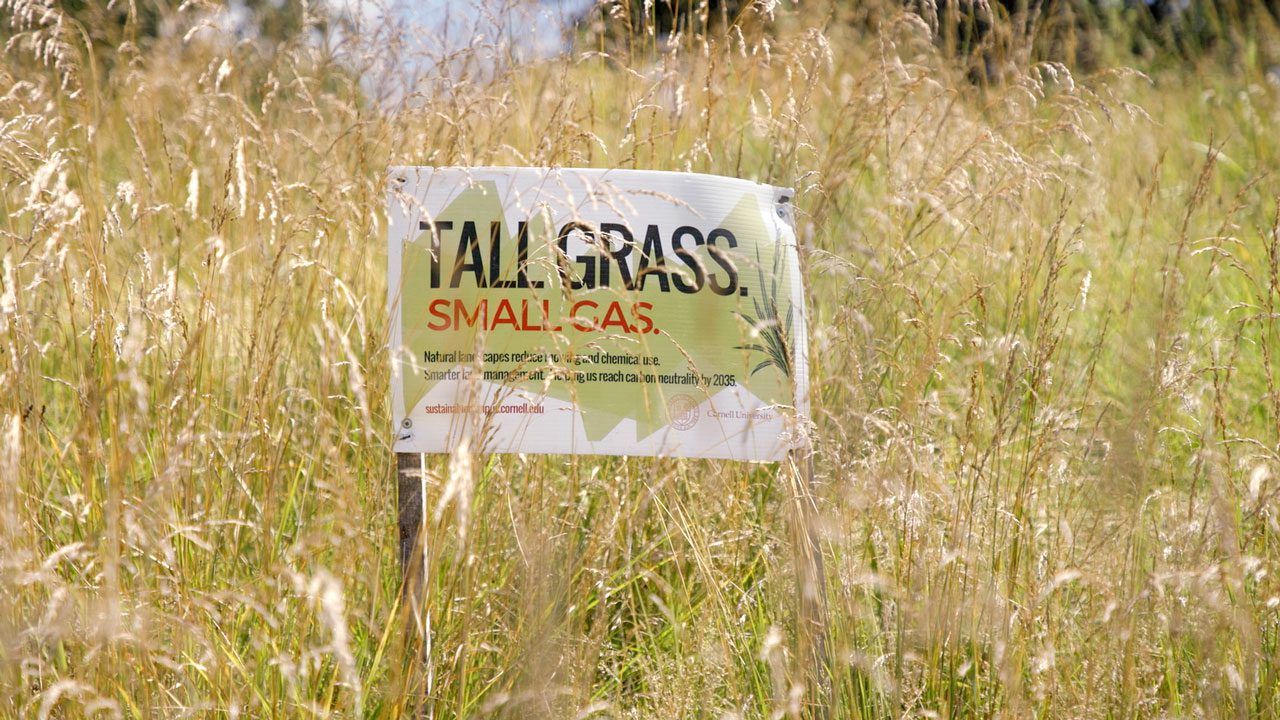
‘Tall Grass, Small Gas’ fosters a living lab on Libe Slope
A desire to mow less inspired the Tall Grass, Small Gas initiative on campus in 2009. Since then, Cornell has decreased the frequency of mowing hillsides and difficult-to-reach areas.
Approximately 35 acres are mowed just once a year, saving around 9,700 pounds of CO2 emissions annually. The shift has also nearly eliminated nitrogen fertilizer, which emits nitrous oxide, a particularly damaging greenhouse gas.
The initiative is part of Cornell’s Climate Action Plan to reduce emissions and reach its goal of carbon neutrality by 2035.
And now a Tall Grass, Small Gas area on Libe Slope is doing double duty as a research site.
Kyle Wickings, associate professor of entomology at Cornell AgriTech, wondered if reduced mowing could improve the biodiversity of organisms that live in the soil and how they cycle carbon. So he integrated Libe Slope into a larger study at AgriTech in Geneva, New York.
The study contrasts annual mowing on Libe Slope and the weekly mowed areas just adjacent to it. Similar plots at AgriTech include plots that are mowed every other week and every four weeks.
So far they’ve found mowing every two weeks seems to be driving the highest biodiversity.
Wickings’ team chose mowing as its variable for the study because it’s applicable to all managed grass systems – from homeowners’ lawns to golf courses and hayfields. “It’s low hanging fruit for something we can affect with management,” he said.
For a more in-depth version of this article, please visit https://news.cornell.edu/stories/2024/08/campus-grasslands-grow-environmental-solutions
Related Articles
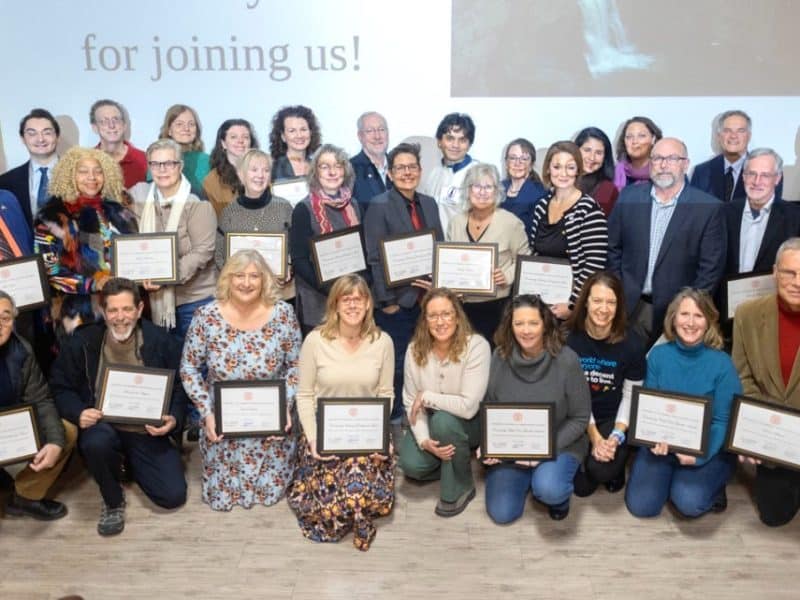
Town-Gown Awards honor housing, child care collaborations
Town-Gown Awards recognized Cornell and community partnerships supporting affordable housing and child care in Tompkins County.

Lorin Warnick to end term as Cornell Veterinary College dean
Warnick Cornell dean Lorin Warnick will step down in 2026 after leading the veterinary college through growth, innovation, and major public health milestones.
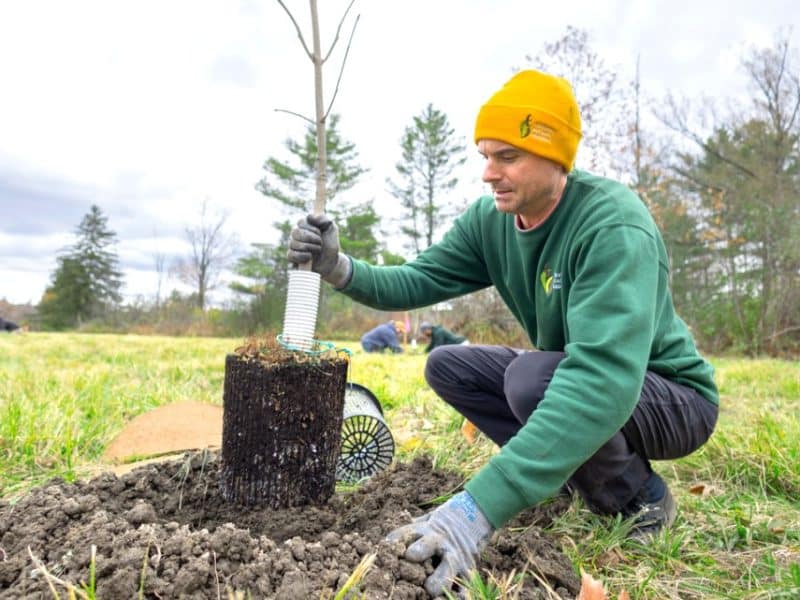
Cornell ash trees aim to beat back borer insects
Cornell plants ash trees with potential resistance to emerald ash borers, advancing statewide restoration through the Trees in Peril project.