
Cayuga Lake’s harmful algal bloom season is getting longer
The ongoing issue of harmful algal blooms (HABs) in the waters of Cayuga Lake started earlier than ever this year, with a widespread bloom spotted June 3 in the marshes of Cayuga State Park. With global warming and other factors exacerbating the growth of HABs, one not-for-profit has amassed a team of volunteers willing to monitor the problem, despite the fact that prevention is a large-scale uphill battle and there is currently no effective means for treating the harmful blooms.

With the health of the public at risk, HABs detection, education and outreach are key, said Alyssa Johnson, HAB-monitoring program coordinator for Community Science Institute (CSI).
CSI has offices in Ithaca that operate with the mission to foster and support environmental monitoring in partnership with community-based volunteer groups in order to better understand our shared natural resources and how to manage them for long-term sustainability and protection.
CSI was founded in 2000, and its Cayuga Lake HABs monitoring program began in 2018.
HABs are not actually algae, Johnson said. The term “harmful algal bloom” was coined a long time ago (not by CSI). It has become a commonly used term around the globe, but it is inaccurate.
“It’s actually bacteria,” Johnson explained. “This cyanobacteria is in both freshwater and saltwater environments all the time, and it’s not always harmful. It’s in the water all the time, and it does not harm you.”
There are a multitude of factors that can create a bloom of bacteria that is harmful to humans, pets and livestock.
“We have a nutrient load entering our water and lakes,” Johnson said. This can be runoff from agricultural practices, such as the spreading of manure or chemical fertilizer application, particularly nitrogen and phosphates.
“In particular, we see blooms occurring after a big rain event,” Johnson said.
After a heavy rainstorm, creeks and streams swell with extra water, and this is sometimes associated with the appearance of a harmful algal bloom one to two days afterwards, due to the influx of nutrients being carried by the rain into the lake water.
Fertilizer applications to keep lawns looking pristine and jewel green contribute to the problem.
“The biggest lie we’ve been told as Americans is that we need a perfect lawn,” Johnson said. “It’s a barren wasteland of an invasive species of grass that has no life to it.”
Climate change is another contributing factor.
“The temperature of our climate around the world is climbing on average, so we’re getting longer growing seasons,” Johnson said. “It’s getting warmer earlier in the year and staying warm later.”
On June 3, CSI received its first HAB report of 2024. This widespread bloom was found in the northern marshes of Cayuga State Park.
“That’s very, very early,” Johnson said. “The last one reported last year was on Oct. 26, which is pretty late in the season.”
Five other blooms have been reported to CSI this year, according to CSI’s Cayuga Lake HABs Database (database.communityscience.org/hab).
Most recently, two blooms were spotted in the northwest region of Cayuga Lake on July 5, one from Sheldrake Point to Deans Cove and one from Schuyler Creek to Canoga Creek. Two small HABs were reported about two weeks apart in the Harris Park/Frontenac Park area, and last month there was one large, localized bloom from Cass Park to Glenwood Point.
The presence of zebra mussels in Cayuga Lake also contributes to the water’s ideal HAB-growing conditions.
“Bivalves like clams, oysters and zebra mussels are called ‘filter feeders’ because they filter out plankton in the water,” Johnson said.
This gives the water a clear appearance that can be misleading.
“It often gives people this false sense of cleanliness,” Johnson said. “In another job previous to this one, I gave guided canoe and kayaking tours, and people would say, “Oh my gosh, the water is so beautiful and clean!’ But this allows sunlight to penetrate much deeper in the water, which warms the water deeper than it would otherwise.”
When lake water appears “dirty” and hazy, that is usually caused by the presence of tiny organisms like phytoplankton and zooplankton, which are natural and normal. They help filter the sunlight to a certain depth.
“If you remove [these organisms] with these invasive zebra mussels, and you’ve got hotter, more intense summers and a higher nutrient load being added to the lakes, now you’ve got a hot petri dish with Miracle Grow in it,” Johnson said, adding that this is a “crude” but effective analogy to describe the lake conditions that lead to HABs.
Another factor is calm waters.
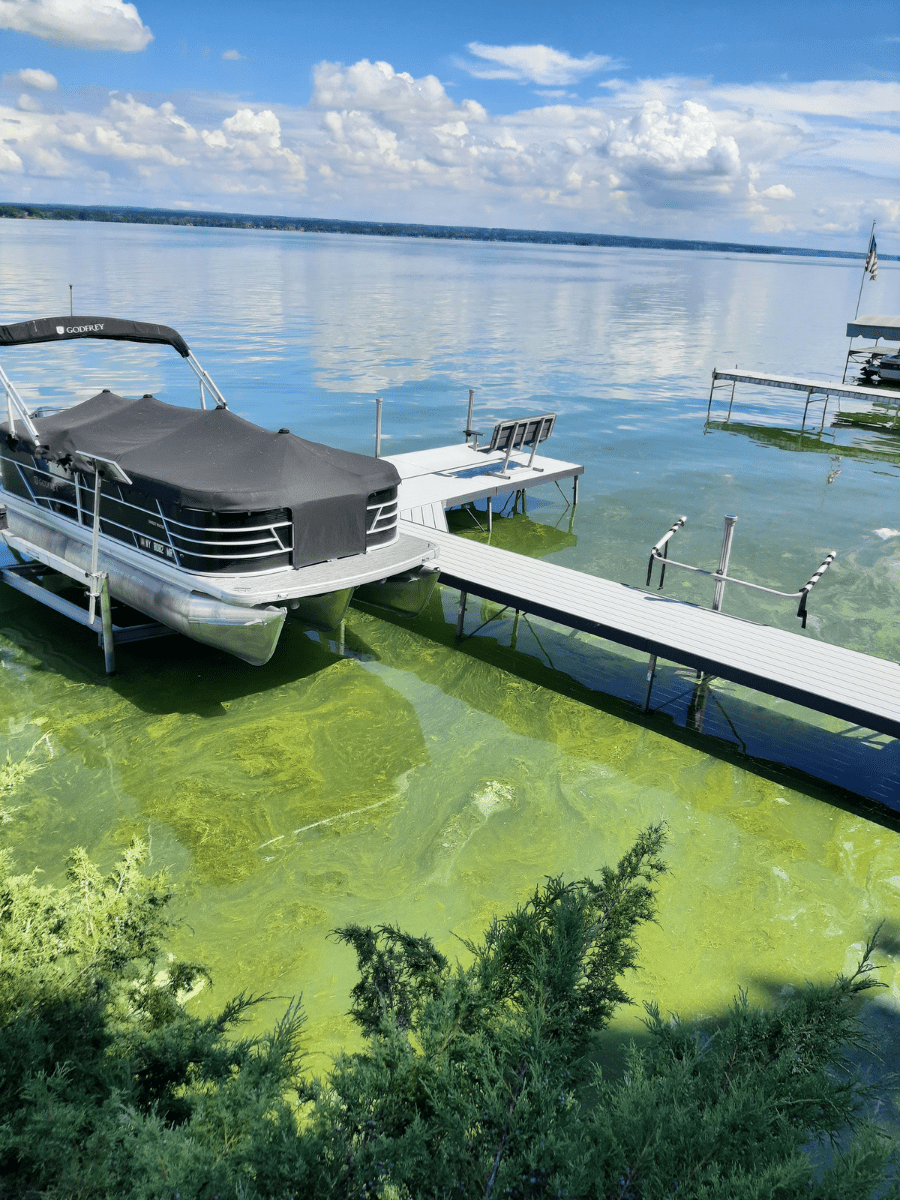
“We often see the blooms occurring around docks and in little bays along the shoreline, where it tends to be a little calmer, there’s low-oxygenated water — a perfect storm of conditions for a huge bloom of this bacteria, and that is when the toxins are created by this bacteria,” Johnson said.
Different types of the bacteria create different toxins.
“On Cayuga Lake, we at CSI have the most rigorous volunteer monitoring and water sampling across the state,” Johnson said.
The New York State Department of Environmental Conservation (DEC) has a monitoring program that it oversees across the state, but Johnson said that the DEC does not test samples as rigorously as CSI.
CSI tests every single sample collected from a suspected HAB to confirm, without a doubt, what is growing in the water. The one caveat to this procedure is the time frame when testing takes place — currently, CSI has the resources to test samples only from July through September.
Johnson said that CSI’s employees have to strategize to make resources last as long as possible.
“Historically, the most heavy time of the year is August to September, but perhaps that is shifting,” Johnson said. Even when frozen, HAB samples are viable for only two weeks, so in the off-season, CSI visually confirms HABs with photos.
The entire effort is made possible by the assistance of about 120 CSI volunteers all around the shoreline who keep an eye on the water and collect samples. The organization Discover Cayuga Lake monitors open water for HABs as well, Johnson said.
“It can make people sick,” Johnson said of the toxic bacteria. “Hepatic toxins affect your liver. There are all different kinds; some are very toxic to pets.”
Younger and older people are more susceptible to becoming ill from accidentally ingesting the toxins, as young people do not have fully developed immune systems, and older people are more likely to be immunocompromised.
HABs can also have a negative ecological effect. The June 3 report of what appeared to be a harmful bloom was associated with a nearby fish kill, Johnson said. Because the CSI lab was not yet open for testing samples, the HAB was confirmed visually. But, Johnson said, it looked very much like a HAB, and the dead fish point to that, as well.
“We made an educated assumption that it was likely a harmful algal bloom,” she said. “The fish had to have died of something.”
What does a harmful algal bloom look like?
One telltale sign is that the bloom of bacteria often creates striations in the water that run parallel to the shoreline due to the wave action on the lake.
“Even if it’s very calm, if a boat passes by, the wake from that boat eventually makes its way to shore and creates striations,” Johnson said.
HABs can look like frothy chartreuse paint spilled on the water’s surface.
A HAB will often be very bright green, but because it is composed of living bacteria, its appearance is likely to change as the bacteria moves through its lifecycle.
“When it’s dying off, it does change color,” said Johnson. Sometimes it can be a teal blue, and sometimes the different colors create a marbling effect.
“Sometimes we see a bloom with pollen in it, as well, so our volunteers are trained to think very critically about what they’re seeing,” Johnson said. “Especially this time of year, I ask them to err on the side of caution.”
“I would rather we call it a bloom if it’s not and have the public treating it like a bloom for a couple of days,” she added. “That’s better than going in the water and getting sick.”
That is not to say that people should be afraid to go into the lake — just that they should be well informed before they do so. The New York State Department of Health advises people to wait for 24 hours after the bloom visually dissipates completely before entering the water.
In addition to the ecological impact the HABs have on the environment and the people looking to spend time on the lake, there are economic impacts associated with the harmful algal blooms.
“Thousands of people are coming to our region for the beautiful water, wanting to swim and boat and play, renting homes for the season and using Airbnb and Vrbo. They’re showing up not knowing what is happening, thinking it’s just duckweed or something else but not being aware of the true potential harm and then being very upset,” Johnson said. “It could have an effect on local restaurants, wineries and breweries. All these things that don’t directly correlate to HABs have a wider impact.”
“The woman who reported that June 3 bloom was just a homeowner who learned about us when she discovered a bloom, and she was very upset,” Johnson said.
The homeowner contacted “every authority she could find” for answers about the suspicious water near her row of lakefront cottages, which her family has been visiting for 60 years.
Her brother lives in one of the cottages year-round, and she signed him up to be one of CSI’s volunteers, Johnson said.
“There is nothing you can do to clean it up so it never comes back, but data collection and monitoring aid in the bigger picture. You may never see a full-stop solution — I may never see that in my lifetime — but you and your family can be part of the buildup to that,” Johnson said. “That’s how you can feel like part of the solution.”
Learn more about harmful algal blooms and how to get involved as a CSI volunteer at communityscience.org/monitoring-partnerships/harmful-algal-bloom-monitoring. A contact email for the public for HABs-related questions or to report suspected HABs is HABsHotline@gmail.com. To report a suspected HAB via a report form, visit https://forms.gle/vYvmS5m6Vi4BLw1u5.
Author

Related Articles

Holiday traditions bring community cheer
Tompkins County holiday traditions light up homes, farms, and schools with festive cheer and community spirit.

The gift of an experience: Local businesses offer hands-on holiday fun
Holiday experience gifts in Tompkins County include candle making, gourd crafts, and pottery workshops for creative seasonal fun.
Code Blue shelter opens amid praise, concerns and ongoing debate
Ithaca’s Code Blue shelter opens with larger space, showers, and case management to help residents during cold weather.