
Cayuga Medical Center nurses to rally, alleging anti-union tactics by hospital management
CMC nurses plan a rally, alleging unsafe staffing and illegal anti-union tactics as the hospital highlights recent patient-safety gains.
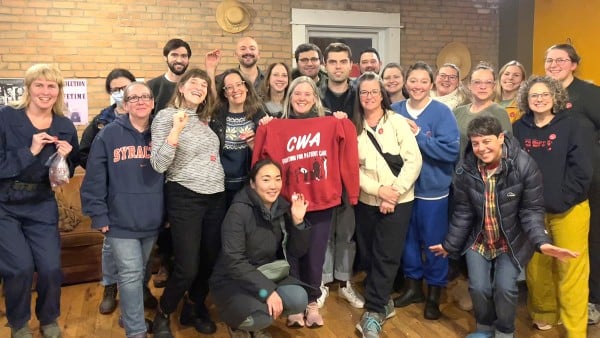
Nurses at Cayuga Medical Center in Ithaca celebrated the kickoff of their union, Cayuga United-CWA, last week. They have since had to file an unfair labor practice charge with the NLRB against hospital administration for subjecting them to a captive audience meeting.
Nurses employed at Cayuga Medical Center (CMC) in Ithaca will gather on the steps of the Ithaca Town Hall Saturday morning to share their concerns regarding working conditions in the hospital and to speak out against management’s alleged unlawful abuses of power, according to a press release issued by the Communications Workers of America (CWA) union today.
The press release alleges that CMC management is soliciting nurses to be their anti-union spokespeople, violating federal labor law. CWA, representing more than 350 registered nurses at CMC, filed charges with the federal labor board against the hospital on Thursday.
City of Ithaca Deputy Mayor and Common Council Member Kayla Matos, City of Ithaca Alderperson-Elect Jorge Defendini (Ward 1) and District 125 Assemblymember Anna Kelles are expected to stand alongside the nurses with Cayuga United-CWA at the gathering, scheduled to be held at 215 N. Tioga St. at 11 a.m. Dec. 20.
“Management continues to retain an anti-union consulting firm and is likely paying them hundreds of dollars an hour to run this brutal anti-union campaign, all while the hospital receives public funding and nurses and patients complain of short staffing,” the press release states.
Earlier this month, Cayuga United-CWA petitioned for union recognition after a supermajority of eligible nurses signed union authorization cards, indicating their desire to form a union with CWA. The nurses will vote to authorize their union in an election overseen by the National Labor Relations Board on Jan. 14 and 15.
Nurses say that they are organizing because of deteriorating conditions that impact both their working conditions and patient care. They claim that since the COVID-19 pandemic, nurses have seen increasingly short staffing, which can leave them caring for an unsustainable number of patients, compromising patient care and worker safety.
CMC officials reject the idea that patient care has worsened, pointing to the medical organization’s most recent patient safety score from the national nonprofit Leapfrog, which assigns letter grades to hospitals based on their record of patient safety in an effort to help consumers protect themselves and their families from errors, injuries, accidents and infections.
CMC receives a Leapfrog grade two times per year. Following its most recent evaluation, the hospital received its first “B” score in recent years. The improved score comes after CMC earned a “C” grade in every prior evaluation within the last three-and-a-half years, according to Leapfrog’s website, hospitalsafetygrade.org.
Nursing leaders and frontline nurses played a central role in the improved score, the press release from CMC states. “The Cayuga Medical Center nurses have created meaningful improvements in the quality of care we provide,” Dr. Debra Morton, RN, chief nursing executive, stated. “They have strengthened collaboration, communication with clinical colleagues and families, and reinforced consistency in how care is delivered. Their dedication and professionalism directly contributed to this improved Leapfrog score and, more importantly, to safer care for our patients.”
Moira Bulloch, senior campaign communications coordinator with the Communications Workers of America, said that the nurses at CMC are deeply dedicated to their patients and have worked hard to improve patient care.
“But the truth is that CMC nurses are doing more with less,” Bulloch said. “CMC nurses put their patients first, even when it means that their own needs come last, and this is not sustainable. Nurses need a union voice at the table to ensure that their needs are met so that they can continue to provide high-quality patient care.”
In a recent interview with Tompkins Weekly, Herb Alexander, Chief Human Resource Officer at Centralus Health, CMC’s parent company, credited the improvement to the hard work of bedside nurses in conjunction with leadership initiatives.
Alexander emphasized the importance of direct communication with frontline staff and the potential drawbacks of unionization, citing lack of flexibility and dues as issues.
“We believe that folks don’t have to pay dues in order to get the representation that they need and want,” Alexander said.
“There is some feedback we got around health benefits here that we were able to pivot and make changes on really quickly because of the feedback we got,” Alexander added. “When things are in a contract, it’s very difficult to be able to make changes, when you have a bargaining agreement. … So, the flexibility to be able to hear, respond and change can definitely be impacted with the union in place.”
Alexander also noted a projected 61,000-person health care worker shortage in New York by 2028. He acknowledged that securing adequate staffing at CMC has been difficult but said this is true of medical facilities across the region and not unique to CMC.
Roughly two months ago, CMC’s staffing committee, which by law is required to be 50% bedside nurses, voted against increasing nurse-to-patient ratios in one area — the fourth floor, which is the medical-surgical floor — from 1:5 to 1:6 during nighttime hours.
“We heard this in many different sessions with our nurses: The ask [to increase the number of patients per nurse] has people concerned … and that’s valid, right? That concern is valid. But the actual action, and what we decided to do, was not to increase those ratios,” Alexander said.
Kristen Wiest, a registered nurse in CMC’s emergency department, said that CMC would likely not experience its current level of staffing issues if it treated its employees better. She said that there is high turnover, leading to frequent training sessions that monopolize nurses’ time. She also described a hostile work environment inflicted and perpetuated by CMC’s leadership.
“We come into the emergency department sometimes with over half of the patients being held over from the night before,” Wiest said. “By noon, now our waiting room is overflowing.”
Wiest said that the plan to increase in the nurse-patient ratio on the medical-surgical floor was designed to alleviate the burden on the emergency department. She said that the plan was to add an additional patient to the nurses’ workload on the fourth floor when the emergency room was backed up.
“It’s almost like a divisive tactic,” Wiest said, “in that [the administration is saying], ‘Well, the emergency room nurses say they need people out of the ER, so you have to take the brunt of it’ — and that’s not what we’re asking for. We’re asking for everyone to have safe staffing, not just the emergency room … not just the OR. Everyone.”
She said that sometimes nurses go a whole 12-hour shift with very little time to rest, watching their patients receive three meals over the course of the day while they get just one 30-minute break.
The supermajority of nurses seeking union affiliation are collectively echoing complaints that they are overworked, overwhelmed with too many patients, and not given adequate break time.
Wiest has been in her current position with CMC for a little over two years and was in the same position at CMC 10 years ago; she had been on staff for two years the first time CMC attempted to unionize, with a different union. She took a break from emergency room nursing for several years and returned to CMC in October 2023.
When she returned, she said she observed that staffing had decreased, while the number of patients in the emergency room had increased.
“Some days, we’re staffed better than others; however, I would say generally, on a week-to-week basis, we’re not fully staffed all day, every day.”
Nurses claim that CMC held an illegal meeting on Dec. 8. They have filed an official claim against the medical center for holding a captive audience meeting in violation of federal labor law.
The nurses say that during this mandatory meeting, a department director read a script of anti-union messaging that was purportedly prepared by the CMC legal department. Workers were allegedly reprimanded for speaking up to share their support for their union.
On the advice of CMC’s attorney, CMC officials declined to comment on the specifics of the alleged meeting, though they said that CMC received the complaint from the National Labor Relations Board and responded in accordance with the law.
CMC has hired an outside consulting company, Labor Relations Institute (LRI), which Alexander said provides voluntary education sessions to both CMC leaders and other hospital employees.
Wiest said that the meetings are held constantly, multiple times per day. She found them to be disruptive; she attended one on her own time and said she cannot imagine a nurse being in the right mindset to return to work after sitting through one of the hour-long meetings during a shift.
“I felt like they’re trying to bring in a level of confusion or uncertainty,” she said. “I feel like they’re speaking half-truths. I don’t feel like I would have wanted to go back to work.”
Wiest said she is concerned for her coworkers who might leave the meetings feeling frazzled. “They’re not as prepared with all the facts as the people who read the [anti-union] scripts are, and so it can become a moment of question,” she said. “However, that being said … I don’t think it’s working. I do believe that our nurses are standing strong.”
Alexander said it is important to remember that CMC has a mission. “That is making sure that we improve the patient care and well-being of the communities we serve,” he said. “So, that’s the core of it. Regardless of where we land, that’s the most important thing to focus on.”
Author

Related Articles

Street Beat: What are you looking forward to in the new year?
We asked five random people. Here’s what they had to say.

5 things to do in Tompkins County this weekend
Plan your visit and discover what’s happening this weekend.