
City council members react to encampment cleanup as a longer-term plan develops
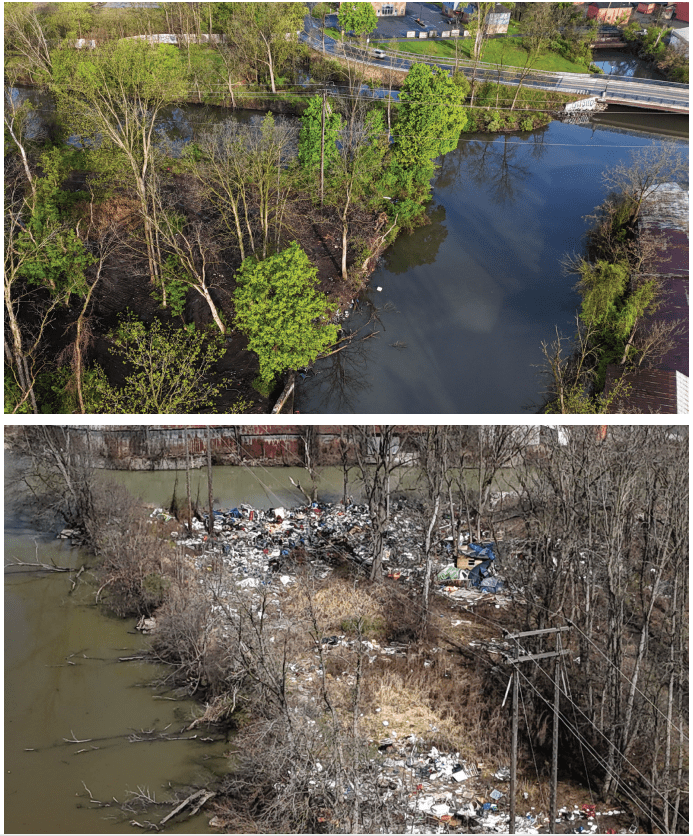
The homeless encampment on Cayuga Lake near the train tracks and Cecil Malone Drive has been cleaned up, and the results are pretty dramatic. What was once a sea of trash that reportedly included shopping carts and hypodermic needles is now a mix of grass and freshly raked soil, though the long-term environmental ramifications of the encampment remain to be determined.
The transformation of the property occurred after Tompkins County issued notices of violation to both the city of Ithaca and Watco, the company that manages a portion of the property owned by Ithaca Central Railroad.
The letter to the city was sent by Elizabeth Cameron, Tompkins County director of environmental health, and was addressed to Deb Mohlenhoff, Ithaca city manager. The letter only addressed the county’s environmental concerns regarding the encampment, but there were a host of other problems with that area, including the safety of the people camping there. The site and two other encampments in Ithaca are collectively referred to as “the Jungle.”
“I’ve seen firsthand how people are struggling there,” said Patrick Kuehl, Ithaca Common Council alderperson for the 4th Ward, who said he has worked in the Jungle since around the year 2000 as an emergency responder. “We have to think about the people in our city. We have to make sure they have the opportunity to succeed and that we’re not making their lives even more difficult than they already are.”
Kuehl said that emergency responders have an “inherently dangerous” job, and the encampment, which has no lighting and is very challenging to access, is a highly difficult and dangerous area to respond to.
“We want to make sure, from the city’s perspective, that we minimize the risk to first responders,” he said, adding, “we need to think holistically about how to approach problems in the city.”
Kuehl also said that the county and city have been working more closely to develop a plan to address homelessness in Ithaca. “I’m happy there has been a much more open line of communication since January,” he said, “and we’re actively working with them on solutions.”
The Tompkins County Whole Health Department has received a draft plan from the city regarding the cleanup and provided feedback on it, Lisa Holmes, Tompkins County Administrator, said Monday.
“The county is in close communication with city leaders on many aspects of the encampments/homelessness issue,” Holmes said. “Staff from the county and the city are engaged in collaborating toward longer-term solutions.”
“What was interesting in the sanction we received is it is not just talking about the area that got cleaned up,” David Shapiro, City of Ithaca Common Council alderperson for the 3rd Ward. “Elizabeth Cameron, she’s talking about it being a larger area that may present a public health nuisance in the future, and I’d really like to see us focus on some infrastructure improvements.”
While there was serious conversation at a recent Common Council meeting about the possibility of installing a fence, neither Shapiro nor Keuhl could say with certainty whether that is going to happen.
To increase safety in the area, Shapiro said that he is very interested in installing lighting and security cameras at the site, and he plans to bring that idea to the Common Council. The recordings would aid police in cases of suspected violence and arson, he said.
“The people that are living there, once you get to that type of living situation, you really have no other place to turn,” Shaprio said, “so many of them become revictimized.”
“Usually when there is a fire in the Jungle, it’s very rarely someone’s poor use of their own heating system,” Shapiro added. “More often, there is some kind of criminal element.”
Cameras could also cut down on crime at Nate’s Floral Estates, a mobile home park located near the encampment. “There have been nuisances in Nate’s Floral Estates,” Shapiro said. “I think we need to give the police force a tool. It’s impossible not to notice the rise in crime.”
Shapiro said that beyond the purely environmental fix, he would like to see the city work on outreach and building services for Ithaca’s homeless residents.
Shapiro said that ideally the area could be used for housing for the homeless. He said he is inspired by Second Wind Cottages in Newfield. “Homeless people have lived hard lives and need not just a place to stay and a roof over their heads but a little bit of space, nature, community,” he said. “If zoning allows, we could build 50 shelter cabins.” Shapiro said he does not believe that the city’s current zoning laws would allow for that type of development on the particular piece of land in question.
“So there’s hurdles,” he said, “but if you could fit something there and turn a place deemed a public health hazard into something that can help heal instead, I’m all about that.”
Author

Related Articles

Design details unveiled for new Center of Government
Design details for the Tompkins County government building in downtown Ithaca are now public, with a county survey open for feedback.

Holiday traditions bring community cheer
Tompkins County holiday traditions light up homes, farms, and schools with festive cheer and community spirit.

Cayuga Medical Center improves patient safety score
Cayuga Medical Center Leapfrog Grade rises to “B,” showing improved patient safety and nursing care quality.