
Code Blue shelter opens amid praise, concerns and ongoing debate
Ithaca’s Code Blue shelter opens with larger space, showers, and case management to help residents during cold weather.
A larger, improved shelter on Cherry Street opens for the season
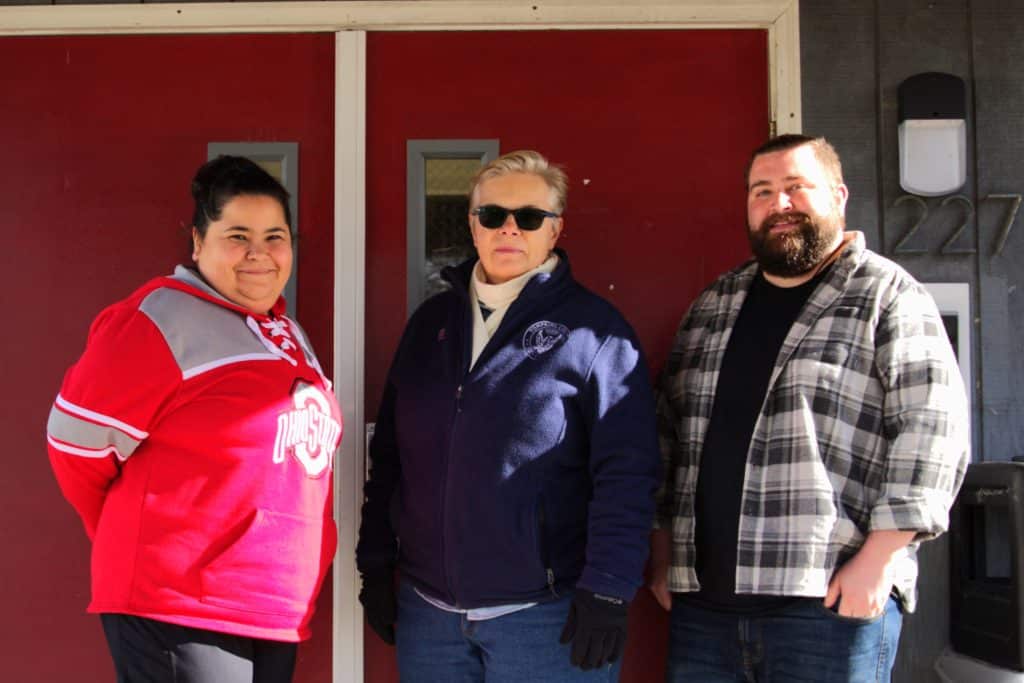
(Left to right): Lisa Barrett, Ithaca housing and shelter director at Volunteers of America, Anne Koreman, Tompkins County Legislator and Jonathan Goodhines, shelter services program manager at Volunteers of America, stand outside of the county’s Code Blue shelter on Cherry Street on Nov. 29.
Nov. 24 marked the first night that a new Code Blue shelter on Cherry Street opened its doors, at the former location of FOUND in Ithaca.
Code Blue is a statewide mandate requiring counties to provide warm, indoor shelter on nights when the temperature drops below 32 degrees.
This year’s Code Blue location at the county-owned former retail space is approximately twice as large as last year’s shelter, noted Tompkins County Legislature Chair Daniel Klein in a written statement issued to the public Nov. 20. The 7,000-square-foot building is slated for eventual demolition so the county can build a new, permanent 100-bed homeless shelter on the site. The new building will host the county’s Code Blue shelter as well.
“Unlike the previous shelter [on North Tioga Street], the bathrooms are fully inside, as compared to having a bathroom trailer attached to the building,” Klein elaborated in his statement. “This year’s shelter has showers — last year’s did not. The men’s and women’s sections are now separated in a more private way than they were previously. There is now another small room in the shelter that can be used to provide an extra space for any situations where a little additional privacy may be needed.”
Klein told Tompkins Weekly on Nov. 25 that the night before, 23 people were provided shelter at the new location, 227 Cherry St., though it can accommodate many more. Klein estimated it can hold up to 100 beds.
He pointed out that New York state’s Code Blue laws require counties to furnish a warm space only on nights when the temperature drops below 32 degrees, but the shelter will be open every day, regardless of weather conditions.
“Tompkins County is going well beyond the legal mandate to try to provide a safe and humane option for those in need, and to help them get out of their current situation,” Klein said in his statement.
The Code Blue shelter will be open continuously starting on Nov. 24 until April, even if outdoor temperatures do not drop below 32 degrees.
The county has increased the budget for the operation of Code Blue. The extra money is being used to keep the shelter open all day, as well as all night.
“This is the first year we have ever provided an all-day emergency cold weather shelter,” Klein stated.
Funding, contracts and long-term planning
Klein said that the county has entered into a $2.3 million annual contract with Volunteers for America, but $2 million will be covered by state funding. Tompkins County receives the highest amount of state funding for its Code Blue operations in all of New York state outside of New York City, Klein added.
The New York state government has indicated that it will provide less Code Blue funding for Tompkins County in 2027, probably because the state has realized its funding for Tompkins is so high, Klein said.
Food, storage and access to laundry facilities are provided at the shelter, and transportation will be provided on a limited basis to pick up people at certain locations who want to go to the Code Blue shelter.
Dogs will be accommodated as much as possible. “Dogs require an extra level of infrastructure and cost and raise potential issues about safety of guests and staff, flea infestations, and diseases such as rabies and parvovirus,” Klein stated. “If the shelter becomes infested with fleas, the entire shelter must be shut down for six days to clear the infestation.”
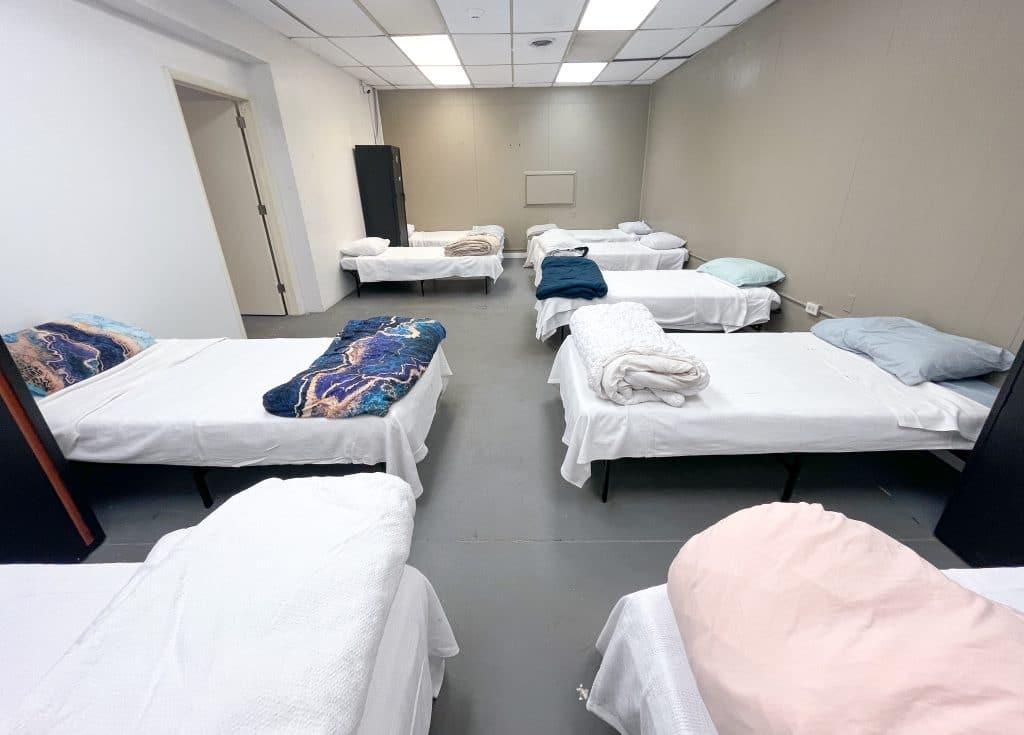
Open beds in the county’s newly opened Code Blue shelter, located at 227 Cherry St. in Ithaca.
VOA’s role and expanded support services
Another addition this year is case management, which will take place in the shelter and will be provided by Volunteers for America (VOA), the not-for-profit human services agency hired by the county to operate the Code Blue shelter.
VOA serves about 100,000 people per year. “We successfully work with people who are struggling with multiple challenges, including mental and behavioral health concerns,” states an informational summary about VOA that was provided by the legislature. “Using our model that combines safe shelter and supportive services, we are able to move people from crisis to stable housing and improved self sufficiency.”
“VOA is committed to operating the shelter safely and respectfully while maintaining open communication and collaboration with our neighbors and local businesses,” the agency added. “We appreciate the support and understanding as we work together to provide essential services to those in need.”
Community rally calls for more action
Members of the community came together for a rally Nov. 12 at Ithaca City Hall to send the message that they did not believe the county was doing enough for its homeless population.
With the new Code Blue shelter not yet open, the county had instituted a temporary fix of setting up homeless people in need with rooms at local hotels.
Those who organized the rally criticized the county’s methods and the lack of traditional walk-in shelters, saying that the warming shelter at First Baptist Church in Ithaca does its best to provide a warm place to stay but could not meet the community need that is supposed to be filled by the county.
“Currently, all we have really is the warming center [at the church] on Code Blue nights, and obviously they can’t stay all night,” rally participant Catherine Stone said.
Since Code Blue season began earlier this year, those seeking last-minute shelter were asked to visit or call DSS (Tompkins County Department of Social Services) in Ithaca during regular business hours or, during non-business hours, to call an emergency services number provided by the county to arrange for a room.
Some of the people protesting the lack of accommodations for the homeless stated that the emergency number went to the Tompkins County Sheriff’s Office. Some local unhoused people might, understandably, be hesitant to contact the sheriff, the county’s critics said. Klein told Tompkins Weekly last week that the protestors were misinformed and that the number actually went to the local 911 dispatch center.
“If you Google that number, it might say that it’s the sheriff’s office, but it’s not,” Klein said.
As for the protestors’ claims that unhoused people had to wait for a return call if they reached out for help via that number after regular hours, Klein said that is correct.
“If they didn’t have a phone, they would need to make their way to the Department of Social Services during business hours,” he said, adding, “Most people have phones. … If you don’t have a phone, you’d have to do your best to find someone who has a phone. … People are not usually wandering around by themselves. They have their own community.”
Klein also said that the protestors were incorrect in their assumption that the county currently has no permanent shelter available for those in need of a long-term stay. The county does not publicly disclose the location of its long-term shelter because it does not want to jeopardize the privacy and safety of its residents or the county’s relationship with the owners of the property, according to Klein.
At the Nov. 5 meeting of the county legislature’s housing and economic development committee, Brittanie Earle, Tompkins County commissioner of social services, reported that 43 people were currently staying at the permanent shelter location.
The Burger King “navigation hub” plan on backburner
The development of the new Code Blue location comes after nearly a year of planning with the city of Ithaca to create a resource hub/Code Blue shelter at the former Burger King, 100 Commercial Avenue, off South Meadow Street. Those efforts came to a halt last fall when, according to Klein, it became clear that the empty fast-food building would not be a feasible Code Blue site — at least not this winter.
Klein said that expenses kept adding up, and things came to a head when the county found out that the building did not have working heat or water. The water lines were found to be insufficient to support showers on site, he added. Klein said the county has offered to collaborate on what the city is referring to as a “navigation hub” at the Cherry Street site, but city officials declined. Klein said he believes that the city is attached to locating the navigation hub in the former Burger King because it would provide bathrooms within walking distance of the homeless encampment behind Walmart.
“The City will now need to reconsider its approach in light of the County’s timeline and budgetary concerns, which have ultimately brought the collaboration to a halt,” Ithaca City Mayor Robert Cantelmo said in a public statement Sept. 15. “As we always have, the City of Ithaca will contribute when called upon by the County and our partner agencies. But we also expect those partners to make good faith efforts to conduct their necessary due diligence and work together toward common solutions.”
“This decision comes a year after representatives of the County Legislature sat with me in a town hall with Nate’s Floral Estates and promised the residents to be good neighbors and not make a decision about the temporary shelter’s location without community input,” Cantelmo added at the time. “Irrespective of the logistical considerations at hand, this decision represents a walking back of that commitment.”
Community meetings with stakeholders
At the Nov. 5 meeting of the county legislature’s housing and economic development committee, Bridgette Nugent, deputy county administrator, said that on Nov. 4 the county held a successful meeting with neighbors and other stakeholders in the area of Cherry Street, as well as legislators and VOA staff members, to address concerns related to safety and security and provide an avenue for anyone in the vicinity to provide feedback on the operations of Code Blue.
“We received good feedback from that,” Nugent said.
“I do want to give a huge shout out to Volunteers of America and everybody who played a role, [including] DSS,” said Legislator Greg Mezey, chair of the Housing and Economic Development Committee. “I’m incredibly impressed with the professionalism, the organization, the responses to some very challenging and nuanced questions. I think as they continue to learn our community and get established here and build trust with both clients and community partners and our organization here at the county, I’m looking forward to it being a successful partnership.”
Klein echoed Mezey’s praise for the effort put into establishing the Code Blue shelter.
“When I look at the dedicated staff we have — both in the county and with our not-for-profit partner Volunteers of America, who are engaged in very difficult work — when I look at all the monetary and other resources we are bringing to bear to address people in need, when I look at the ways we go far beyond what is legally required of us, I see an organization that deserves congratulations,” Klein stated. “I am proud to be part of such an organization.”
Looking ahead: A temporary fix before demolition and rebuilding
The new Code Blue shelter remains a solution for this winter and next winter, Klein said, but after that the county will once again be faced with finding a new location while the FOUND building is torn down and construction of the new, permanent shelter begins. Klein said that the county does not yet know where it will host the next Code Blue shelter in two years. He said he hopes the county will not have to go back to using hotels.
“For a hotel, someone has to call and book the hotels, and it’s less desirable in that we can’t provide services because we don’t know where people are going to be on any given day,” Klein said. “There is almost nothing desirable about the hotels, so that’s our last choice.”
Author

Related Articles
Holiday traditions bring community cheer
Tompkins County holiday traditions light up homes, farms, and schools with festive cheer and community spirit.
The gift of an experience: Local businesses offer hands-on holiday fun
Holiday experience gifts in Tompkins County include candle making, gourd crafts, and pottery workshops for creative seasonal fun.