
Colleges grapple with constant change as fall semester begins
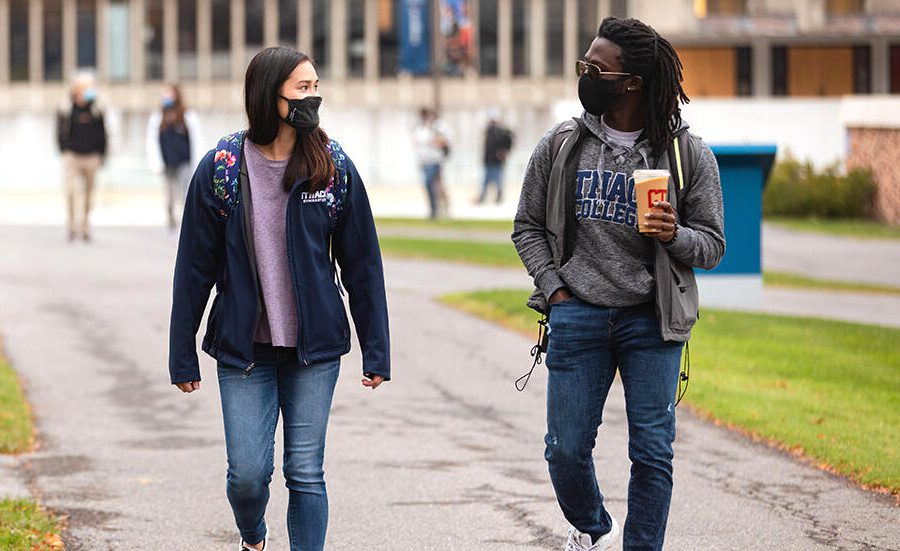
In spring, when college administrators looked to the fall semester, most expected a significant return to normalcy (see t.ly/JnJf), but as it has for many in the county, the Delta variant has greatly changed those expectations. Now, with students back on campus and some classes already started, administrators are working to ensure their campuses can weather the constant changes being thrown their way.
Changing policies
Late last week, the Tompkins County Health Department announced that Tompkins County is in the “High” transmission rate as defined by the Centers for Disease Control and Prevention, showing just how prevalent the Delta variant has become. Due to the increased risk, county colleges have had to rethink their policies surrounding things like masks, vaccinations and testing.
At Cornell University, for example, administrators have reinstated an indoor mask mandate for all individuals regardless of vaccination status. Students are also required to be vaccinated prior to the start of classes, with very limited exceptions. Vaccinated students will have to take a weekly COVID-19 surveillance test, and unvaccinated students must take a COVID-19 test twice a week.
“We weren’t planning on continuing our required surveillance testing of all who are on campus, but we are now going back,” said Joel Malina, vice president for university relations at Cornell. “The key to our success at this point is identifying and being able to isolate any asymptomatic infection. … Our hope is that as we are able to assess the prevalence of any breakthrough infections, we might be able to relax some of those requirements, or the opposite would be true as well; we might be able to come to the conclusion that we need to strengthen our protocols.”
Tompkins Cortland Community College has similarly switched to requiring everyone to wear masks while indoors. Deborah Mohlenhoff, associate vice president of college relations, described Tompkins Cortland’s testing policies.
“We’re going to still trying to maintain the surveillance testing that we were doing,” she said. “We’re offering it to anyone, but we will require that the unvaccinated population be tested weekly.”
SUNY very recently established its own mandate that students must be vaccinated to attend in-person classes, and Mohlenhoff said this policy was expected and Tompkins Cortland administration is prepared to enforce it.
Ithaca College, like Cornell, is mandating masks indoors and that all students be vaccinated, with very limited exceptions. Unvaccinated students will have to participate in surveillance testing once per week, and all students, faculty and staff will have to complete daily health screenings every day they’ll be on campus.
No campuses have issued a vaccination mandate for staff, but all are encouraging staff to get vaccinated. Sources said there has been considerable cooperation from staff so far.
“We’ve engaged in a concerted effort to achieve high vaccination levels among our employees,” said David Maley, IC director of public relations. “We’re approaching 80% vaccination rate among all employees who will be on campus for the fall. And for those employees who are not vaccinated, in addition to a daily health screening, they also have to undergo regular surveillance. We’re trying to incentivize our employees to be vaccinated.”
Effects on students, staff
Understandably, staff, faculty and students at area colleges are all feeling some of the strain from having to take several steps backward as far as pandemic progress.
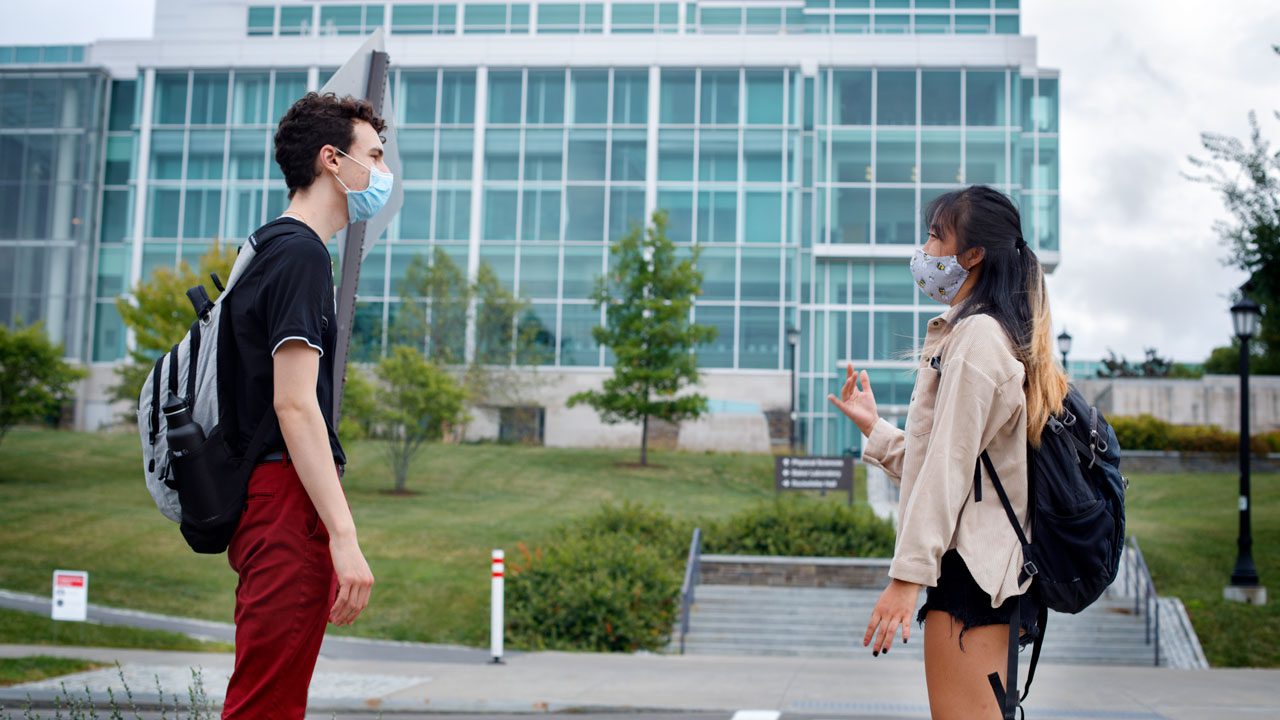
“There’s certainly some disappointment about having to go back to some of the restrictions,” Maley said. “But I think there’s the recognition that these are intended to help ensure that we, as much as possible, don’t have to institute any further restrictions, that we are able to have a healthy opening to the fall semester. … There’s a mix of apprehension and excitement. I think people are very excited to be able to have a learning and living experience for our students that [fits] their expectation for college.”
Mohlenhoff’s description of staff’s and students’ feelings is in line with Maley’s.
“I would say maybe if there’s one emotion that has risen to the top, it’s probably frustration,” Mohlenhoff said. “I think we’re kind of back to where things are changing all the time. It’s uncertain, you’re trying to put information out, and then you have to rescind it and put something new out when new guidelines or new information comes out. I would say people are pretty frustrated in trying to manage that.”
Malina also echoed the “frustrating” situation staff and students are in, but he, like Maley, has also seen some optimism.
“I’ve really enjoyed as I’ve walked around campus these last few days to see our students, and our faculty and staff, with, frankly, smiles on their face,” he said. “It’s a very exciting time. We recognize that all of the work that has gone into all of this public health planning and all of these protocols is, at the end of the day, enabling an in-person experience that will be rewarding and successful for all involved. So yes, it’s frustrating. It’s a little disappointing, but we’re looking beyond, at the positive aspects.”
Looking ahead
While sources agreed it’s hard to predict exactly how the situation surrounding the pandemic will change in the coming months, everyone is preparing for the unexpected.
“There’s always going to be challenges,” Maley said. “Certainly, the pandemic has presented us with many. I think we are prepared to meet those challenges. That’s the thing that I think we all have in our hearts and in our heads, is that we have considered what the challenges are likely to be and have prepared for them.”
Malina added that college administration is dedicated to continued collaboration with the Tompkins County Health Department and Cayuga Health System, which will further help the campus cope with upcoming hurdles. He said the college is better prepared now to handle those challenges than at the start of the pandemic.
“There is a large amount of appreciation for the work and the experience that we now have under our belts, that even with all of these challenges, today, we are in such a stronger position than we were at this point last year,” Malina said. “Now, would I love for vaccination rates around the country to increase? Yes. Would I love for the pace of the pandemic to subside? Absolutely. But we are going to focus on all that we can do based on the science to ensure a successful semester.”
Mohlenhoff said that she also expects Tompkins Cortland to face significant challenges related to staff’s and students’ mental health.
“I know there’s a lot of concern and worry about some of the spikes that we’re seeing locally,” she said. “So, I know that one of the challenges will be in making sure we’re all still figuring out how to take care of one another and keep everybody safe, given that the anxiety levels are back up again.”
In addition, one change expected to impact Tompkins Cortland, in particular, is the state’s very recent shift in leadership, as Kathy Hochul began her new role as New York governor just yesterday.
“It might help to stabilize some things a little bit,” Mohlenhoff said last week. “We might get more clarity coming out of Albany. SUNY’s done a great job of messaging and communicating to us. They were really on the front lines of keeping all the campuses safe last time. … But I assume that, in general, once we have our new governor, we will start to get a little stability and get better information coming out.”
A collective effort
All sources interviewed for this story said that the best way to ensure that the next semester goes as smoothly as possible is to have full cooperation from everyone involved, both on and off campus.
“We’re just reminding everyone that there is both individual and collective responsibility, that actions have consequences, and that positive actions have positive consequences and that we ask that they be respectful of one another in public health practices,” Maley said. “And that is how both the college community and the greater Ithaca community are going to continue to thrive.”
Malina expressed a similar sentiment, asking community members both within and outside the campus communities to “care for one another.”
“We have gotten to this point through a combination of public health protocol, but also compassion and support for one another and a recognition that your own individual actions are only part of the solution with regard to COVID,” he said. “It needs to be a collective responsibility to protect ourselves and to protect one another.”
For more information about campus policies, visit Cornell’s website at cornell.edu, Tompkins Cortland’s website at tompkinscortland.edu and IC’s website at ithaca.edu.
Related Articles
Street Beat: What are you looking forward to in the new year?
We asked five random people. Here’s what they had to say.

5 things to do in Tompkins County this weekend
Plan your visit and discover what’s happening this weekend.