Cornell at its Core
The university faces the future with values of openness and inclusivity in mind
This is the first in a three-part series about Tompkins County’s institutions of higher education. With articles featuring the speeches of three college presidents, made during the weekly meetings of the Ithaca Rotary throughout the month of February, future issues will include Tompkins Cortland Community College on Feb. 28 and Ithaca College on March 6.
By Jaime Cone Hughes
Managing Editor
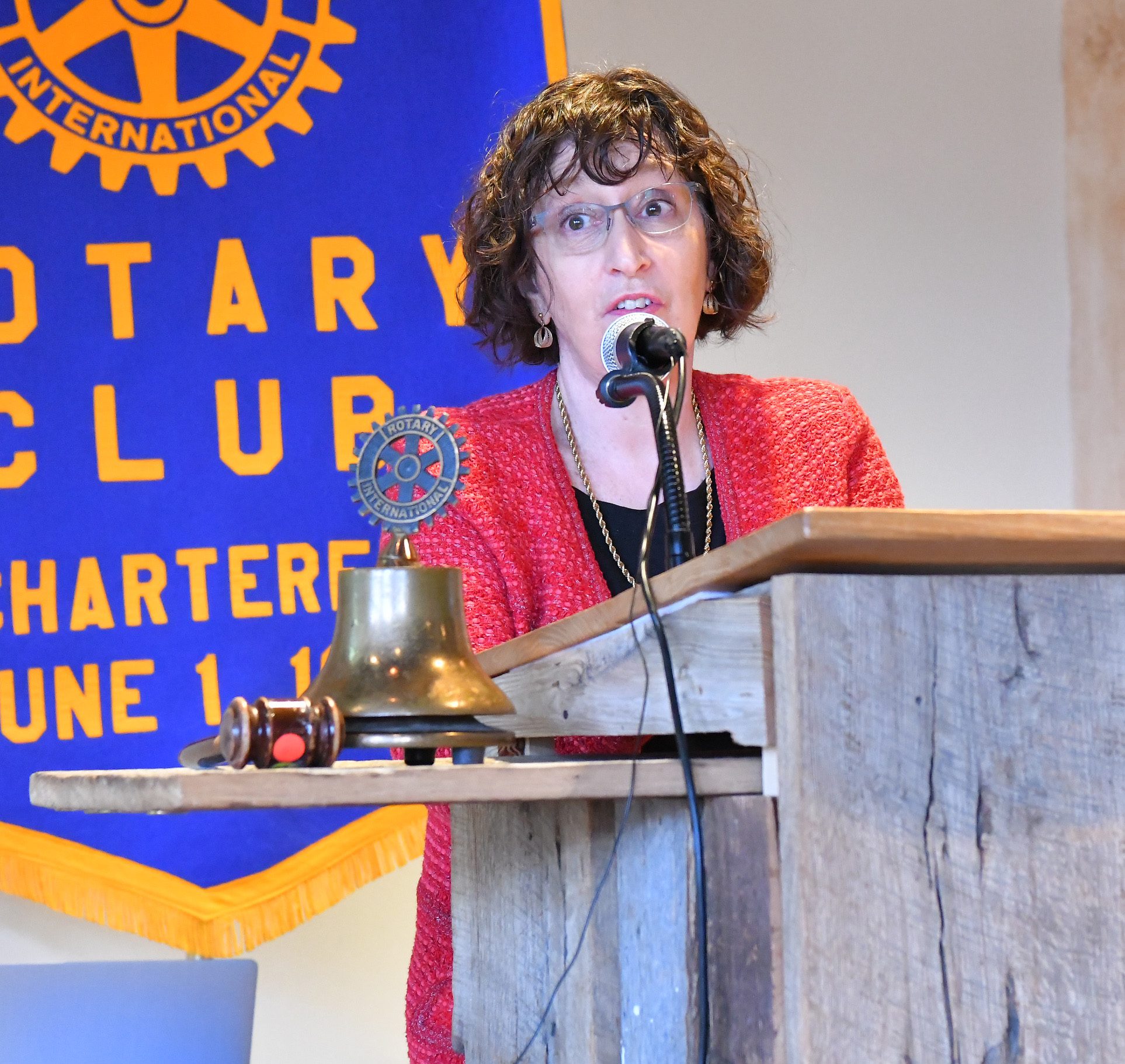
At the Rotary meeting at Coltivare in Ithaca Feb. 7, Cornell University President Martha Pollack said that the college recently adopted a set of core values. Pollack highlighted each value one by one and gave examples of the ways in which the university reflects them in its work and is striving to uphold them.
“Our core values are a reflection of our potential,” Pollack said. “They describe who we are and what we want to be — beginning, of course, with purposeful discovery.”
Purposeful Discovery
Cornell’s excellence rests on this first core value, Pollack said, as the faculty and staff at Cornell work to expand the boundaries of human knowledge and “deepen the understanding of our world in all its complexity and all of its beauty.”
Pollack said examples of faculty who demonstrate purposeful discovery in their work at Cornell include aerospace engineer Disha Sahni, whose research helps stabilize spacecraft so they can work smoothly even in extreme heat and cold, and Sara Bronin, who is a member of the National Advisory Council of Historic Preservation and works to bring history education, continuity and a sense of common identity to future Americans.
***
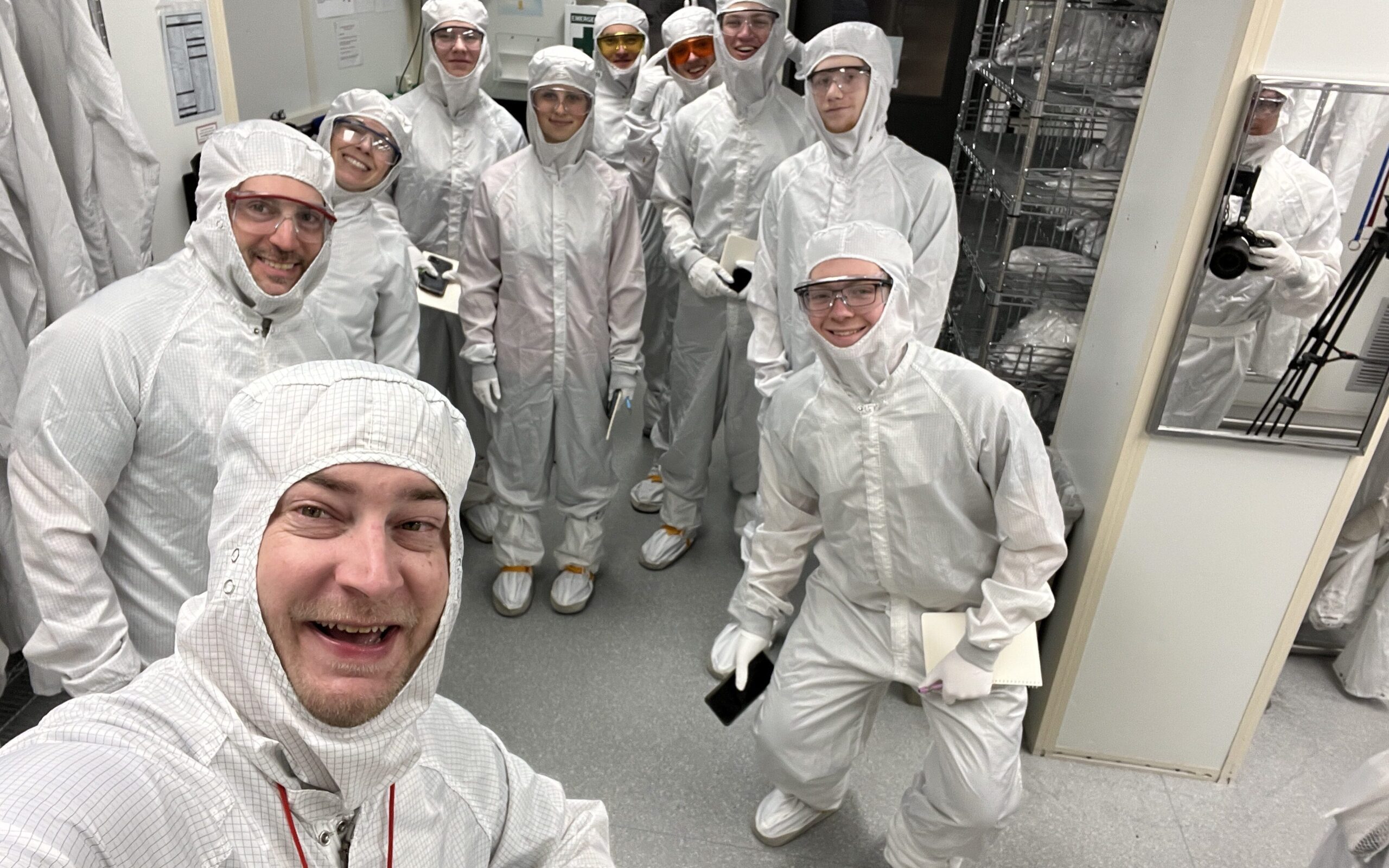
Illustrating many of these values is Tom Pennell, who works at the Cornell NanoScale Science and Technology Facility (CNF).
Pennell works at CNF in two significant roles: he is a member of the technical staff, and he trains researchers on how to use equipment and helps them develop innovative ideas that advance the state of nanoscale technology.
But he does so much more than that as one of the many Cornell faculty members incorporating purposeful discovery into his work every day. As he works to develop new technologies, his real passion is sharing his knowledge and skill with younger generations, and it all starts with capturing their imaginations and making a career in nanoscience feel possible.
Pennell does this through education and community outreach at multiple levels throughout Tompkins County. He works with college students at TC3, is involved with starting up a new program at TST BOCES later this month, and provides virtual tours of Cornell’s giant, cutting-edge clean room, finding ways to make it fun and engaging despite the fact that the children are not allowed inside.
Free and Open Inquiry
This academic year, Cornell has chosen to celebrate and explore the value of free and open inquiry through its university-wide theme.
“At Cornell, our goals are both to deepen our understanding of the issues surrounding expression and to provide opportunities to develop the skills essential to a civil society — skills such as active listening, leading controversial discussions and effective advocacy,” Pollack said. “We’re pursuing those goals in ways that reflect the breadth and the depth of our academic excellence and the diversity of our community, with invited speakers and panels who are exploring the foundations of First Amendment law exhibits, which you can go see, that explore how clothing, art and appearance can function as symbolic speech and expressive conduct.”
There are many activities planned for this semester, many of them open to the public, Pollack said, adding that many of them will be live-streamed. Visitors to cornell.edu/expression will find a complete calendar.
“I want to note that the title of our theme this year comes from the words of the late Supreme Court Associate Justice Benjamin Cardozo, who called freedom of speech “the matrix” — the indispensable condition of nearly every other form of freedom, because freedom of expression is indeed the indispensable condition not only of our academic enterprise but of our democracy, and as a university we believe it’s our responsibility to ensure that our students are exposed even to ideas that challenge them, even to ideas they find offensive or wrong, because being exposed to ideas that one disagrees with is a core part of a university education,” Pollack said. “It’s key to learning how to evaluate information and develop considered beliefs. It’s key to developing the ability to engage respectfully and productively in civil discourse. And it’s key to learning how to advocate for one’s own deeply held values.”
A Community of Belonging
“Cornell was created as an institution for any person, with an understanding that our teaching and our research — and indeed our society — all benefit from a university that welcomes many different kinds of people with many different perspectives and throws them all together, where they can learn with and from one another, and we honor that foundational commitment to diversity and equity and inclusion in many ways,” Pollack said.
In line with this commitment to creating a diverse community of belonging, this coming fall, most students from families with annual incomes up to $75,000 a year will pay no tuition, receiving no-loan financial aid, Pollack said, adding that Cornell is highly committed to supporting United States veterans and was recently named America’s number-one college for veterans by U.S. News and World Report.
***
Inclusivity even has a role at the Cornell NanoScale Facility.
“We do very cutting-edge research at CNF, but the unique thing at our facility is that it is open access,” Pennell said.
CNF has an open-door policy. That is not true of most other facilities doing similar work, said Pennell.
“The open and accessible nature of our facility is the most important thing that will contribute toward workforce development,” Pennell said. “We try to say yes to opportunity. That’s what we do.”
In 2023, CNF hosted over 4,000 visitors to the facility.
“We have all this expertise,” Pennell said. “We should be extending ladders downward to every educational group.”
This means he works with very young students all the way up to adults learning later in life.
Exploration Across Boundaries
“Exploration across boundaries is fundamental to our ability to address challenges that do not neatly fall into one area of study, which I think is just about all of the major challenges we face in the world today,” Pollack said.
The nanoscale technology programs Pennell leads and works in are a prime example of multidisciplinary application in action.
At the nanoscale facility, chips are created that are used in almost every aspect of everyday life.
“These chips are everywhere,” Pennell said. “They are in your TV, your phone, your car, your computer. They perform a lot of the computer tasks we need for our current life to be at the state that it is.”
The chips are so ubiquitous that more skilled engineers are needed to make them, and Pennell recently partnered with high school educational program Tompkins Seneca Tioga BOCES.
“I think the trades that come out of the BOCES program are fantastic, and I thought maybe we can build there,” Pennell said. He is partnering with BOCES to start a specialized program at the end of February.
To create the kind of tiny chip found in a smartphone, the devices being used are incredibly small and incredibly sensitive to the purity of the gas used, he explained. A special type of welding expertise is needed.
“All of the BOCES programs in the surrounding area have a welding program,” he said, “but none are offering this ultra high purity gas line welding program.”
Changing Lives Through Public Engagement
“We have a mandate to take what we do here out into the world,” Pollack said.
Cornell does this through the work of the Ironhorn Center for Community Engagement, she said. The center connects Cornell faculty, students and staff in many ways, including through the college’s pro bono reentry legal assistance program, a partnership with the Cornell Law School that helps clients review and, when possible, seal nonviolent criminal records “to ensure that [those with such records] aren’t held back in their lives and careers by records that may be inaccurate or decades old.”
***
In his role as outreach coordinator, Pennell invites junior high school and high school students to visit the campus.
Last year he hosted three “chip camps,” with 120 junior high school children from Syracuse attending each one.
The students are too young to be allowed in the clean room, where much of the high-tech engineering takes place, but Pennell has developed some creative workarounds.
“We converted the Duffield Hall Atrium into a nano-extravaganza,” he said. The students take a virtual tour of the clean room, engage in other science activities, and wear cleanroom suits so they can pose for selfies in front of an 8-foot-tall poster that makes it look like they are in a clean room.
“These are amazing experiences for the students and the staff,” Pennell said.
“My favorite thing when we do outreach — that quote that I look for — is ‘that’s so cool,’” he said. “That’s my paycheck for the day. That’s how I know I nailed it. I inspired them.”
Respect for the Natural Environment
“We continue to move forward in our goals of carbon neutrality on our Ithaca campus,” Pollack said. “Personally, I’m very excited about our planned new 110-megawatt solar voltaic project, which is in Batavia, New York. Once it goes online, it will bring us to a critical milestone in our sustainability goals, meeting the electricity needs of our Ithaca campus with 100% renewable energy.”
Pollack also mentioned Cornell’s earth-source heat project. She described it as an “ambitious plan” to heat the campus with hot water and said that the college has dug a test hole, with the initial data looking very promising.
Moving Forward in Today’s World
“Before I end, I want to note that over the last few weeks, and actually few months, we’ve seen higher education in the news for reasons that reflect much larger tensions, both nationally and globally,” Pollack said. “As we grapple with these tensions, especially those that arise between our Cornell values of free expression and being a community of belonging, it is tremendously important that we not lose sight of the vital role that higher education, not just at Cornell but higher education broadly in this country.”
“Higher education today is facing gale-force political whims in a sped-up political culture that moves from outrage to outrage with little space for reason, discourse, consideration or debate — the very things we value most at universities,” Pollack said, “and yet universities like our own must push back against that with clarity and resolve, with intellectual humility and with an openness to always improving.”
Author

Related Articles
AmeriCU proudly connects students with annual scholarship opportunity
AmeriCU scholarship program awards $1,000 to students pursuing college or vocational education. Applications are open through March 15.
Trumansburg schools consider regionalization as TST BOCES plan advances
Trumansburg school regionalization remains undecided as TST BOCES outlines goals for shared services and student learning.