
Cornell class studies sediment accumulation in Lake Treman
By Jamie Swinnerton
Tompkins Weekly
Before Cornell University Associate Professor Tom Whitlow will take on a project for his Restoration Ecology class it must meet several requirements. It must be complex enough to be interesting to the undergraduate and graduate students that are taking the class, it must be simple enough that its goal is not to save the world, it should be relatively close to campus, and the client must be interested and engaged. For last semesters class, Whitlow found a project that checked all of these boxes.
Through a connection with a former student, Whitlow was approached by the regional director of the New York State Parks and Recreation Department and asked to study the sediment buildup in Lake Treman behind the dam that makes up the lake’s north point in Upper Buttermilk Falls State Park. After accepting the project Whitlow and his students got to work.
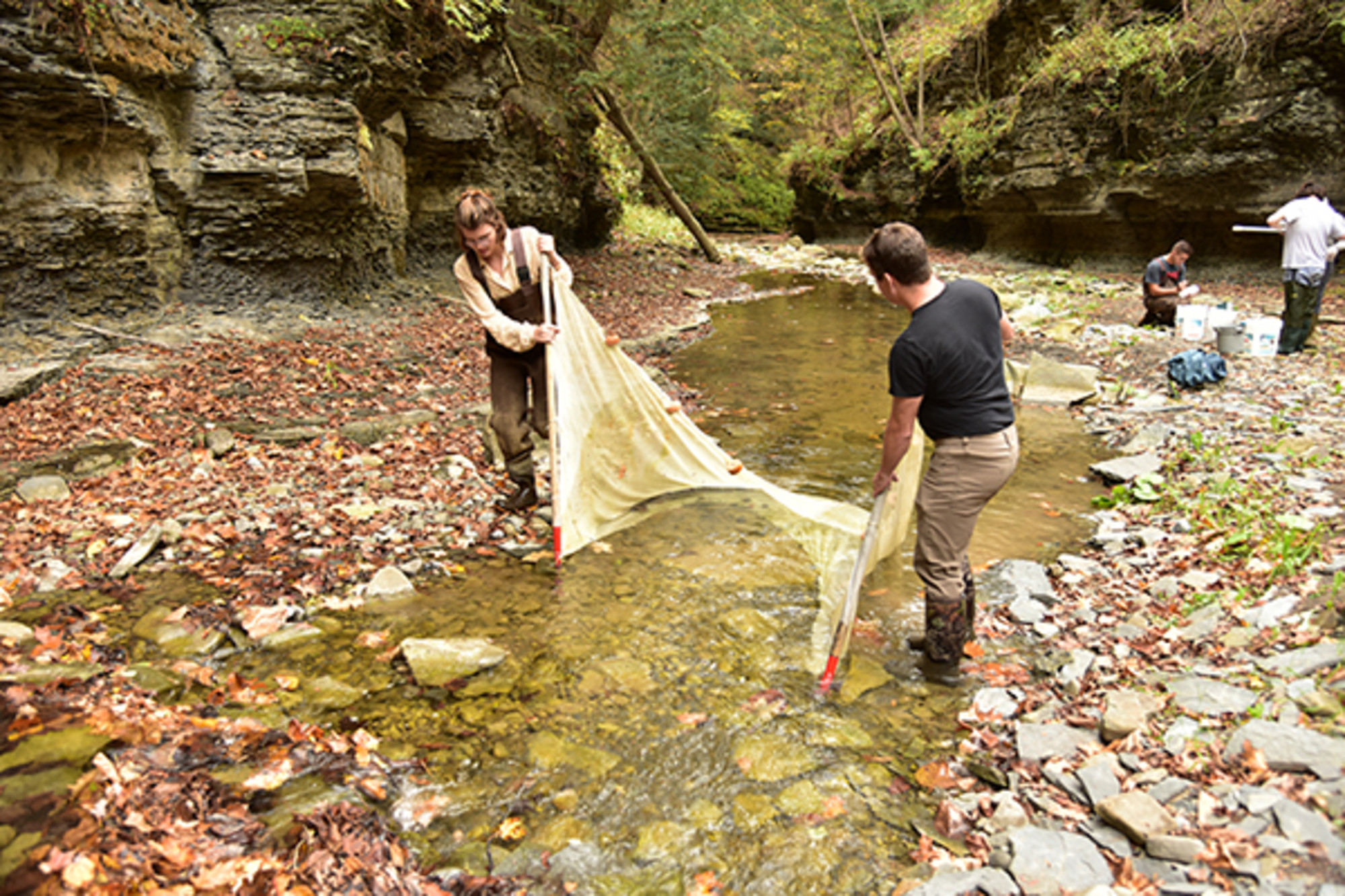
“I think students remember things and get a lot more involved and feel empowered,” Whitlow said of the advantages of bringing his students into a project like this. “This is not a recipe or a lab exercise, this is something that we sort of make it up as we go. We have some initiating things that we’re interested in, we listen to our clients and see what they’re interested in, and then that primes the pot and then I will add in other things.”
The experiential learning aspect of the class isn’t something you get in a lot of other classes, said Audrey Stanton, Whitlow’s teaching assistant for the class.
“This is a chance for students to see if this is the career path they would like to take, or if this is something they see themselves doing in grad school,” Stanton said. “To actually try it out and learn from someone who can instruct them in how to do it properly is a wonderful opportunity.”
Whitlow said that right now he and Stanton need to do quality control on the report before it can be printed and distributed to the students and the stakeholders at the state level. They have all the pieces, Stanton said, those pieces just need to be compiled into a nicer format.
“They’ve gotten thousands of pictures from us that have informed their gross understanding of the site,” Whitlow explained what has already been given to the state parks and recreation department.
Birdseye view footage and pictures of the lake have helped give the parks department a much better understanding of what the lake looks like, as opposed to a ground level view that is obstructed by weeds and cattails. Initially, Whitlow said the parks department wanted to know more about the stands of phragmites and Japanese knotweed (an invasive species in the area) because the department had received money to learn more about the Japanese knotweed problem.
“We gave them a lot of information about that or a lot of data on that. Data has to be interpreted in order to be informative, so whether they were completely satisfied with what we gave them I’m not sure,” Whitlow said.
Along with using this information to check whether the parks department missed any areas of Japanese knotweed that they can control, Whitlow said the information will also inform the department’s decision of whether to decommission the dam. Although the team did not do a structural analysis of the dam, their report includes information about the weight of water and sediment behind the dam.
Tanvi Naidu is doing her graduate studies in environmental engineering. While taking Whitlow’s class and working on the Treman project she worked on learning more about the sediment buildup. By analyzing historic maps of the lake and comparing them to current maps she could figure out roughly how much sediment had been added to the lake since the dam was built.
“My analysis was what figured out how much time it’s going to take until the lake fills up,” Naidu said.
She believes it will be about 50 years until the lake fills with sediment and becomes a marshy wetland. But, this is only an approximation. The historic maps of the lake are not as detailed as current maps, and the path of the channel has changed a lot over the years. Several factors, like the possibility of an increase in the frequency of intense storms, were not taken into account.
“There’s a pretty big margin of error in that estimate,” Naidu said. “But, I think it’s fair to say in more or less 50 years we could expect the lake to fill up with sediment.”
Hydrologically, Naidu said the lake is not stable, it continues to change as more sediment is being added.
Part of this instability is due to what the parks department were initially interested in learning about: invasive plant species in the area. Plants like Japanese knotweed can cause erosion upstream of the lake, adding to the sediment. Samantha Schultz, a senior in the plant science major, was a student leader on the vegetation team for the project and studied the invasive species like the Japanese knotweed in the Lake Treman area.
“A lot of what we were looking at with sedimentation and stuff like that, is the plants currently present help prevent erosion and if we change the vegetation that surrounds the area that could possibly inhibit some of the sedimentation that’s building up behind the dam,” Schultz said.
As a student leader, Schultz said she helped other students better understand some of the terminology related to the plants. She agreed that the project was a good way to get hands-on experience solving real-world problems. Although the team doesn’t know exactly how the state will use the information in the report, Schultz said she does know they have ideas about the invasive plant species problem.
“The state was mentioning they might want to try thinking about adding more native vegetation just to decrease the ability for invasive species to invade the area,” Schultz said.
What she wants people to know about this project, and ecosystems, in general, is that they change. But, sometimes that change is due to human influence.
“We’re definitely having an impact on this environment and this ecosystem and it’s not a dynamic system and it’s always changing,” Schultz said. “The more we know, the better we can try and approach the problem.”
Related Articles

5 things to do in Tompkins County this weekend
Plan your visit and discover what’s happening this weekend.


Tompkins Chamber announces Rob Montana as new vice president
Rob Montana, community leader and communications professional, has been appointed vice president of the Tompkins Chamber, where he will help drive economic growth, workforce development, and community engagement.