Cornell Prison Education Program celebrates grads
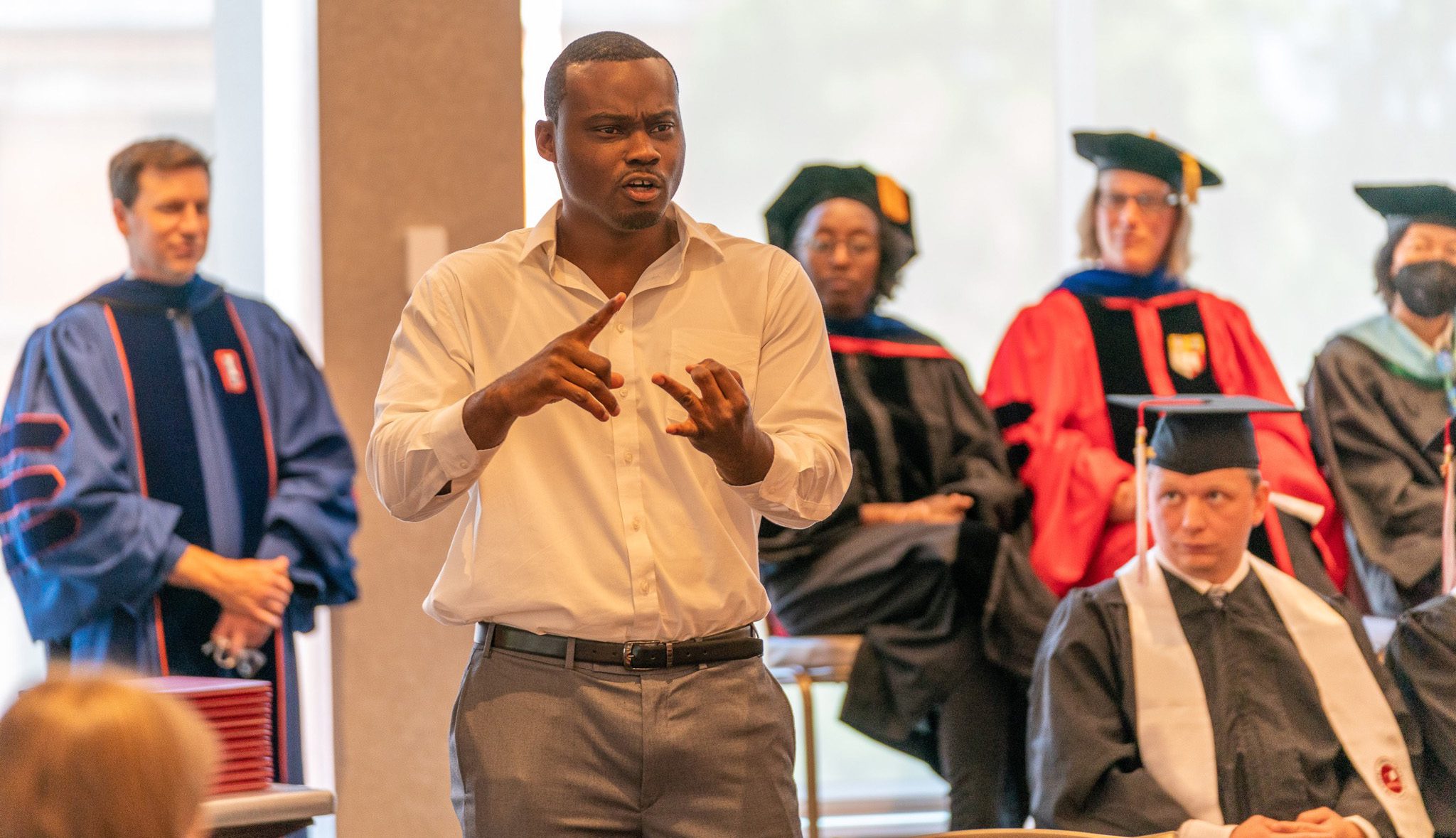
Earlier this month, 10 recent graduates from the Cornell Prison Education Program (CPEP) joined with family members and Cornell University faculty at the Statler Hotel ballroom on campus to celebrate the graduates’ completion of an associate degree and/or Certificate in Liberal Arts through the program.
Typically, CPEP’s commencement ceremonies are held in prison, but since pandemic safety protocols made doing so this year difficult, organizers opted for an on-campus event to celebrate CPEP graduates who were released from prison after the pandemic hit.
As those involved in the program explained, the ceremony not only served to mark a momentous achievement for graduates but also shine a light on a program making a big difference in so many people’s lives.
Rob Scott, executive director of CPEP and an adjunct assistant professor of global development in the College of Agriculture and Life Sciences, said that Cornell started its “college in prison” program around 2008, and at the time, it was nothing short of revolutionary.
“If you go back two decades or so, this work was really unheard of,” he said. “It had been really squashed by the 1990s-era set of bills, legislation that really tamped down on programming in prisons. So, [in] the early aughts, people would do this type of thing to try to get classes in prison, volunteer, bring in graduates and undergraduates to volunteer in prisons. It was really under the radar. So, the time that the program started really offering a degree in 2008 and on was kind of a turning point.”
Scott joined the program in 2013, taking over for its first director. At that time, CPEP was available in just one prison, where Cornell instructors taught classes and graduates could earn an associate degree through SUNY’s Cayuga Community College.
“Since that time, we expanded to the other three prisons that are programmable in our area by 2017,” he said. “And that was just the expansion of the associate’s degree program. Simultaneously, then we started to offer a Certificate in Liberal Arts from Cornell. And the reasoning there was that the students in the prison, of course, always saw so many folks from Cornell coming in and offering classes, tutoring, computer labs, conversation, and they weren’t getting a Cornell credential. So, a bunch of faculty got together at Cornell with me and others, and we launched a certificate program.”
Of the 10 graduates at this month’s event, nine received associate degrees by Cayuga Community College: Jonathan Istvan, Darryl Miller, Kenneth Rogers, Victor Saunders, Philip Taft, Angel Torres, Jeffrey Whitmore, Lamont Williams and Timothy Wyatt. Rogers and Miller, along with Michael Shino, also earned a Certificate in Liberal Arts from Cornell.
Over the past few years, the program has grown even more as support of prison education in general improved.
“Right now is the time when financial aid has been restored, so now, it’s becoming the status quo,” Scott said. “There have been a couple of bills, one in the at the federal level and another at the state level, to reinstate financial aid for people in prison. And people in prison can now get a Pell Grant from the federal government or a TAP grant from the state of New York to pay for tuition. We anticipate a lot more people wanting to be involved in higher ed in prison now that there’s money on the table for it.”
As far as what the programming looks like, Scott explained that while these are college-level courses, life for a CPEP student looks very different than that of the average on-campus student. For one, incarcerated individuals have far more restricted access to technology, so anything that would require high-tech equipment like science labs are out of the question.
Second, CPEP students don’t travel between buildings for classes like an on-campus student would. Instead, all classes are held in a single building at the prison, where about a dozen or so students gather and take classes together under the watchful eye of security officers.
One of the most notable differences actually has to do with addressing the needs of formerly incarcerated individuals once they’re out of prison. As Scott explained, the world outside of prison generally requires people to have at least an email address to progress, but incarcerated people, having little if any internet access, aren’t properly prepared for that transition.
“To be cut off from all that is this big blind spot of how we do corrections right now in America because you can give someone a great liberal arts education, you send them home, and they don’t have a cell phone, and they don’t have an internet device,” he said. “What does it mean that parole says they’re required to be housed or required to find a job, they’re required to find all the social services that they need to apply for? So, that’s not generally the college curriculum, but that’s an area that we’re often kind of pushed into.”
The pandemic further complicated the formatting, forcing staff to switch to providing remote classes and students to spread out even more than usual to meet safety protocols.
As for qualifications, CPEP used to have to be very selective with who it brought in, not because its standards were higher, but because there was such a large demand that, given the constraints the program was under, it simply could only fit roughly 15 to 18 people in the classroom out of dozens of applicants.
“Today, there actually is pretty decent coverage in New York for higher education in prison, so we’re getting closer to being able to say people who meet the minimum requirements to get into a SUNY associates degree granting program, which is what we partner with SUNY to offer, can get in, which is basically you can document the fact that you’ve got a high school diploma or high school equivalency degree, you’re in good standing with the prison,” Scott said. “That’s mainly it.”
Once an individual meets that requirement, their coursework is then determined based on their educational experience so far, which means that everyone often completes their degree at different times.
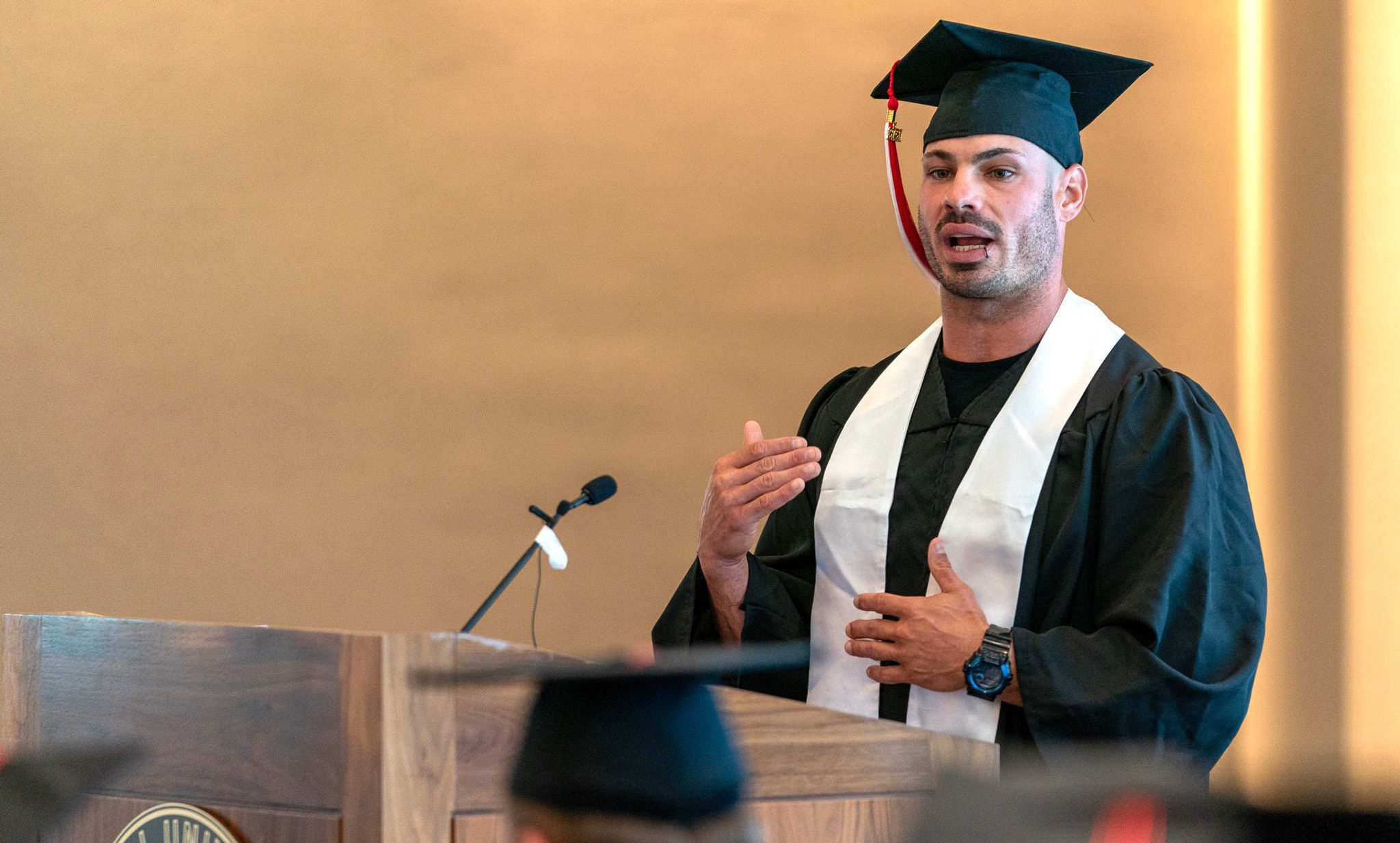
To hear it from program participants, as difficult as the process was compared to an on-campus experience, it was well worth it. Paul, for example, who spoke at the commencement celebration, said he joined the program because he “wanted to do things differently.”
“When I came home, I didn’t want to get caught up in that same revolving door, that same cycle that I’ve been a part of since the age of 15,” he said. “But, number two, I also knew that having a felony on my record are things, on paper, that enable people to judge me before they even get to know me. … But then I thought, with a degree, a degree is also a piece of paper, but it’s a piece of paper that will give people the chance to judge me in a positive light before they get to know me.”
Paul said that, even though at the time he was in a maximum-security prison, “every time I stepped into that classroom, I was no longer a prisoner; I was a student.” Because of the harsh conditions he faced while incarcerated, it was the little things, which many on-campus students take for granted, that he appreciated the most.
“One of the most important things CPEP taught me was the value of humanity, … someone treating you as they feel like they want to be treated,” he said. “I’m not talking about any extra perks, not talking about anything out of the ordinary that transpires in a regular classroom. We’re just talking about people treating people with respect.”
Since being released, Paul has taken on numerous roles, including that of a rapper, poet and lead intervention counselor for the organization STRONG Youth. He said his experience at CPEP was invaluable to getting where he is today.
“Constantly writing, thinking for academic writing, academic thinking, it [gave] me a different language,” he said. “It’s still the English language, but my ability to converse in different realms has increased greatly. Also, it prepared me for many different job positions.”
Rogers, a Rochester native, also shared his experience. Like Paul, Rogers joined CPEP for a break from prison life.
“I went there for the purpose to get out of the dorm, get away from the noise, and I walked into a room of 20 guys and a couple of TAs,” he said. “They were just having three or four different conversations, and I was vaguely familiar with what they were talking about. So, I just listened pretty intently. I realized that none of my homework, none of my reading was going to get done. That really wasn’t the place for that. It was a place to kind of build a little bit more, talk about the things that were going on in class, in the world and just kind of network a little bit. And I left there, and I was like, ‘This is amazing.’”
Because the program left such an impact on him and so many others, Rogers said he’s eager to see it expanded.
“It’s very few people who can go into a place like that and make something better for themselves or even realize that that’s available,” he said. “And so, the more opportunity that guys have to get an education, the more work that they find in themselves. And they need to be shown that because it’s easy to fall into a darkness, kind of go cold, the way people treat you in there. CPEP offers something different; they offer that opportunity. And with an expansion of the program, you have more positive interactions and continued education. I think that that is one of the things that people lack the most.”
Fortunately, expansion is coming, Scott said. He explained that Cornell is in the process of adding a bachelor’s degree offering through the program.
“Our hope is that in the years ahead, the part-time bachelor’s program that will be offered for off-campus students, nontraditional students, will be extended to the incarcerated students that are served by the Cornell Prison Education Program,” he said. “So, that’s not happened yet, but we anticipate in the next couple of years, there’s a very good chance that Cornell will be the first Ivy League school to offer a bachelor’s degree to people in prison. And so, that’ll be the next, kind of pinnacle of accomplishment for this thing.”
Learn more about the commencement celebration at tinyurl.com/22ab8raq. To learn more about CPEP as a program, visit its website at cpep.cornell.edu.
Jessica Wickham is the managing editor of Tompkins Weekly. Send story ideas to them at editorial@VizellaMedia.com.
Related Articles
AmeriCU proudly connects students with annual scholarship opportunity
AmeriCU scholarship program awards $1,000 to students pursuing college or vocational education. Applications are open through March 15.
Trumansburg schools consider regionalization as TST BOCES plan advances
Trumansburg school regionalization remains undecided as TST BOCES outlines goals for shared services and student learning.