Cornell releases anthology of 58 stories of the university’s international programs

From famous Chinese mushrooms to stories of travels in Nepal, there is a window into the world of almost every Cornell department, as seen through the lens of the college’s international studies programs, in “Beyond Borders,” soon to be released by Cornell University Press.
“I’m very happy and hope that many people are picking it up and find it as interesting as we do,” said Heike Michelsen, one of the book’s editors.

Michelsen was responsible for programming, assessments, communications and grant writing at Cornell’s Mario Einaudi Center for International Studies during the 16 years before her 2019 retirement, according to her biography in the book.
Prior to that, she was a senior research officer at the International Service for Agricultural Research, a member of the Consultative Group of International Agricultural Research Centers with projects across sub-Saharan Africa focusing on higher education systems, institutional partnerships and collaboration and institutional performance.
Michelsen has also served as a consultant to the Social Science Research Council, the American Council on Education in support of Higher Education for Development, and the Network for Agricultural Research for Development. She holds a doctorate in economics from the University of Hohenheim (Germany).
She contributed some chapters of her own: “A World of Knowledge for a World of Good: The Mario Einaudi Center for International Studies” and “Title VI Grants to Cornell: A Demonstration of Strength in International Studies,” to name a couple.
There are 58 different stories in the book, most written by different authors, though a few contributors authored more than one piece.
“Returning Mushrooms to China: Seventy Years of Safekeeping,” or “the mushroom story,” as it is commonly referred to by those who know it, was a coast-to-coast news story in 2009. As Colle explains in the book, the story began in the 1920s and concluded after seven decades when David Skorton, who was Cornell University president at the time, traveled to China to give back a mushroom collection that had been meticulously gathered by international Cornell scholar Shu Chun Teng on his horseback treks across China.
Michelsen said she enjoyed collaborating with the “fantastic team” that worked together on the book.
“There are so many vignettes in there, and many chapters, so anyone linked to Cornell could have an interest in it,” Michelsen said.
There are chapters about each of the different colleges, hopefully making the book appealing to a wide audience, including staff, students, alumni and potential students, she said.
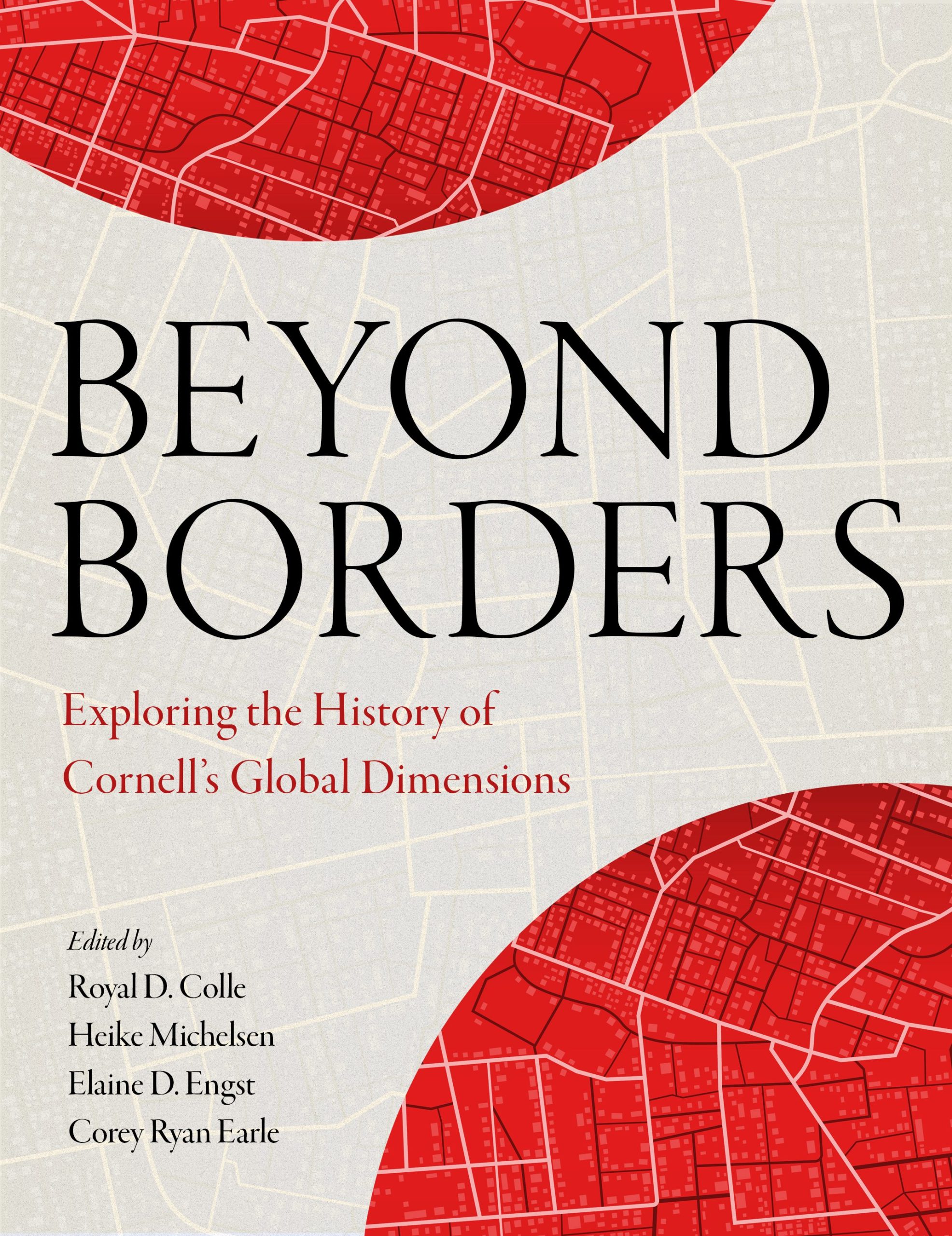
Michelsen said the project was the idea of Cornell history professor Royale D. Colle, who is also an editor of the book, along with Michelsen, Elaine D. Engst and Corey Ryan Earle.
Colle is a professor emeritus of communication at Cornell University, where he taught development communication for 40 years. He has worked on Cornell projects in India, Samoa and Guatemala and has served as a consultant on development communication projects in Africa, Asia and Latin America for many international organizations, including the World Health Organization, the World Bank, UNICEF, the Food and Agricultural Organization of the United Nations and the Ford Foundation, the book states.
He prepared two booklets for the UN on engaged learning that focus on teaching information and communication technologies for development. He received the International Communication Association Lifetime Achievement Award and is recognized on the Wall of Honor at the East-West Center in Honolulu, Hawaii, for his development work in Asia.
“There were a lot of history books written about Cornell, but nothing focused specifically on all the international engagement of Cornell,” Michelsen said. In 2021, the group that would become the book’s editors started putting their heads together in earnest to get the collaboration off the ground.
“It was, I would say, two-and-a-half years of really sitting down and conceptualizing the book, which included reaching out to all different kinds of stakeholders, so it was a whole process,” Michelsen said.
The book is not at all your traditional academic publication or journal, she added. Rather, it is composed of dozens of vignettes, all between three and 10 pages long.
“This book is quite comprehensive, in a sense, but it is still just a snapshot,” Michelsen said.
The goal is to showcase how much Cornell is and was international, all the way from its founding in 1865.
“We have drawn cases from the university’s earliest days up through the beginning of the twenty-first century,” Colle wrote in the book’s forward. “They examine the teaching and research programs, the international development projects and programs, the contributions of library and museum collections, and the experiences of students and faculty. The vignettes introduce some of the people involved in these activities and explore the institutional framework that fostered Cornell’s global dimensions. They highlight the diversity, accomplishments, and impact of many remarkable and pioneering activities both on campus and abroad.”
Michelsen said that she hopes readers find the book compelling and that the stories motivate people to pursue international relationships.
“We hope it is inspiring to others, to build institutions around the world and build these unique and beneficial relationships,” Michelsen said, adding, “No one is isolated anymore. Everyone is global and interconnected. The role of the education system is important in making an impact for a better world.”
Though Michelsen worked in the Mario Einaudi Center for 16 years, she said she finds it amazing to be reminded of how much she does not know about the different departments every time she speaks with a faculty member.
“There is so much depth in all different areas, everywhere you look,” she said. “Even though you think you know Cornell, you always find something new.”
Author

Related Articles
AmeriCU proudly connects students with annual scholarship opportunity
AmeriCU scholarship program awards $1,000 to students pursuing college or vocational education. Applications are open through March 15.
Trumansburg schools consider regionalization as TST BOCES plan advances
Trumansburg school regionalization remains undecided as TST BOCES outlines goals for shared services and student learning.