County health officials and doctors respond to increase in COVID-19 cases
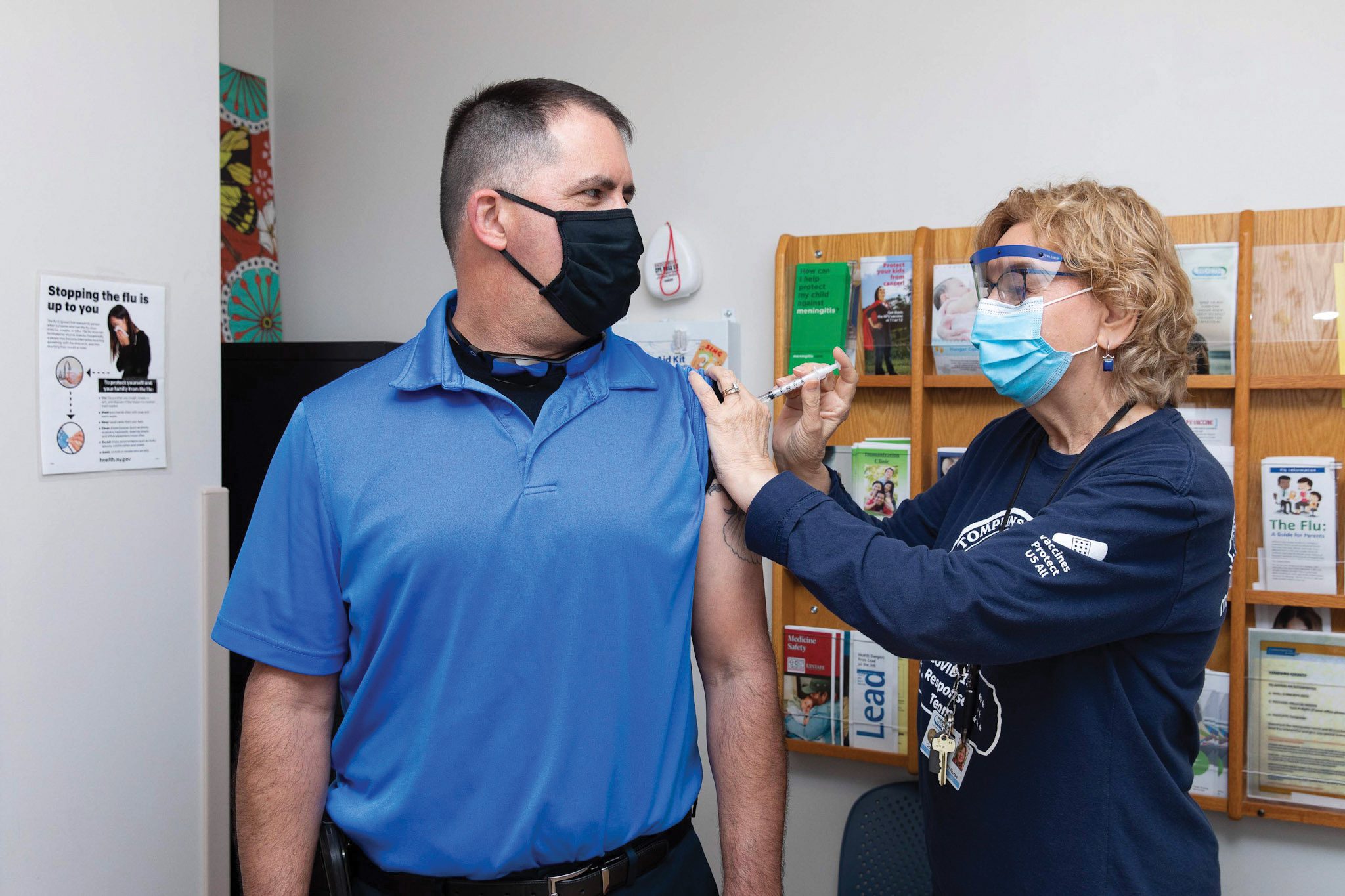
Tompkins County Whole Health’s Community Health Nurse Gail Birnbaum administers vaccine to staff. Photo by Sheryl Sinkow
Since early 2020, the COVID-19 pandemic has been in the forefront of people’s minds. Early in the pandemic, there were shutdowns and mask mandates. Vaccines were introduced in late 2020, but by the end of 2021 there was a new variant of the virus called Omicron.
Public perception of the risks associated with the virus has ebbed and flowed during that time. On Jan. 20, Tompkins County Whole Health sent out a reminder that COVID-19 is still here.
Following recommendations from the Centers for Disease Control and Prevention (CDC), the department elevated the community COVID-19 risk from low to medium, citing an increase in COVID-19 cases and fewer hospital beds available countywide.
The uptick in cases was linked by the CDC to a new subvariant of Omicron called XBB 1.5. The subvariant is more transmissible than other Omicron subvariants.
County Whole Health Commissioner Frank Kruppa said that while this is not a cause to panic, it is a sign that COVID-19 is still being spread in the county and beyond.
“It’s another reminder to the community that COVID is still with us. We’re encouraging, particularly individuals with underlying health conditions, to be cautious about where they go, and we encourage mask wearing,” he said. “We know the tools; we’ve been dealing with this for three years. COVID is still with us, and there are people in our community who are higher risk. We all have a role to play in keeping each other safe.”
Kruppa said that the community alert level is determined by the CDC by using three key factors: number of COVID-19 cases, new hospitalizations and percentage of hospital beds that are occupied in the county.
He said the week before the level was raised, fewer available hospital beds prompted the alert level to go up.
“I don’t know if I would say that this is an alarm necessarily or that things have changed dramatically,” Kruppa said. “It’s more about COVID is here, and our baseline is that we still have COVID cases and there are people in the hospital. If we have a small increase in cases, it can really impact the number of people that end up needing to be in the hospital.”
As of Jan. 26, the alert level for Tompkins County has returned to low.
Northern Region Medical Director for Guthrie Medical Systems David Ristedt agreed that data has indicated that the new subvariant has mutated in a way that makes it easier to infect people.
Ristedt said that it isn’t known for certain if the new subvariant is more deadly than other Omicron strains, but being fully vaccinated and boosted will help anyone who is infected with any strain of COVID-19 avoid the hospital or serious illness. In addition, he said, individuals who have underlying medical conditions should continue to take extra precautions.
“This is unfortunately, something that I think is going to become similar to the cold and other viruses, meaning it’s endemic and it mutates now and then. It’s an interesting virus in that it mutates quickly, more rapidly than the flu,” Ristedt said. “I think this is a virus we’re going to be dealing with for several years.”
When asked about wearing masks, Ristedt said he doesn’t think the level of infection has risen to the point where a mask mandate is necessary.
Still, he said that wearing a mask could be a good option for residents who have comorbidities such as asthma, COPD or any condition of the heart or lungs.
“I think we need to do what we need to do to protect ourselves,” he said. “I don’t think we’ll need a state or national mandate to go back to masks because it’s endemic within [the] culture today. If you’re going to a movie theater or a place where there’s a whole bunch of people you don’t know, you should do what you need to do to protect yourself.”
“Populations that have comorbidities or are visiting that population should do what [they] can to try to prevent someone from getting seriously ill,” Ristedt added. “I don’t know that we need to go back to mask mandates for everybody, because the Omicron variant and the coronavirus that we have, the vaccines are still reasonably effective.”
Vice President for Medical Affairs at Cayuga Medical Center (CMC) Andreia de Lima agreed that vaccines go a long way in preventing serious infection.
De Lima said she doesn’t want to downplay the rise in cases or the new subvariant, but she agreed with Ristedt that there are vast differences in how the public should deal with COVID-19 in 2023 compared to 2020.
“This is the way viruses work, it’s not new. The virus’s goal is to survive, so it becomes more transmissible so it can reach more people, and [viruses] usually become less virulent because for the virus to survive you have to survive as well,” she said. “There will always be some risk, especially with a new subvariant. What we can do is mitigate the risk.”
De Lima said that according to the CDC, someone who has received the bivalent COVID-19 booster is three times less likely to end up in the hospital than someone who received the initial vaccination but isn’t boosted.
She also cited numbers from the CDC that show that someone who has received any dose of the vaccine is 19 times less likely to be hospitalized if they get COVID-19 than someone who is not vaccinated.
“Even though it just started in September, there is good data to show that the booster is really giving protection,” de Lima said. “The recommendation is the best thing you can do to prevent severe disease is to get the bivalent booster.”
De Lima and Ristedt also commented on the effectiveness of COVID-19 in-home tests versus the polymerase chain reaction (PCR) tests administered at testing sites and hospitals.
Both said that the PCR test is more accurate, but a person who has symptoms or was exposed to someone with COVID-19 and tests positive with an at-home test can trust that they do have the virus.
If someone is experiencing symptoms but tests negative with an at-home test, de Lima and Ristedt said that person should confirm the results with a PCR test.
De Lima said that patients admitted to CMC are tested for COVID-19. She said that in some cases, a person may come in with, for example, a broken bone, but test positive for COVID-19, which impacts the hospital’s COVID-19 statistics.
She said for the last few months, CMC has seen five to 10 patients in the hospital with COVID-19 on any given day, and the hospital is still seeing those numbers, even with the new variant.
De Lima also said she doesn’t want to downplay the severity of the disease. Still, her hope is that in its next phase, COVID-19 is becoming a seasonal virus similar to the cold or flu virus.
“I’m always optimistic. I think we’re going to learn to live with it; I don’t think we’re going to be able to get rid of it. I think COVID is here, like many other viruses, to stay. I think we’re evolving in the way we live with it,” she said. “Outside of the health care setting, people really moved on from COVID and wanted to live their life, and I think that’s eventually the goal that we’re going to get to. Hopefully in the future, getting COVID is like getting the flu – if it happens, you get treated. You get better and move on.”
In the meantime, de Lima said people should feel free to live their lives while taking precautions when necessary.
“COVID is very different now than what it was in 2020,” she said. “The message is that the situation is evolving. We still need to be careful and do all the things we can to protect ourselves, but life continues, and we need to continue to live our lives to the fullest while being careful.”