
Dalai Lama Library opens at Namgyal Monastery
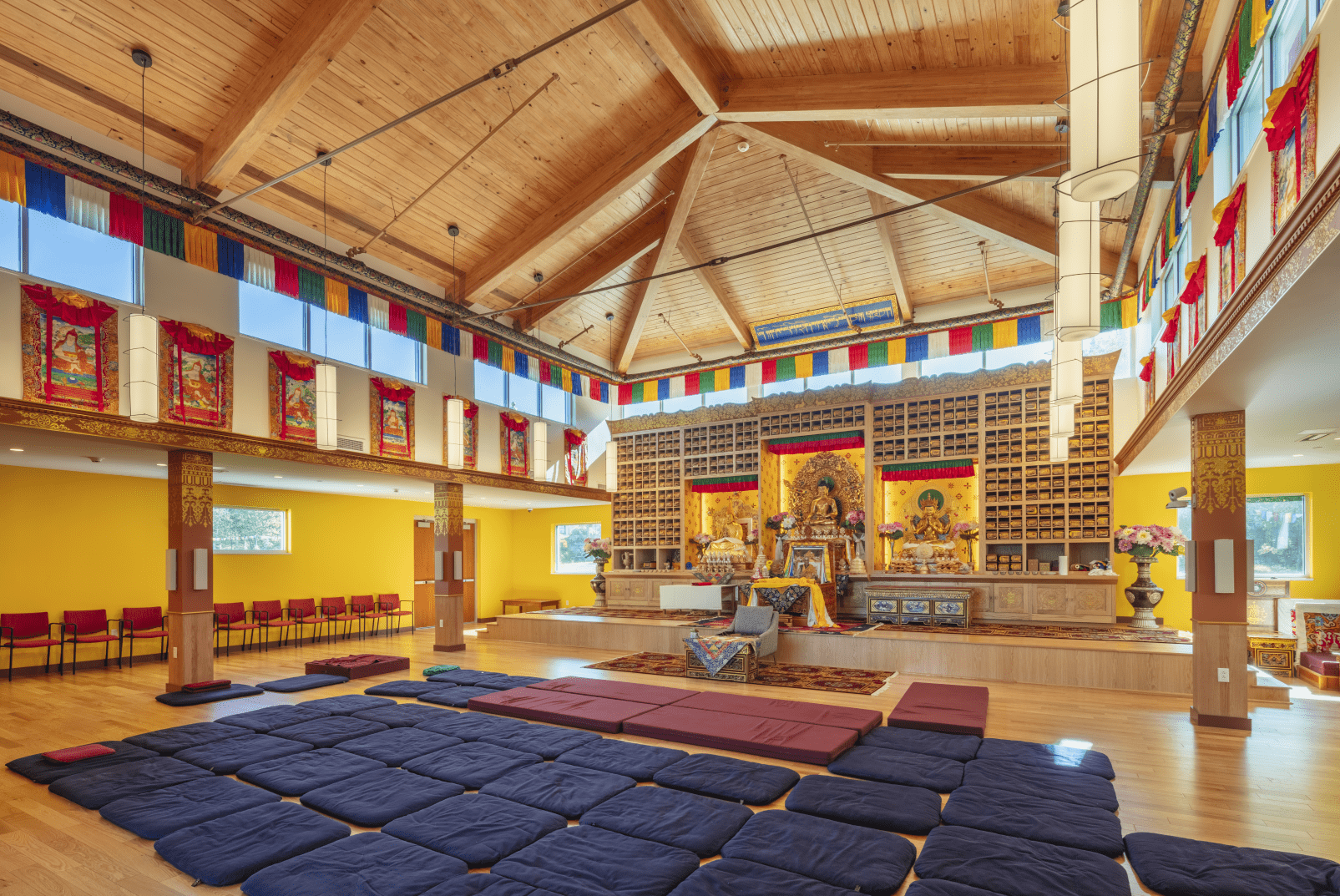
His Holiness the Great 14th Dalai Lama Library and Learning Center, the first library in the world created to house the books of His Holiness the Dalai Lama, opened with a ceremony inside the new building on the morning of Sept. 8 at the monastery’s Ithaca campus.
The library and learning center is an expansion of the already existing Namgyal Monastery Institute of Buddhist Studies, a 501(c)3 nonprofit organization that is the North American Seat of the Personal Monastery of His Holiness the Dalai Lama.
The great hall of the new building was filled with members of the public and donors to the project, with monks leading the ceremony at the front of the room. The large, open space was ornately decorated in rich colors, from the carpeted floor to the vaulted high ceilings.
“Buddhism is not just a matter of routinely reciting prayers,” His Holiness the Dalai Lama said in a remote message to the attendees. “It has to do with using our intelligence and wisdom to bring about a transformation in the way we think based on the three types of understanding drawn from study of scriptures, the conviction that comes about through reflecting on the meaning of what you have learned and experience of that gained through meditation.”
It was an emotional day for Tenzin Choesang, president of The Namgyal Monastery of Buddhist Studies and his holiness and the library and learning center, who spoke at the ceremony. He said on Friday that it felt good to see so many people in attendance.
“I was so, so happy to see all those people,” he said. “Happy and overjoyed. It was very, very crowded.”
He noticed that the room was filled with officials from the Town of Ithaca.
“Those official people are so kind and so passionate and really, really kind to us regarding this project,” Choesang said, “and also Ithacans are always supportive and so friendly, and I’m so, so happy that we did something for our community, especially Ithacans, and this is our main purpose: to provide something good for our community.”
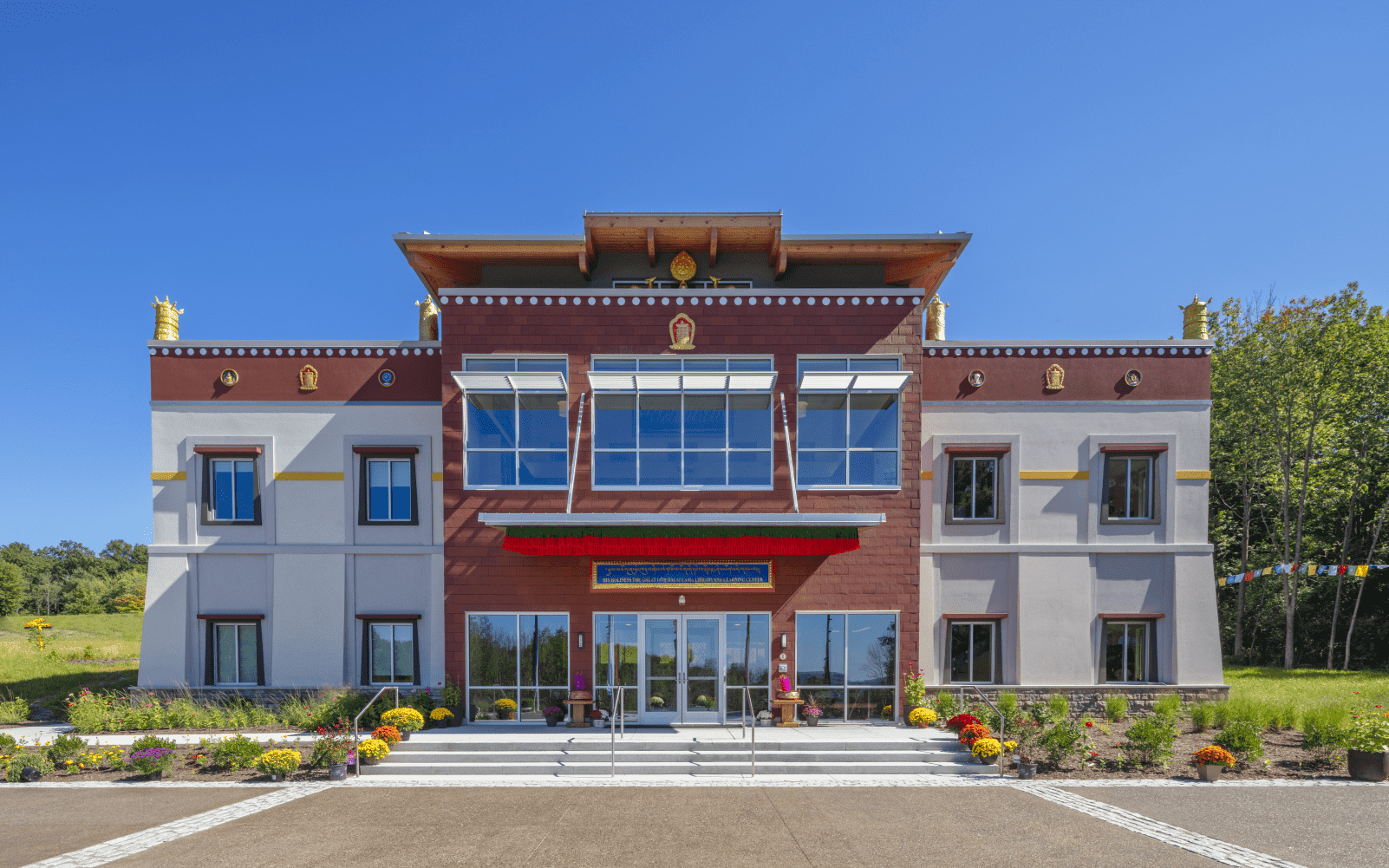
At the brand new 9,250 square-foot library, the monks presented yellow sashes to those who helped the project come to be, including Steven Hugo, vice president and principal architect with HOLT Architects in Ithaca.
Hugo said Friday that he felt honored to be a part of the unique project.
“Part of the mission of Namgyal is outreach and connecting to the world and the community,” Hugo said. “I don’t know if many Americans realize this is the only library in the world for His Holiness the Dalai Lama.”
Launched with the inspiration of the late Venerable Pema Losang Chogyen, a Namgyal monk, and several of his American friends, Namgyal-Ithaca was established as a branch of the main Namgyal Monastery located in Dharamsala, India, according to the Namgyal Monastery website.
The primary mission of the newly established Ithaca branch, established in 1992, was to offer Western students the opportunity to study authentic Tibetan Buddhism in a monastic setting, the website states.
Namgyal-Ithaca also serves as a cultural center for the Tibetan refugee community living in Ithaca.
Hugo said developing plans for the library was a very different experience than what he has become accustomed to throughout the years at HOLT.
“There is a very typical structure [to the development process], and that was not the case here,” Hugo said. “This was working with monks.”
“I never thought of myself as a corporate kind of person until I started working with monks on a weekly basis,” he added.
Meetings between the monks and the architecture firm began in 2016. Edger Enterprises, of Elmira, was selected as the contractor.
“We had interviewed a number of contractors, and there were much larger companies that pursued it, but Edger gave [the monks] a very special level of attention,” Hugo said.
Hugo said he realized that in every single project he has ever worked on, there was always an element of the budget—usually it is a big part of conversation right from the beginning.
“People are always trying to work against the numbers,” he said. “On this one, it was just like, ‘What does this project need to be?’”
Choesang said fundraising was at the top of the list of challenges.
“In a Western country, number one is fundraising,” Choesang said. “That is the most difficult part … especially during the pandemic. Of course, I understand everybody has their difficulties.”
Ultimately, despite the challenges, the monastery raised $6.5 million, which covered the entire cost of the project, Choesang said, adding that HOLT was “wonderful to work with.”
All through the development of different iterations of the building and the presenting of the plans and developing the first budgets for the project, the monks continued to reach out to donors until they eventually raised the money to move forward with the building they have today.
And the team at HOLT was very excited to be on the project, Hugo said.
“When we started the project, we did six different building designs,” he said, adding that the company had 15 people all working on the concepts to present to the client.
There was a point during the design phase when the client came back with a 10-page report of things that needed to be modified, but the message that came back from the Dalai Lama was simple.
“He said he had a tea leaf ceremony and that he had seen the future, and it was going to be excellent,” Hugo said, adding that those words kept HOLT’s employees going as they finished the project. “He was kind enough to recognize us, which felt good.”
“I think we found the sweet spot,” he added. “The building is intended not to be purely Tibetan architectural design. For me, it’s a riff on traditional Tibetan design.” While it has many aspects of a traditional Tibetan structure, it also incorporates some American characteristics, such as more light-filled spaces than a Tibetan building typically would have.
Hugo said there has been discussion of potentially adding retreat housing to the property’s 28 acres in the future.
“There could be some residences put in the woods with little walking trails behind the building,” Hugo said, adding that he is looking forward to collaborating with the monastery again.
Some of the design elements were completed in the last days and weeks before the opening ceremony.
“A couple of nights before, they were still putting up library shelving and books,” Hugo said. “All the stones in the meditative garden were laid out in a beautiful circular pattern the day before, which blew my mind. I expected them to bring in standard river stone or something like that; I had no idea it was going to be such a beautiful sculpture.”
One of Hugo’s favorite aspects of the interior is the hand-painted columns, which he said were completed over the course of just three weeks.
“To watch them paint the columns and the beams … it was so cool to see people mobilize like that,” Hugo said.
“I didn’t know what it was going to be, so it was really exciting to see how it developed,” Hugo said. “I don’t think I’ll ever have another experience like this again in my career. It really was a labor of love for us.”
Author

Related Articles

Holiday traditions bring community cheer
Tompkins County holiday traditions light up homes, farms, and schools with festive cheer and community spirit.

The gift of an experience: Local businesses offer hands-on holiday fun
Holiday experience gifts in Tompkins County include candle making, gourd crafts, and pottery workshops for creative seasonal fun.
Code Blue shelter opens amid praise, concerns and ongoing debate
Ithaca’s Code Blue shelter opens with larger space, showers, and case management to help residents during cold weather.