
Fernando de Aragón reflects on 27 years of local transit leadership
Fernando de Aragón reflects on 27 years leading Tompkins County transportation, emphasizing collaboration and sustainable transit solutions.
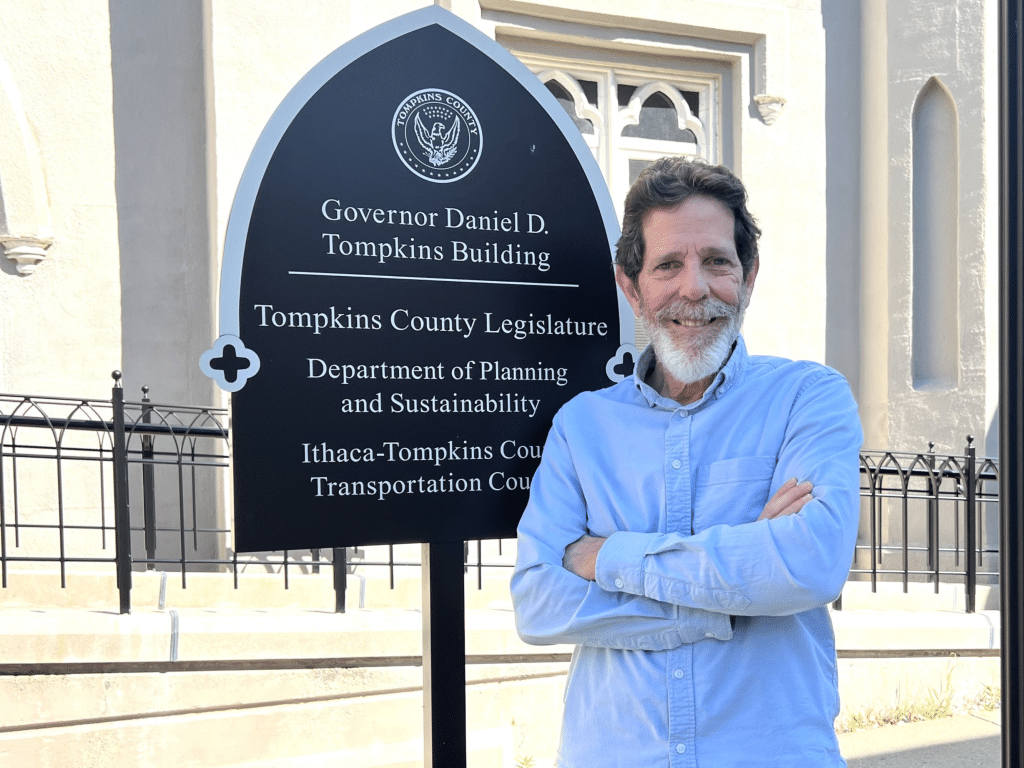
Fernando De Aragón outside the Ithaca Tompkins County Transportation Council offices on East Court Street in Ithaca.
In the world of American transportation, cars are considered king. No one understands this better than Fernando de Aragón, outgoing executive director of the Ithaca Tompkins County Transportation Council (ITCTC).
But that doesn’t mean it is impossible to strike a balance between automobiles and their alternatives, de Aragón said. It has been the great challenge of his career to help keep the roads and bridges paved and safe while also pushing for a more diverse transportation ecosystem that includes more walkers and bus riders, fewer SUVs.
“I really admire him for striking that balance, because he’s a passionate bike commuter and yet he fought for the safety of the entire network for everyone, the drivers and pedestrians and bikers — they were all given a good balance,” said Ray Burger, director of planning for the town of Dryden.
Leadership transition at ITCTC
De Aragón has been at the helm of the ITCTC for 27 years, and Tom Knipe, former city of Ithaca deputy director for economic development, is stepping in to take over the role starting this week.
“Fernando and ITCTC staff care deeply about their work and the role of the ITCTC. Working alongside Fernando this week has been a great orientation,” Knipe said.
“Fernando and I have known each other since 2009 and worked on several projects together over the years,” Knipe added. “Having a strong working relationship has certainly helped with a smooth transition. His legacy of collaboration and impact is something that I aspire to emulate and build upon.”
As de Aragón wraps up his career and reflects on his time as the head of the council, he takes a look back at what he has learned over the years and what he believes the county needs to do for a healthier, less traffic-ridden future.
The council itself, which is classified as a metropolitan planning organization (MPO), was created in 1992 and encompasses all of Tompkins County. MPOs can be created only for urban areas with a population larger than 50,000 people.
The council’s main goals are to assist in transportation planning and to help facilitate the obtaining of funding by the county for transportation-related services, he said.
“We’re maintaining process and moving paper and, you know, meeting requirements,” de Aragón said.
Securing funding — while collaborating
Helping different agencies — usually local governments and nonprofits — successfully complete grant applications is a crucial part of de Aragón’s job, and the council’s efforts bring in about $10 million per year. With the agency, the work pulling in federal transportation dollars would be done by New York state’s regional Department of Transportation office in Syracuse.
“Those are good people over there; we work with them all the time,” de Aragón said. “But, you know, you fight for your own turf a little harder.”
“Some of that money comes to us by formula; like every two years we’re told that ‘you get this much.’ Other money comes in a competitive fashion,” he explained.
“We’ve been very good in this county in getting grants,” he said. Those grants include money for sidewalks in Dryden and Trumansburg, the rebuild of the historic Newfield covered bridge, and many new trails, including the Cayuga Waterfront Trail.
Even though there is only so much funding to go around, de Aragón said that the ITCTC focuses more on the greater good of the county than on the competitive nature of the grants.
“Over the years, we’ve managed to establish a very collaborative program,” de Aragón said. “People help each other. I’ve seen multiple instances of one project sponsor making a move to allow another project sponsor to get some money. … IProbably one of the biggest successes here is to be able to establish a collaborative framework to assign funding.”
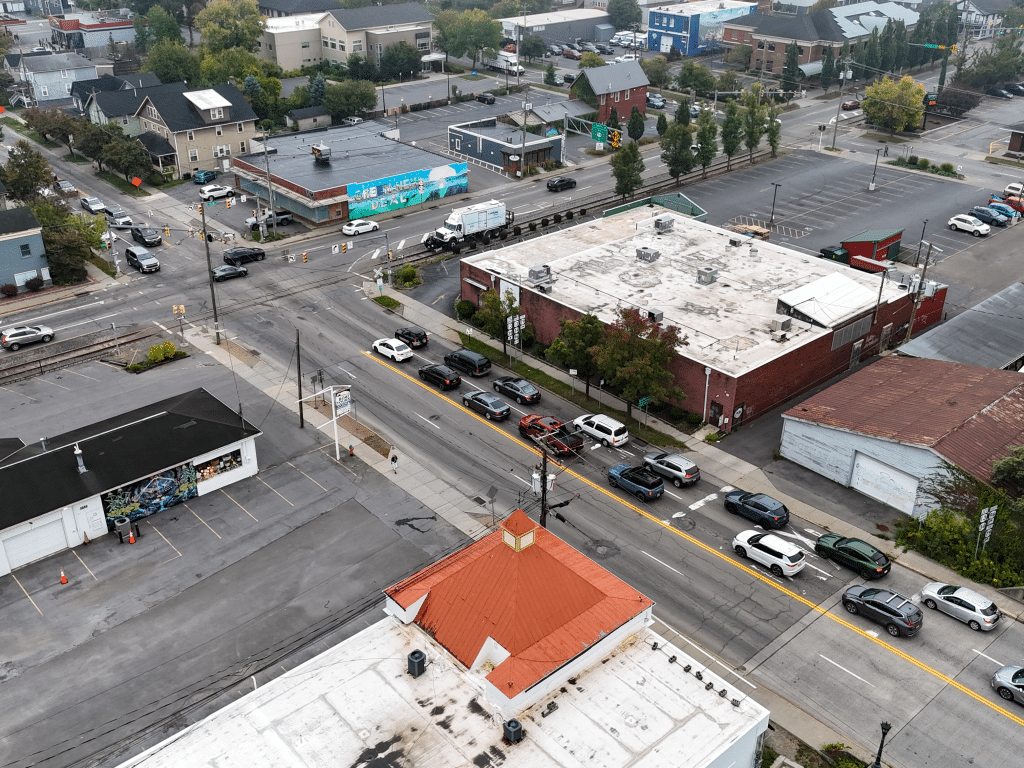
Long lines of traffic frequently come to a standstill at the intersection of West Buffalo Street and North Fulton Street in Ithaca’s West End.
Congestion myths and realities — and the true culprit
The city of Ithaca area has long been the subject of frustration for drivers who resent the long waits during rush hour at traffic lights in the “octopus” section of Ithaca’s West End and further south on South Meadow Street through the series of lights near the shopping centers housing big box stores such as Staples and Walmart, as well as grocery stores Wegmans and Trader Joe’s.
With his nearly three decades in the transportation trenches in Tompkins County, de Aragón said he can confirm that this is not a new problem and that traffic studies clearly show that the number of vehicles on these heavily travelled roads has not risen dramatically in recent years. In fact, he said, the numbers have remained fairly consistent since the 2000s.
“People don’t like to hear this,” de Aragón said, “but there’s no magic bullet.”
After doing thorough studies, time and again, popular theories on the cause of the congestion have been debunked.
In response to complaints that there was too much through-traffic by large commercial trucks, the council did a count of tractor trailers passing through the city.
“Truck traffic is like 6% of traffic,” de Aragón said, adding that this is not a large percentage when compared to other urban areas.
“It’s low,” he said.
“We looked at the flow of trucks,” he said. “We literally had people at the edges of the county on the entry roads of the county and the entry roads of the urban area to determine which trucks were coming in and going through.”
This was many years ago, and at the time people were saying that trucks were using Ithaca roads to cut between Route 81 and Elmira. What did the data show?
“Urban legends,” de Aragón said. “Two percent of truck traffic was through-traffic.”
So what, ultimately, does 20 years of meticulously collected data show?
“The end result of the different analyses that we’ve been looking at — the data shows that we are our own worst enemy,” de Aragón said. “I mean, congestion exists, [but] not because of trucks. It’s because of SUVs and sedans. It’s basically everybody doing everyday trips. So, what do you do about that? The problem is we drive way too much.”
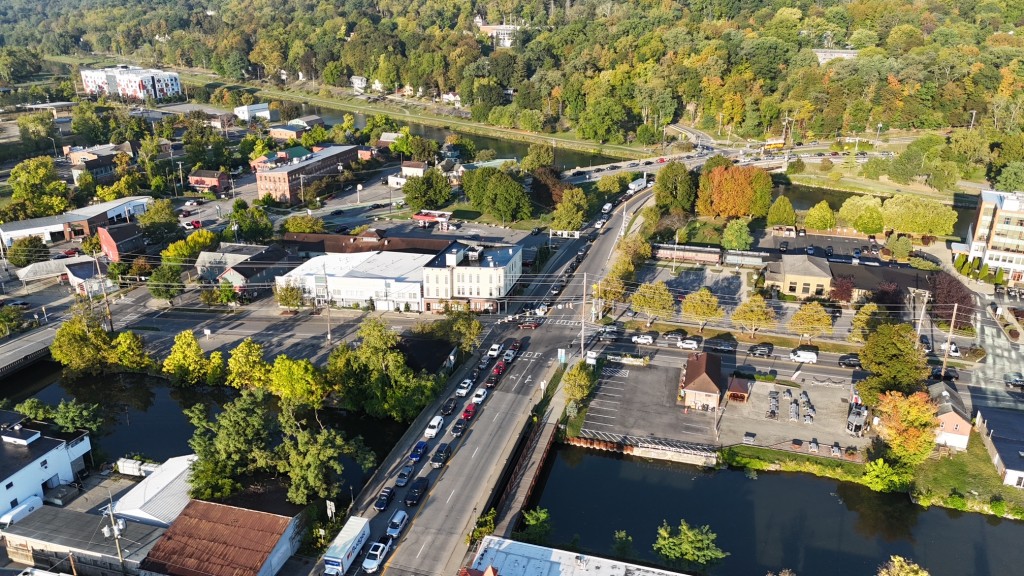
Traffic backed up on a recent weekday morning in the Ithaca area known as “The Octopus.”
“You can’t build yourself out of congestion”
When he first started in his role at ITCTC, de Aragón was involved in a study that aimed to determine whether or not a bypass might be feasible for the Ithaca area.
“Many cities have a bypass system,” he said, “and so why can’t we have one?”
The main reason: it would be “hugely disruptive” to the outlying communities, which are effectively suburbs, de Aragón said.
The second problem is the topography.
“We have every creek coming in: Fall Creek, Cascadilla, Six Mile Creek and the inlet. Each one of those has a valley. That means there’s an up and down nature to it.” Trying to navigate that topography would be “a headache,” as de Aragón put it, involving costly bridges. “The costs are ridiculous,” he said.
Reducing automobile dependency
If there is one surefire way to reduce traffic congestion in the city, it is to reduce the number of cars via alternative methods of transportation.
As de Aragón pointed out, in many cases it only takes reducing the traffic load a little bit at a busy intersection to make everything run more smoothly. Traffic does not have to be reduced to zero; it takes a relatively small percentage of people biking, walking or carpooling to make a noticeable difference.
“A lot of the congestion happens at the margins, meaning, if you have a road that can handle 100 cars comfortably, and you have 100 cars trying to get on it. … This is a math problem,” de Aragón said. “I don’t want everybody to get a bike. I just need, like, 5% or 7% of people to get one.”
With the advent and increasing popularity of e-bikes, there is even greater potential in eliminating some automobile traffic in favor of a bike commute. Suddenly, the hills of Collegetown don’t seem so daunting anymore.
Unfortunately, de Aragón said, infrastructure is lagging behind. “If we’re going to realistically make a case that more people should be biking, then we need to make it safe for that,” he said.
Buses are another mode of transportation that many people don’t consider, he added. A change in mindset could be freeing for some people. “It’s almost liberating,” said de Aragón, “to let someone else do the driving.”
Ithaca Carshare, Ithaca Bikeshare, Way2Go, GO Ithaca, Bike Walk Tompkins and 511NY Rideshare are all local programs aimed at promoting alternative methods of transportation and making them more convenient and feasible for those who cannot drive or who would like to move away from a reliance on cars to get around.
“De Aragón has been a great advocate for alternative modes of transportation,” Burger said. “Anyone who has enjoyed Ithaca Carshare or Bikeshare or a TCAT pass, or anyone who has enjoyed the reduced street congestion that results from this, they can thank Fernando in some small way for that.”
ITCTC has also made great strides in helping to secure funding that will make smaller communities more walkable.
Trumansburg, Dryden and Varna, for example, all recently secured funding for new sidewalks.
“The recent makeover in Hamlet of Varna where they repaved [Route] 366 and improved it by widening and putting in sidewalks — that really transformed that little hamlet,” Burger said. “It’s an area that everybody’s been through, and it became a very walkable community, and I think everyone’s enjoyed that transition. They needed that makeover, and [de Aragón] was part of getting that project.”
Trails that will make biking and walking a better option for commuters are also an essential part of the equation and one that de Aragón’s work with the ITCTC has supported over the years.
The Rail Trail in Dryden is a long-term project that may soon see major progress with the construction of a pedestrian bridge.
“In the next month, we’re hoping to get some good news on that,” Burger said. “It’s a key ingredient to connecting with the Cornell vet school, and a lot of people really anticipate that.”
Looking to the future of transportation
What can drivers in the city look forward to in the months ahead?
De Aragón said that the city will begin a large paving project that tackles most of Route 13, the early stages of which are slated to begin this fall.
“That’s going to be a big project,” he said. “We’re going to be doing a lot of work at night, trying to mitigate the impacts.”
“I’m sure they’re going to do everything they can to make it quick, and to make it as painless as possible,” he added.
In the years to come, Knipe said that he is looking forward to building on everything that de Aragón accomplished in his nearly three decades at the ITCTC.
“There is some complexity to the work,” Knipe said, “but [de Aragón] has created an administrative process guide for just about everything. I am so grateful to him for leaving the agency in a strong position.”
Author

Related Articles
AmeriCU proudly connects students with annual scholarship opportunity
AmeriCU scholarship program awards $1,000 to students pursuing college or vocational education. Applications are open through March 15.
Street Beat: What’s one of the best holiday gifts you ever received?
We asked five random people. Here’s what they had to say.
5 things to do in Tompkins County this weekend
Plan your visit and discover what’s happening this weekend.