
Developers talk road ahead as projects’ challenges lessen
It’s been nearly three months since Tompkins Weekly last covered development projects around the county, and a lot has happened since then. From updates on current projects to new project announcements, it’s been a busy couple of months, so we’re diving back in to see how the situation around development has evolved in the county and where we’re headed from here.
One of the bigger development stories from the past month came Oct. 14, when the Vecino Group and Harold’s Holding reached an agreement regarding the Asteri project (Vecino) and Harold’s Square (Harold’s Holding).
As covered previously in Tompkins Weekly, Asteri is set to redevelop a portion of the Green Street Garage into a conference center and affordable housing, and Harold’s Square includes apartments, offices and retail overlooking the Green Street Garage. The two projects are set to be neighbors, with Harold’s Square nearly complete and Asteri still in its planning stages.
The new agreement increases the separation of Asteri’s 12-story tower from Harold’s Square’s 12-story tower to nearly 45 feet. To make up for the loss in space to Asteri, L Enterprises, partner in Harold’s Holding and owned by David Lubin, provided Vecino Group with an option to purchase and develop a prime portion of land at the Emerson Power Transmission site, located on Route 96B, less than 1 mile from the Green Street Garage. This will allow Vecino Group to develop an additional 100 affordable apartments in proximity to both downtown and Ithaca College, according to a recent press release.
Eric Ekman, vice president of development and acquisitions at Harold’s Holding co-partner McGuire Development, explained the lead-up to the agreement.
“Vecino’s proposal for a 12-story building initially had a lesser setback from Harold’s Square, which created a concern for the living environment in both projects,” he said. “So, through a productive process with Vecino, the result was an agreement beneficial to both neighbors.”
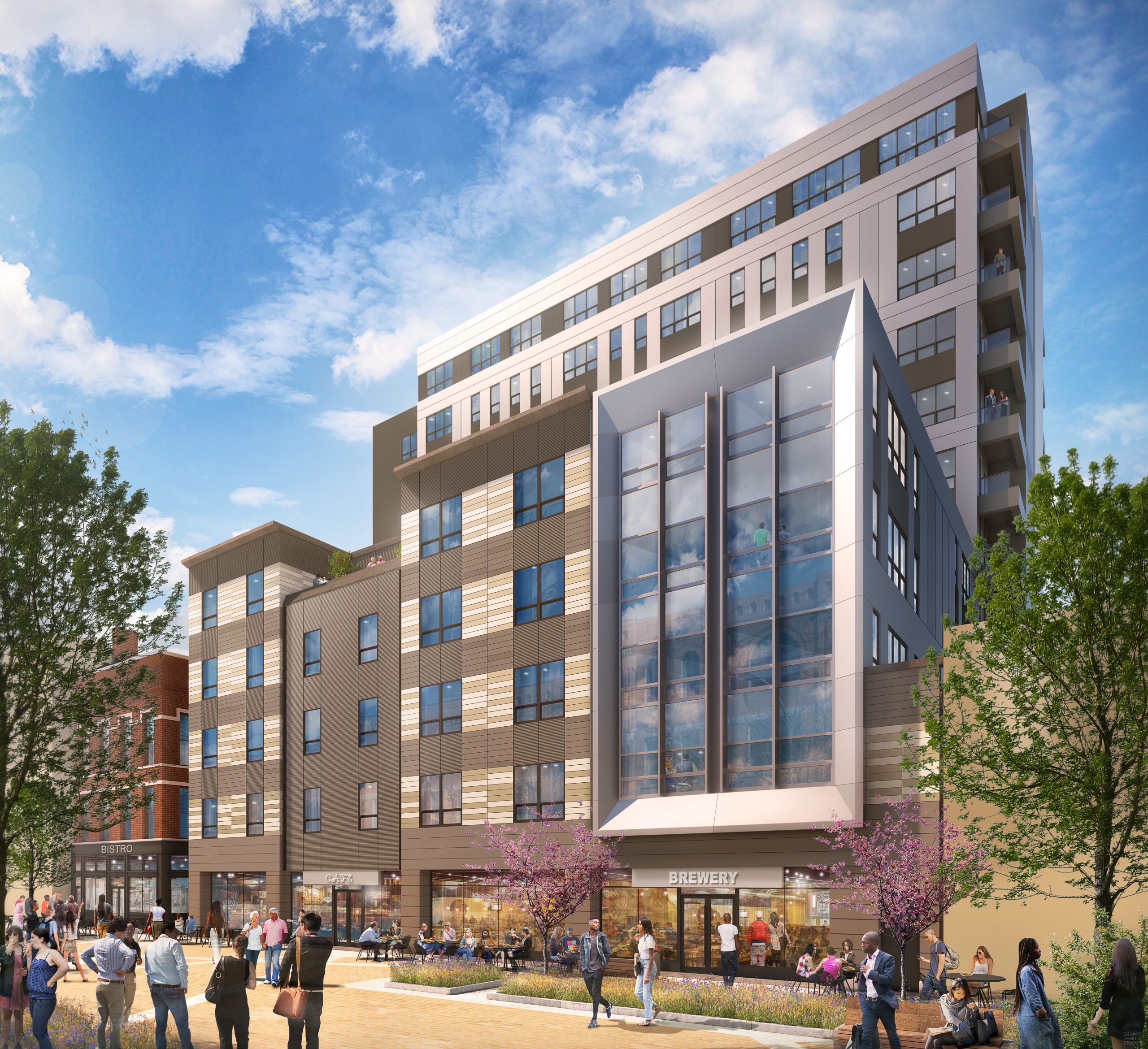
Vecino Group President Rick Manzardo explained that ultimately, the agreement is a win-win for both projects, providing a better living situation for tenants of the projects’ apartments and a net gain in affordable housing projects for Ithaca.
“We looked at, can we give up 36 units here for a prospect of 100 units in the future up on the hill for a different site [and] give people more choice?” he said. “We thought that was a good trade-off. And also, I think everyone living in each of the towers, it will provide them better experience. There’s going to be more daylight, more sunlight and more separation, just a better quality of living.”
Outside of the agreement, Vecino Group and Harold’s Holding discussed the overall status of their projects and the challenges they’ve been facing. Asteri is set to begin construction in January 2021 and as such hasn’t faced challenges that projects under construction have been facing, like labor and material shortages.
With Harold’s Square in the construction phase, the project has faced some of the challenges discussed in our previous development article such as construction and monetary delays.
“The pandemic has certainly kicked us in the shins with having to shut down,” Ekman said. “We lost eight weeks of time. And it’s pushed our delivery to now Dec. 1, where before we were on track to deliver in August.”
General delays are a problem that Heather McDaniel, president of Ithaca Area Economic Development (formerly named Tompkins County Area Development), has also seen with other projects in the county.
“Because of COVID, I think the lining up the contractors, the supply chain and completing the bank financing, everything has just been slowed,” she said. “So, I will say that they’re moving forward but at a slower pace than they had anticipated.”
In addition, Ekman said, the pandemic has impacted the normal leasing season and delayed what would have been a busy leasing period. Now that much of the county has reopened, however, Ekman has seen that impact lessen. And that theme of challenges finally decreasing isn’t unique to Harold’s Holding.
McDaniel said there is a reason to be hopeful, as she’s seen a rush of new projects going through or completing the site plan approval process at the Industrial Development Agency just within the past month. Some of these projects include a development planned on State Street by Arnot Realty, The Ithacan planned for East Green Street, Rimland Tower and others.
“All of these projects developers were talking about, … they slowed a little bit when COVID hit, but then, I think they decided that now’s the time to continue their investment path in this community because there’s a market here,” McDaniel said.
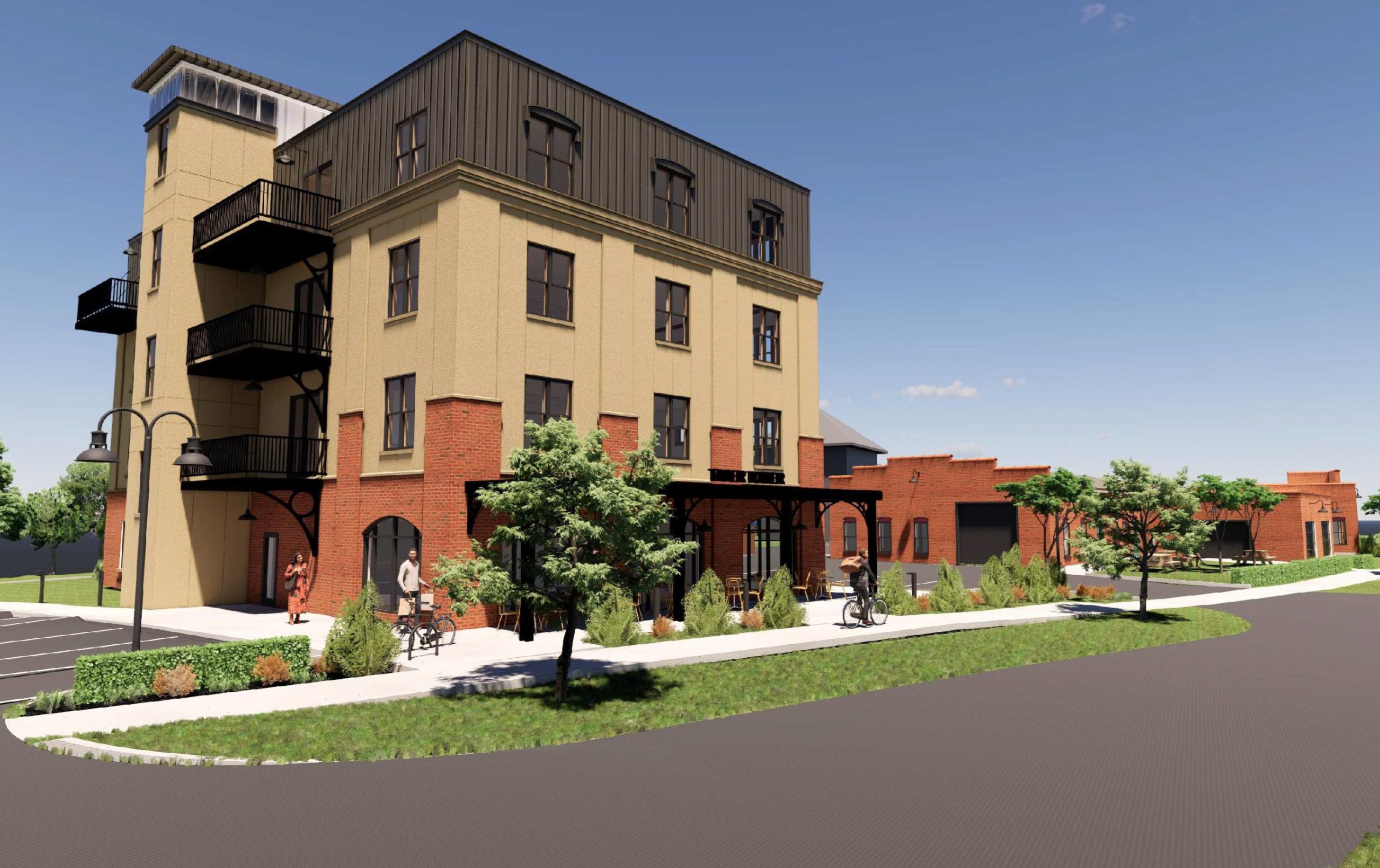
While some projects are moving past pandemic challenges, another project has found inspiration in them — Taber Tower. Part of several developments planned for the Aeroplane Factory campus on Taber Street in Ithaca, Taber Tower is a mixed-use project that includes a cafe, 5,000 square feet of office space and five apartments. Also planned for the site is a 2,000-square-foot, one-story office expansion on the south side of the Hangar Building at 140 Brindley St. Both Taber Tower and the Hangar Building addition were designed by Jason K. Demerest Architecture.
Developer Jerry Dietz said that he’s envisioning “work/live units” for Taber Tower, something inspired by the pandemic.
“The work/live concept sort of came out of COVID really, this notion that people have now begun to work — and employers have accommodated people’s need to work and desire to work — at home,” he said. “They’ll be fairly small units that are primarily meant to be someone’s office, but we’ll have a full kitchen and a full bathroom so that should someone decided they wanted to use it both as a workspace and their living space, they will be able to live there.”
The first phase of the project — the Hangar Building expansion — is set to break ground in November, while Taber Tower is set to begin construction in the spring of 2021. While the project faced some initial delays at the start of COVID-19, it’s now seeing progress thanks to the county’s continued reopening.
“Now, I’m in a situation where I have the money,” Dietz said. “So, I’m kind of anxious to get it built so that, as we turn the corner into 2021 and we, I hope, see the end of COVID … in the second half of next year, I would hope that this space would then be attractive either to the current tenant or to a new tenant that we might engage.”
Another project influenced by the pandemic is Waterworks, a mixed-use development planned on Ithaca’s waterfront. Waterworks is a two-building infill project at 313-317 and 321 Taughannock Blvd., managed by a development team that includes Lincoln (Linc) Morse, managing partner Jodi Lee Denman, FLX Fitclub co-owner Sue Manning and architect Noah Demarest of STREAM Collaborative.
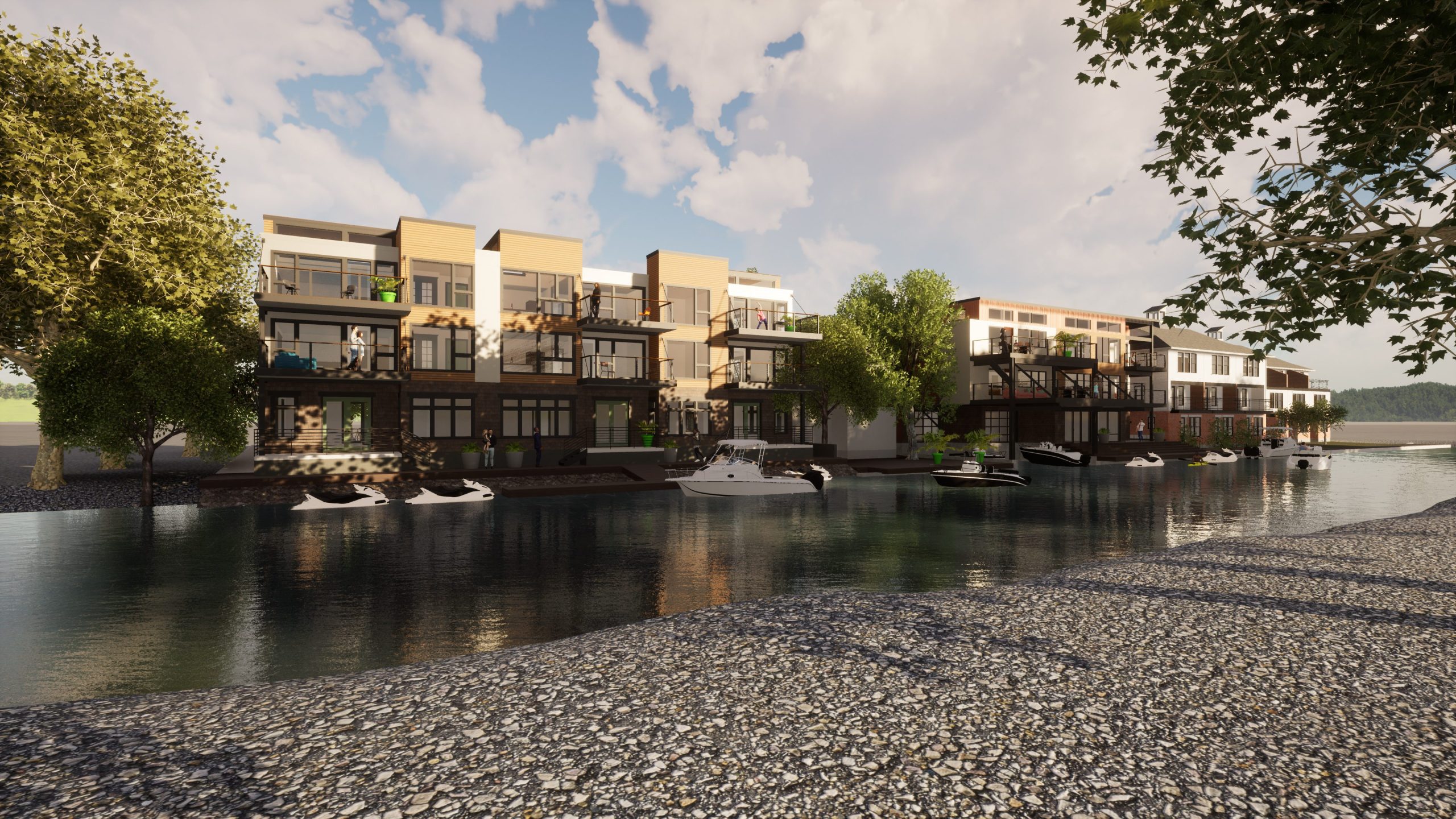
As Morse explained, the development project was split into two different phases — Waterworks North and Waterworks South — earlier this year when Gov. Andrew Cuomo allowed outdoor recreation businesses to open. Puddledockers Retail and Rentals, owned by Denman, was planned at Waterworks and was rushed to completion over the summer to quickly meet the demand, putting the rest of the development on hold.
“Jodi bought a business that needed to operate,” Morse said. “We didn’t have a place that was all done that looked like this to launch canoes and kayaks. So Jodi said, ‘Can we delay the development process and operate this business?’ [Otherwise], it was going to go out of business. So, we repurposed.”
Thanks to that pivot, Puddledockers opened over the summer and was a welcome addition to the area.
“We were fortunate to be able to open,” Denman said. “One of the greatest joys for me out of that this summer was just being able to offer something to the community, to be able to do some outdoor activity, keep the social distancing.”
Waterworks South, where Puddledockers is, will continue to be on pause until 2022, giving Denman another year to further expand her business. Waterworks North is set to begin construction in June after site plan approval is complete.
Sources expressed that these and other development projects help address needs that existed well before, but have since been amplified by, the pandemic.
“More people and more families than people realize, they’re one pay period away from being in a really bad position,” Manzardo said. “COVID has brought that on. And I think it’s more important than ever that we get out there. And we need more affordable housing. We need more programs like this to help those that are doing things right [but] they just get in a bad spot.”
Also, these projects help to lead the area through its eventual recovery from the pandemic, McDaniel said.
“We had the lowest unemployment rate in the state before COVID hit,” she said. “That’s going to be Ithaca again. Will it be in two years? Will it be in five years? It’s hard to say. But I think there are some in this community that are saying, ‘OK, we need to look at ways that we can diversify the tax base, that we can increase property tax base.’ And so, I think it’s a good thing that developers are still saying, ‘OK, there’s market here.’”
Related Articles
Cayuga Medical Center nurses to rally, alleging anti-union tactics by hospital management
CMC nurses plan a rally, alleging unsafe staffing and illegal anti-union tactics as the hospital highlights recent patient-safety gains.
Beginnings Credit Union holds ribbon cutting
Beginnings Credit Union celebrates a branch rebrand in Ithaca, providing improved services and engaging with the local community.
Cailyn McMahon: From Brooklyn to Groton for the love of sweaters
Designer Cailyn McMahon moves from Brooklyn to Groton to raise sheep and pursue her dream of making American-made wool sweaters.