
Dr. Auguste Duplan: A compassionate and calm fixture of Tompkins County adolescent psychiatry
Dr. Auguste Duplan, a compassionate adolescent psychiatrist, has dedicated 20 years to supporting youth and families in crisis.
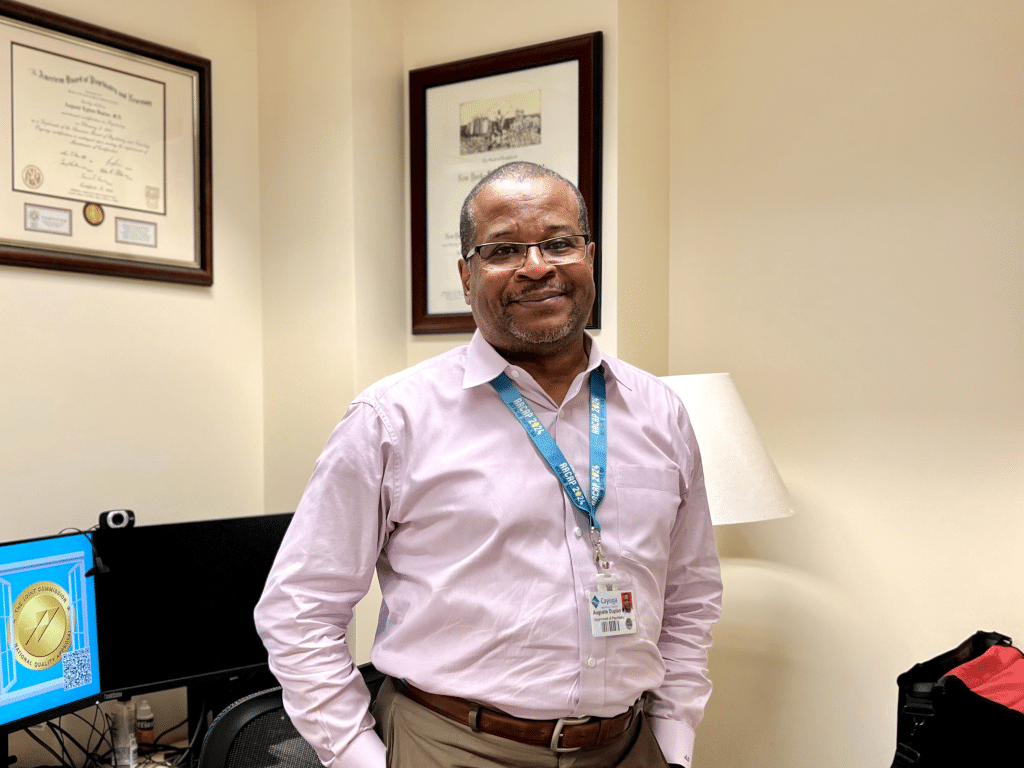
Dr. Auguste Duplan, head of adolescent psychiatry at Cayuga Medical Center, in his office in the Ithaca hospital’s Behavioral Health Unit.
When children in Tompkins County experience a mental health crisis, there’s a good chance Dr. Auguste Duplan is the one called to help. Over the past 20 years, the Haitian-born physician has become a quiet pillar of the community, known for his empathy, humility and dedication to families, which is what makes him this month’s Hometown Hero.
Duplan is responsible for the six adolescent beds in the behavioral health unit at Cayuga Medical Center, where he works with children who are 13 to 17 years old who have been admitted with acute psychiatric emergencies.
“It is a lot of responsibility,” said Dr. Clifford Ehmke, chairman of Cayuga Health Systems’ Behavioral Science Department, of overseeing those six beds, “and it puts him in direct contact with essentially the most vulnerable adolescents in our community.”
“His field is tragically underserved,” Ehmke added. “There just aren’t that many child psychiatrists. He is one of the only ones in this area, so it’s unusual to have that level of training and expertise.”
Jean Tyson said her family’s journey with Duplan started almost 20 years ago.
“Gratefully, we were referred to Family and Children’s Service and Dr. Auguste Duplan,” said Tyson, who nominated Duplan for the Hometown Heroes award, calling him a “humble, unsung hero.”
“[Family and Children’s Service of Ithaca], along with Dr. Duplan, provided emotional support, thorough planning and utmost compassion so needed during this stressful time of parenting. As we sat in the waiting room, along with other parents with their children, we understood that our situation wasn’t unique — but having a service such as Family and Children’s Service definitely was unique,” Tyson said. “Our children could receive individualized therapy sessions, counseling, family group sessions and efficient psychiatric/medication planning as needed — and all of this under one roof.”
Duplan moved from his home country of Haiti as a medical school graduate looking to further his career, completing his residency at hospitals in New York City and moving to Ithaca to take his current position at Cayuga Medical Center 20 years ago.
Deborah Seligmann Kratil, a recreation therapist on the Adolescent Behavioral Services Unit at CMC, has worked with Duplan since he arrived in Ithaca in 2005.
“Needless to say, we have been through it all together: the establishment of the unit and its treatment philosophy, multiple CEOs and hospitalwide transitions and COVID, just to name a few examples. Auguste has never shied away from these challenges, and his warm, reassuring laugh can be heard in the hallways on the unit as we move from treatment team rounds to family meetings,” Seligmann Kratil said.
Duplan also works at the Tompkins County Mental Health Clinic, which serves the public and is available to anyone on a walk-in basis. In addition, he works at the Broome Development Center in Binghamton, which provides services for individuals with developmental disabilities.
Duplan has a private practice, as well. He said that when he interviewed for the job in Ithaca two decades ago, one of the main reasons he accepted the position was that he was allowed to set his own schedule. “They left it up to me to design my practice,” he said.
“There was a shortage of adolescent psychiatrics, so coming to Ithaca, there was always a lot of need, so they did not want to keep me here on the unit but in the community. I designed my job so I could work 28 hours inpatient and 12 hours outpatient.”
Dr. Jessica Conner, director of behavioral health at Northeast Pediatrics and Adolescent Medicine in Ithaca, said Duplan puts service to his community first.
“He just does such an incredible job of recognizing the needs of this community and doing what he can, where he can,” Conner said.
“He is a very busy person with a patient population that has just an incredible need and an incredible dearth of services otherwise, so he fulfills a critical role in the community,” Ehmke said, describing Duplan as “a physician in the old-fashioned, best sense of the word.”
“He’s someone who will really try to get to know his patients,” Ehmke added. “He works with teenagers, predominately, in the setting where I work with him, and there is a way to interact with teenagers that is respectful and recognizes their lack of capacity … recognizing they’re not always authorizing their health care choices for themselves, but still respecting what agency they do have at their stage of development.”
“I think I connect reasonably well with young people — better than adults, I would say,” Duplan said.
Working with young patients usually means developing a relationship with their families, as well. Even when parents have their own mental health challenges, Duplan is able to navigate those relationships “with some deftness,” Ehmke said, leading to safe outcomes for his patients.
Erin Myers, LMSW, said that when the opportunity arose to work with Dr. Duplan at CMC several years ago, she jumped at the chance. It is not every day that a newly graduated mental health professional has the opportunity to work with someone as esteemed and widely respected, she said.
Duplan’s expertise, combined with a calm and reassuring bedside manner, has earned him the trust and gratitude of countless individuals and families in our community and beyond, Myers said. Whether in a clinical setting or through community work, Myers said Duplan exemplifies the values of empathy, integrity and professional excellence.
“Whenever I talk with him, I am shocked to find how calm and non-burnt-out he seems,” Conner said. “He truly is just so compassionate for kids and teens and families.”
“He is a steady person; there’s no drama to him,” Ehmke said. “He’s plain spoken and doesn’t talk down to people or use unnecessary jargon. He’s a straight shooter and comfortable in his own skin, which is essential if you are working with folks in crisis.”
The majority of Duplan’s patients have some form of public health insurance, such as Medicaid. “Certainly, at the hospital, a small fraction of them have private health insurance,” Ehmke said. “He’s a poor person’s doctor, which I find very significant and to his credit.”
“A remarkable feature of Dr. Duplan’s personality is his inclusive nature and how he values others,” Myers agreed.
In Haiti, Duplan graduated with a class of 100 students, roughly 40 of whom also now live in the United States.
“We had a lot of political problems,” Duplan said of life in Haiti in the 1990s. “Schools sometimes could close. During my training, I lost a whole year due to political issues, and people could not go to school. People wanted to train and wanted to learn more, wanted to come to a place where they could continue their education and not be encumbered by issues preventing them from getting more education.”
To help students going through medical school in Haiti, Duplan and fellow graduates from the class of 1991 of the Faculty of Medicine and Pharmacy of Haiti formed the Jacques Stephen Alexis Foundation.
For its most recent project, the group raised enough money to provide the medical school they attended with solar panels and batteries so that the institution could have electricity 24 hours a day.
“Not two months after that was accomplished, gangs took over the capital, and they pillaged, and they took everything,” Duplan said. “To this day, the hospital and medical school are closed, and even the police cannot move [the gangs] from the area.”
“We’re not about to give up and just stop helping because when we do something other people go and destroy it,” he added.
Ehmke said Duplan is “the perfect example of why we need to venerate immigrants.”
“He came to this country and brought so much value with him. Look at how many kids wouldn’t have been served without his choices that he’s made to get an education, go to medical school, go into psychiatry, work with children — these are major choices, but also major commitments that require so much time. … He’s such a prime example that our country is such a better place for him having immigrated here.”
“And,” Ehmke said, “I’m also very pleased to consider him a friend.”
Author

Related Articles

“A Silent Force”: Gail Belokur brings creative leadership to the United Way
Gail Belokur, a Hometown Hero, brings compassionate and creative leadership to the United Way of Tompkins County.
Cady Fontana: Inspiring creative confidence
Cady Fontana, Makerspace librarian at TCPL, helps community members explore creative projects and build skills for free.
Designing a better tomorrow, today: Todd Nau
Todd Nau, manager of Finger Lakes ReUse’s Triphammer location, earns Hometown Heroes Award for leadership, creativity, and community impact.