
Dryden Rail Trail planners optimistic after donations, grants
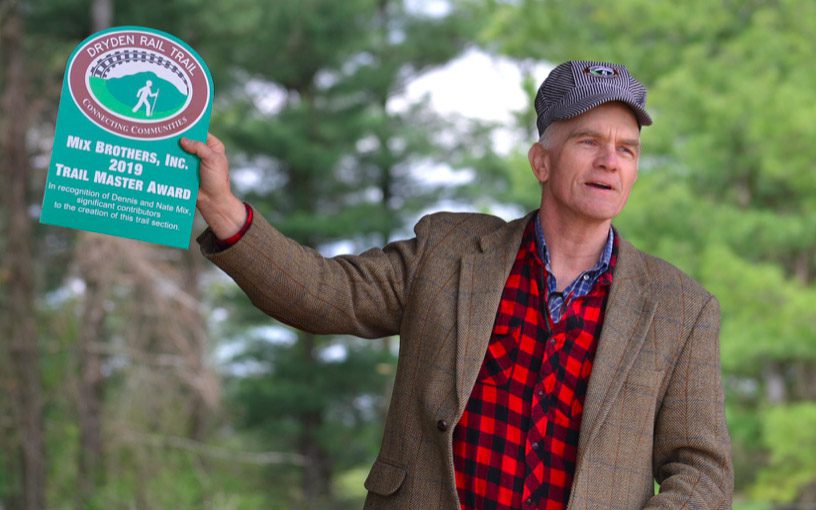
Volunteers and town of Dryden officials planning the trail from Dryden to Ithaca, known as the Rail Trail, are looking toward more intensive trail building in the fall as they move past minor complications caused by COVID-19.
Construction of the trail will move forward on its original timeline, riding the momentum of recent victories in receiving large grants and impressive showings of volunteer labor over the last several years.
The project received $1.5 million in funding from the New York State Department of Transportation’s Transportation Alternatives Program, according to Todd Bittner, the Director of Natural Areas for Cornell Botanic Gardens and member of the Dryden Rail Trail Task Force.
The project received over $700,000 in required matching funds from five different town and grant sources including state parks, Tompkins County, New York state, Cornell University and the town of Dryden.
“Receiving the $1.5 million TAP grant was the pivotal, capstone funding needed to advance the project and cross Route 13, which is arguably the most challenging phase,” Bittner said.
The Task Force is committed to carrying out the project without using the town residents’ taxes, according to Bruno Schickel of Schickel Construction, who has donated materials and labor to the project and has been closely involved in plans for the trail.
Much of the trail already exists, and the work moving forward is to connect the preexisting sections. Currently, walkers, runners and cyclists can travel from Dryden Lake to the village of Freeville, as well as on other sections near Ithaca, according to Dan Lamb, deputy town supervisor for Dryden.
“They built the U.S. railroad from both ends to the middle. We wanted to do the same,” Schickel said.
COVID-19 has created some limitations to the trail progress, but nothing too worrisome, Schickel said.
The Rail Trail Task Force, which was created in a town resolution in 2016, has met monthly since its inception. But, like all other town meetings, it has had to meet remotely over Zoom since the pandemic began.
The pandemic has also slowed progress on some smaller construction projects related to the Rail Trail, which require people to work in close proximity. These projects include the construction of information kiosks and the benches that will ultimately be placed along the trail, according to Schickel.
“We’ve been thrown off a little bit because of corona, no doubt about it,” Schickel said. “Work tends to be springtime and fall, but people were locked down in spring.”
Schickel added that some of these difficulties persisted because of challenges in finding donations of equipment and labor, which are to be expected in summer.
Despite the unexpected obstacles, Schickel is confident that any minor delays will be easily surmounted as construction ramps up in the coming months.
“We’re all about forward motion,” Schickel said.
Schickel was originally the vice chair of the Dryden Rail Trail Task Force. But Schickel stepped down several years ago in order to take on the task of soliciting donations for the project, a task from which town officials are barred. Schickel, and other volunteers on the project, have solicited donations from local businesses and individuals, including equipment and labor donations.
The trail has received broad community support, according to Lamb.
“Forty different people have come out to work on the trail over the last three years, planting plants, running heavy equipment, building railing, installing signage,” Schickel said, adding that last December, locals showed up even in snow storms to contribute to the construction of the trail.
Donations in materials and equipment to the project have poured in from the Mix Brothers, R & S Gravel Pit, Whitmore Fence, B & B Flooring, Bailey Place Insurance, the Dryden Department of Public Works and Schickel Construction.
Overall, the main barriers to the Rail Trail — gaining access to private property, funding and safe passage across Route 13 — have already been overcome, according to Lamb.
Plans for the trail date back to the early 2000s, when local leaders wanted to make use of the unused rail beds in the area and saw Ithaca’s Black Diamond Trail as an example worth replicating.
But when the project first became public, many Dryden residents were skeptical that the town could successfully acquire easements to build the trail through various private properties along its route.
The Rail Trail Task Force had to negotiate 38 different easements for the project. Schickel and Bob Beck, chair of the task force, were crucial to these successful negotiations, Lamb said.
Many of the easements that the town wanted to acquire were previously in place when the railroad was still in operation but were given back to the landowners when the railroad was decommissioned several decades ago.
Two of the private properties that caused the most concern were the Department of Environmental Conservation game farm near Varna and the George Junior Republic Free School near Freeville.
This is on the cusp of securing a 20-to-50-year right of way through the DEC game farm, according to Lamb.
“It’s not in the pocket yet,” Lamb said, but he is optimistic that the town will acquire the easement.
The town has not paid for any of these easements, but in negotiations, the town has made accommodations to various landowners who expressed concerns about the trail — for instance, planting trees to block views from the trail into peoples’ homes.
“We take their concerns extremely seriously, and we understand that this is a gift that they’re giving the town. Those landowners are critical to the process,” Schickel said.
Schickel added that ultimately, the trail will increase property values and that easy access to a commuter trail will prove to boost the quality of life of nearby residents.
Another barrier to the trail’s construction was the question of how to safely cross Route 13. A crosswalk was nixed from the beginning because of safety concerns. A detour that would run below Route 13 was also unpopular among Task Force members, who thought that trail users would likely avoid a detour by taking a shortcut over Route 13, which would present even worse safety concerns than a crosswalk.
This left the option of a bridge over the highway. At first, the bridge seemed unreasonably expensive, but the large grants received from the DOT and other sources have made this aspect of the project feasible.
“The idea that this bridge project would get over $2 million in funding is still something we have to pinch ourselves to believe,” Lamb said.
Related Articles
Dryden Fiber looks back on another year of service
Dryden Fiber reflects on a year of growth as the municipal internet provider expands service across Dryden and Caroline.
Holiday traditions bring community cheer
Tompkins County holiday traditions light up homes, farms, and schools with festive cheer and community spirit.

The gift of an experience: Local businesses offer hands-on holiday fun
Holiday experience gifts in Tompkins County include candle making, gourd crafts, and pottery workshops for creative seasonal fun.