
Egg Geo shares study results for potential Speedsville community geothermal project
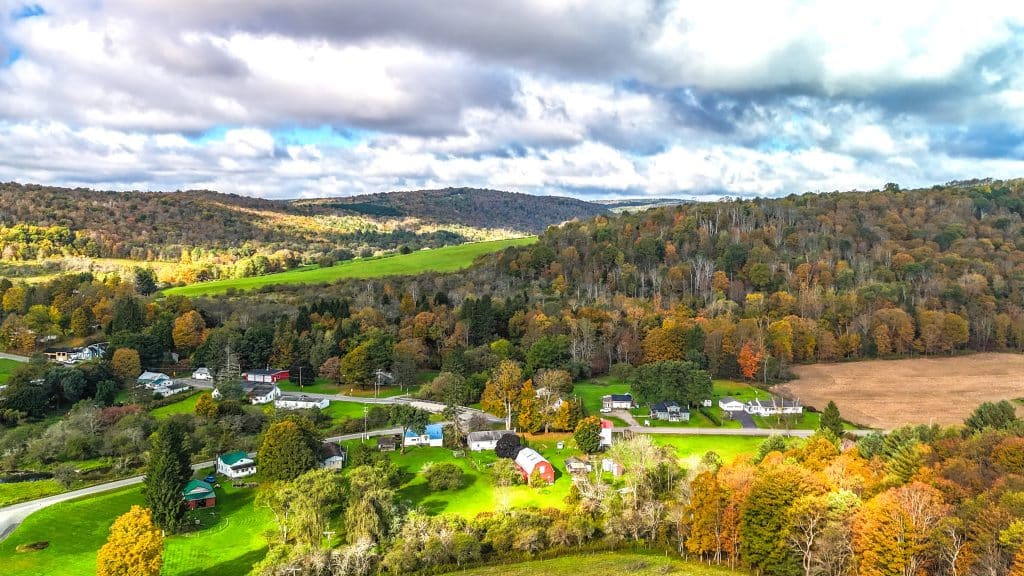
Egg Geo experts believe, after preliminary study of the land, that a community submerged closed loop geothermal system could be used for heating and cooling in Speedsville.
A geothermal company, Egg Geo, has partnered with the Town of Caroline and Speedsville Community Center to conduct a scoping study for a community geothermal system. The study, which is now complete, determined that a community geothermal system in Speedsville could provide heating and cooling for about 35 residences and four businesses in Speedsville with an estimated payback period of about 10 to 15 years.

Managing Editor
Jay Egg, a former nuclear power engineer, started Egg Geo in 1990 and established a partnership with Mark Witmer, Town of Caroline supervisor since 2016, to talk about Speedsville potential for a community geothermal project. Witmer entered politics with an interest in climate change mitigation. Egg said that under Witmer’s leadership, the beginning stages of the local geothermal project have gone more smoothly than many projects he has overseen in the past.
Initially, Witmer and Egg’s efforts focused on heating improvements for the Speedsville Community Center. This led to discussions about a community geothermal project. There was a kick-off public meeting on March 15, 2023.
Initial testing determined that a community geothermal project is feasible in Speedsville, and the next step would be a design study.
With no natural gas available in the area, most Speedsville residents are using propane or fuel oil to heat their homes, Egg said.
In addition to the residential properties that could be powered by the system, the project would also serve the Speedsville Community Center, the Speedsville Fire Department and the Speedsville convenience store.
Speedsville is an excellent candidate for a geothermal project because its residents are experiencing energy poverty, and there is the potential for significant cost savings for residents, Egg said. In this way, it would be the first project of its kind in Western New York.
Carter Johnson, Egg Geo project manager, said initial studies of the area have yielded promising findings. Three types of technologies are being considered: closed loop geothermal, a submerged closed loop heat exchanger, and open loop geothermal.
Closed loop has already been identified as a viable method for Speedsville. “We think it will work really well,” Johnson said. He explained that unlike the other two options, a closed loop system would not actually pump any water out of the ground.
“We’re pumping a secondary fluid that’s essentially mining heat from the ground, so the secondary fluid never leaves the pipes,” he explained. The fluid collects heat from the ground and is then run through a heat exchanger which is used to heat and cool the buildings.
A submerged closed loop heat exchanger requires less separation between wells and is successful in areas with good aquifers. It would require an estimated eight wells over about 20,000 square feet of land.
An open loop geothermal system requires an estimated four wells but relies on the assumption of sufficient water yield from the aquifer.
Of the three options, closed loop requires digging the most wells, but with advancing technology Johnson said there is a good chance that this estimated level of disturbance to the land will not be necessary by the time construction begins.
“Our closed loop analysis yielded that we would probably require about 152 bore holes, assuming an industry standard depth of 500 feet for each of them, in an area of about 61,000 square feet,” Johnson said, “because they need to be separated about 20 feet between each individual borehole.”
New technology has come out that allows drillers to make deeper wells of a depth of up to 1,000 feet, which cuts the number of bore holes and the required square footage in half, Johnson said.
Once the wells are drilled, there would be very little long-term disturbance to the area.
“There will be one manhole where everything comes together, where somebody can service it, and there may even be a pump in there that’s powered by a common meter,” Egg said. “Other than that, the only thing you’ll see is a manhole. Everything else will come into the buildings subsurface.”
“That would seem to address concerns about disturbance of the park area, for instance, I would think,” Witmer said.
Johnson said Egg Geo has the green light for all technologies, but there is the need for further research to decide on the best system to use moving forward.
Author

Related Articles

Lorin Warnick to end term as Cornell Veterinary College dean
Warnick Cornell dean Lorin Warnick will step down in 2026 after leading the veterinary college through growth, innovation, and major public health milestones.
Baden-Powell Council names Leslyn McBean-Clairborne Distinguished Citizen
Dr. Leslyn McBean-Clairborne is named the 2025 Tompkins County Distinguished Citizen for her decades of leadership, equity work, and community service.
Street Beat: What is your favorite Christmas movie?
We asked five random people. Here’s what they had to say.