
Sponsored Sponsored content How weather affects your EV performance with Dovi Motors
Get the facts about how weather really impacts your electric vehicle.
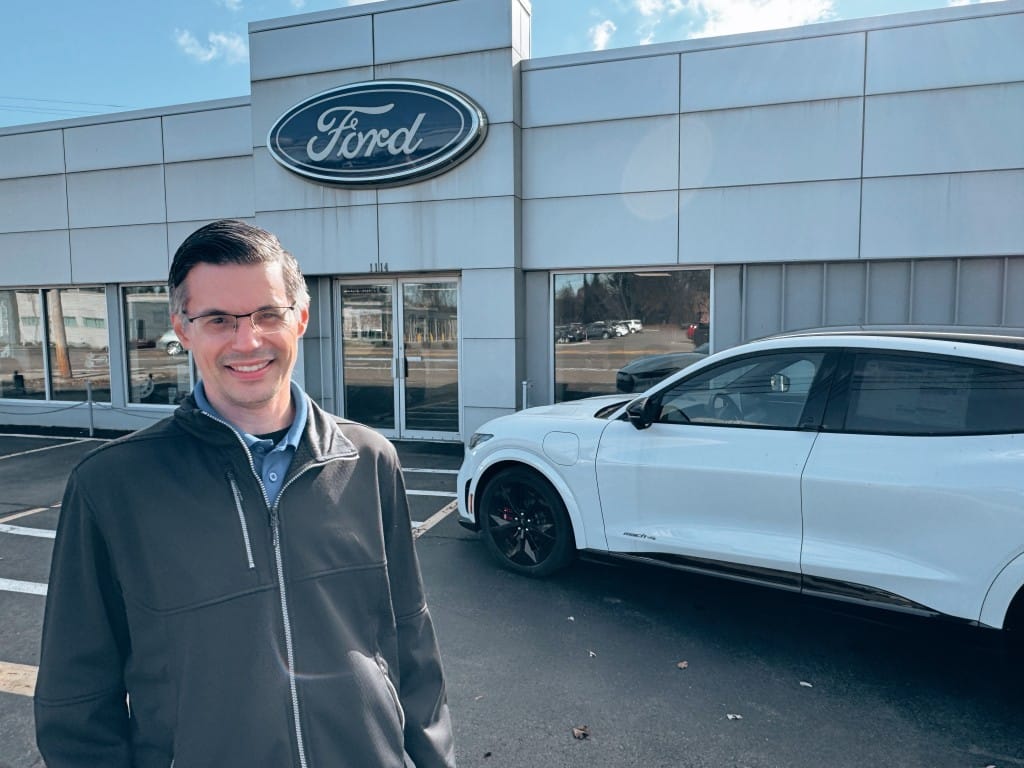
Jesse Dovi in front of the showroom of the 76 year old Ford Dealership started by his grandfather Tony Dovi as a Texaco gas station. Representing the third generation of Dovi’s, Jesse has been working at the dealership part time since he was 14, and fulltime for the past 16 years.
When temperatures drop or spike, many EV drivers start to wonder how much the weather really affects their car’s performance. According to Jesse Dovi of Dovi Motors, a Ford EV specialist, the answer is more than you might think, but less than you might fear.
Cold weather can reduce range, but modern EVs are designed to compensate with smart battery management systems and preconditioning features. By warming up your vehicle while it’s still plugged in, you draw energy from the grid instead of the battery which ultimately helps preserve more range once you’re on the road.
Cold Weather and Your Range
In near-freezing conditions, EV batteries work harder to warm both the cabin and the battery pack, which temporarily lowers efficiency. Data from Ford shows that at 10°F, a vehicle like the Mustang Mach-E can lose roughly 25-40% of its range compared to the standard 300-mile baseline.
However, preconditioning, warming the cabin and battery before departure, can significantly reduce that drop. For 2021-2024 Mach-E models without a standard heat pump, preconditioning can raise the usable range from roughly 180–200 miles to about 200–215 miles.
The latest 2025 models, which include a standard heat pump, perform even better in cold weather. When preconditioned, they retain approximately 225 miles of range at 10°F, compared to as low as 210 miles without it.
Preconditioning is key to efficient performance, it warms the cabin and battery before departure, helping your EV run smoothly and maintain more range on cold mornings.
Hot Weather Matters Too
While extreme cold impacts short-term range, extreme heat affects long-term battery health more than anything else. Modern EVs are equipped with advanced thermal management systems that regulate battery temperature effectively, but overall, batteries tend to tolerate cold better than sustained heat.
At around 90°F, most modern EVs only see a 4-5% range reduction, thanks to smart cooling and pack temperature management. That means even on the hottest summer days, your EV will perform close to normal especially if you keep it plugged in while pre-cooling the cabin before your drive.
Charging in the Cold
Cold temperatures can also slow down charging. On a 50-amp home circuit, a Mach-E typically charges from 10% to 80% in about seven hours. But at 10°F, that can stretch closer to eight or nine hours, since the car uses some of the early charge power to warm the battery before ramping up speed.
Planning ahead by scheduling overnight charging can ensure the battery is warm and ready for an early drive, helping maintain optimal range and efficiency while reducing the impact of cold temperatures on charging speed.
Myths vs. Reality
A common misconception is that cold weather can permanently damage EV batteries. In reality, it’s heat, not cold, that’s the real threat to longevity. Modern EVs are equipped with sophisticated battery temperature management systems that actively protect the battery pack from extreme conditions. These systems automatically adjust charging and discharge rates, heating, and cooling to keep the battery within an optimal temperature range, ensuring both performance and lifespan.
“The battery temperature management systems largely mitigate environmental risk to the battery packs, but if you had a choice it would be better to have the batteries a little too cold rather than a little too hot,” says Jesse.
What to Remember
On a cold January morning or a humid August afternoon, today’s EVs are built to adapt. With a few smart habits, like preconditioning before you drive, keeping your car plugged in when possible, and planning for slightly longer charging times in winter, your EV will perform efficiently year-round.
As Jesse puts it, “Weather’s a factor, sure, but it’s not a deal breaker. Once you understand how your EV handles the seasons, you’ll find it’s just as reliable as any other vehicle, if not more so.”
For more information, visit Dovi Motors dealership in Cortland, NY or dovimotors.com.

Dovi Motors Inc. in Cortland NY is a Ford dealership that sells new and used cars & trucks that are available to lease or buy. Call 607-376-7875 or Visit: dovimotors.com
Related Articles

Sponsored Sponsored content A holistic approach to wellness
William George Agency offers youth recreation programs that boost fitness, mental health, and confidence through holistic activities.

Sponsored Sponsored content Can the Grid Handle EVs? Debunking the Myth
Explore how Dovi Motors is leveraging modern infrastructure and smart EV technology make charging safe, efficient, and manageable for drivers and utilities alike

Sponsored Sponsored content Tech gifts for the holidays – and why fiber internet makes them even better
Explore the best holiday tech gifts and see how fast fiber internet from Empire Access helps your new devices perform their best this season.