Eye on Agriculture: Shelterbelt Farm Starts with Soil
By Sue Henninger
Tompkins Weekly
CAROLINE – “I didn’t eat vegetables when I was growing up,” Erica Frenay confessed. “But, when I was in college, I managed the student farm at Cornell University and they had a volunteer-supported agriculture program.”
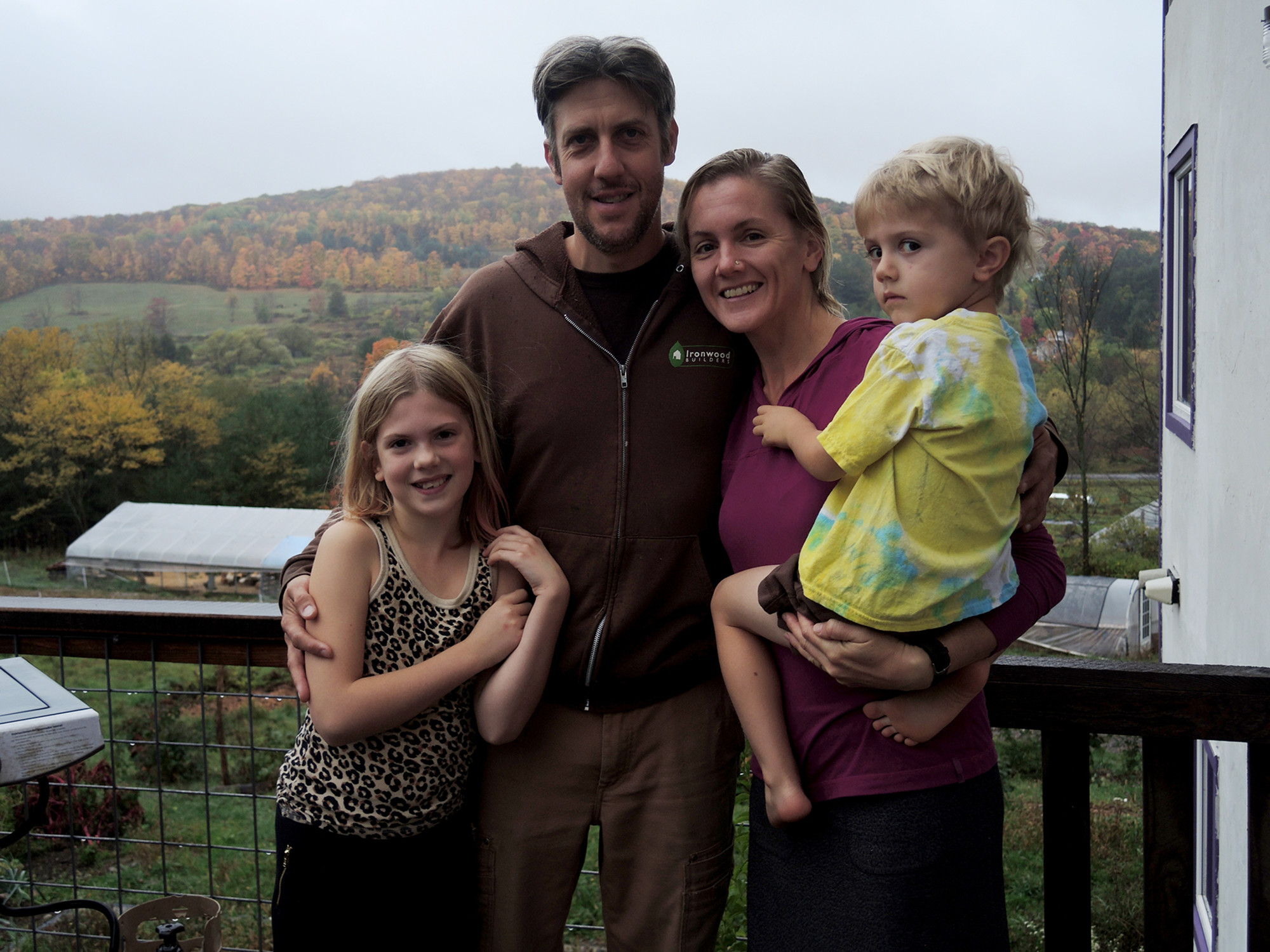
These days Frenay is a vegetarian who has managed to combine her interest in how ecology and humans interface with a career in agriculture. She, her husband Craig Modisher, their children Rowan (9) and Phoenix (4), and numerous pets live adjacent to their Caroline farm, Shelterbelt.
The couple’s dream was to become homesteaders. After much thought and planning, they tried to purchase land with several other couples to defray the cost. When this approach fell through, the two decided to strike out on their own. They spent numerous hours driving around looking at land parcels on the market. When they spotted the acreage on Creamery Road, Frenay and Modisher visited the County Clerk’s office where they learned it was owned by an out-of-state family trust. Contacting the owner by letter first, expressing interest in the land, they followed up with a phone call to explain their vision. Persistence paid off and the family is now the owner of 26 acres.
Preferring not to rush into anything, their first step was to spend a year observing their undeveloped land.
“We looked at the sun angles, the water, the wind, and the soil,” said Frenay.
Their website describes soil as the farm’s “primary” crop. What does this mean?
“We focus on the soil first,” she explained. “If you feed the soil, the soil will take care of everything else; animals, plants, and us.”
Adjusting the pH of an acidic soil can be a costly and time-consuming effort, but Frenay and Modisher persisted, knocking brush back, managing their animals’ grazing to build the soil up organically and using natural fertilizer (animal excrement). The farm became official in 2010, and the two have been steadily working on, and investing in, their land since then. The couple also put necessary infrastructure on the land, including their driveway, house, barn, and a water source, before beginning their planting in 2015.
“We have a plan and yet we don’t!” Frenay said, sounding anything but disorganized as she described how most things on the farm (including the humans!) have multiple uses.
The couple selected everything at Shelterbelt intentionally, either to create an ecosystem or for financial reasons. Take the high tunnel (or hoop house), purchased with a Natural Resources Conservation Service grant.
“It can be used to isolate animals, as a brooder, and for all sorts of plants,” Frenay observed, adding that the structure is cheaper than a pole barn and easy to set up.
Grass-fed animals (poultry, pigs, a family milk cow, and beef cows) were selected so the couple wouldn’t have to deal with the fluctuating cost of grain and also because of what they can contribute to healthy soil through grazing and fertilizing.
“They’re transformative for the land,” Frenay said.
Turkeys were raised initially too, but the couple decided that ultimately the cost/benefit ratio of raising the birds, combined with consumers Thanksgiving expectations, was too great.
“It was stressful,” Frenay admitted. “We weren’t just raising poultry we were raising the centerpiece of someone’s holiday meal!”
There is one drawback to Shelterbelt’s diverse product list, which includes lamb, duck eggs, baby ginger, body balms, and tomatoes.
“We’re making things harder on ourselves in terms of branding and marketing,” Frenay acknowledged. “We’re not strictly a vegetable farm or a dairy farm.”
Regardless, she believes that today’s farmers need to be visible online instead of adopting the mentality: “If I grow it, they will come.” Shelterbelt has a website (shelterbeltfarm.com), a blog, and a presence on Instagram and Facebook.
Technology, however, doesn’t replace the in-person part of farming for Frenay, who values the camaraderie of the farming community and having the chance to interact with the people who buy her products. Shelterbelt Farm participates in local farmer’s markets and has been included on the Finger Lakes Permaculture Tour.
“We have an open door policy,” Frenay asserts. “Come and check us out anytime!”
Though she’s passionate about Shelterbelt, Frenay conceded that the burnout factor can be tough, especially this time of year when the young family has been going nonstop since April. She and Modisher make a concentrated effort to take a break during November and December to enjoy the holidays and replenish themselves, mentally and physically.
Additionally, she’s perceived a divisiveness in the agriculture community, particularly between the large, conventional and small, organic farmers.
“There are so few farmers left that I feel strongly that we need to stick together and stop judging and stereotyping each other so broadly,” she observed. “If you’re lucky enough to have farm neighbors, don’t alienate them, even if they’re doing a different kind of farming than you are.”
Frenay and Modisher have gratefully benefitted from their relationships with area farmers, including Karma and Michael Glos (Kingbird Farm) and Donn Hewes and Maryrose Livingston (Northland Sheep Dairy).
Frenay offered some helpful advice to other young couples considering farming.
“Don’t start your new farming business, a family, and build a home at the same time,” she cautioned. “We survived, but I wouldn’t recommend it.”
She also recommended that potential farmers to plan conservatively, keeping an off-farm job (like she and Modisher have) until they’re secure, both financially and in terms of their farming skills.
Despite the long hours and many uncertainties associated with the farming life, Frenay wouldn’t trade it for anything.
“We both love food, feeding people, and producing foods we know we can trust,” she concluded.
– – –
This is the latest installment in our Eye on Agriculture series, which appears once a month.
Related Articles
Cailyn McMahon: From Brooklyn to Groton for the love of sweaters
Designer Cailyn McMahon moves from Brooklyn to Groton to raise sheep and pursue her dream of making American-made wool sweaters.
Groton’s Future Farmers of America at the New York State Fair
Groton FFA members excel at the New York State Fair Dairy Handlers competition and earn statewide recognition for their efforts.