Foodnet provides meals to quarantined residents
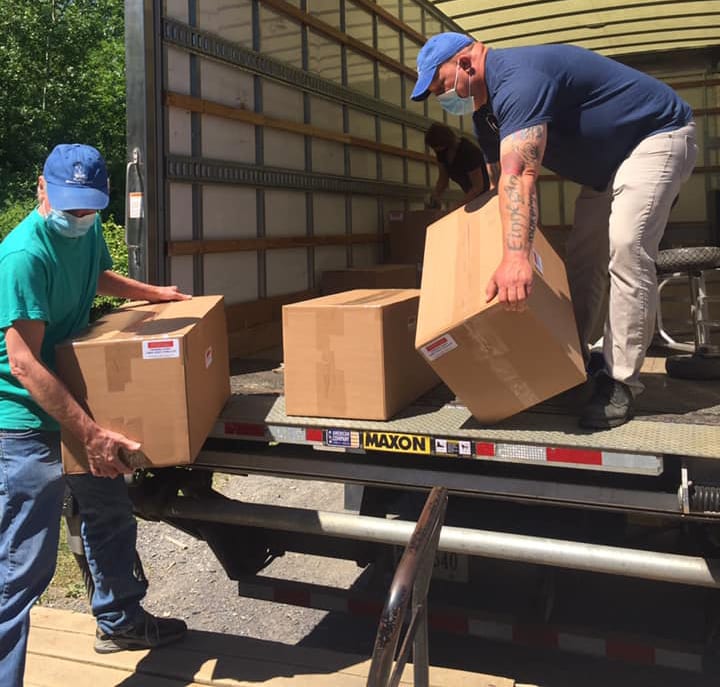
As Tompkins Weekly has covered in the past, the pandemic has worsened food insecurity in the county significantly, magnifying something that was already a challenge before the pandemic hit last March. Numerous county organizations and groups have worked to meet the growing demand, but there have always been gaps between what is needed and what is currently available.
This month, Foodnet Meals on Wheels expanded its services — like it has many times throughout the past year — to help fill these gaps. Specifically, Foodnet’s new program provides emergency bulk meals to county individuals and families in quarantine, regardless of age. While the program is only a couple of weeks old, it’s been able to help many residents who are stuck in isolation.
Foodnet’s quarantine meals service was created with financial support from the COVID-19 Response Fund of the Community Foundation of Tompkins County and has the capacity to offer expanded services to 25 households — or up to 50 individuals — per month, according to a recent press release. Foodnet provides bulk prepared meals as a supplement until the individual or family is either out of quarantine or long-term food services are established for that individual or family.
Foodnet Executive Director Jessica Gosa explained the importance of the program for those in quarantine.
“Because quarantine and isolation orders are immediate, individuals can’t stop at a food pantry or even a store [before quarantining],” she said. “Not to mention, purchasing a 14-day supply or bulk foods can be really cost-prohibitive if you’re on a fixed income.”
The nonprofit developed this project in collaboration with the Human Services Coalition, 2-1-1 referral services and the United Way of Tompkins County, with input from the Tompkins Food Task Force.
Around the holidays, community organizations like Mutual Aid Tompkins, Healthy Food for All and 2-1-1 were working to meet emergent needs at the time, and Foodnet and its partners started brainstorming on a more sustainable and long-term solution. Gosa explained Foodnet’s motivation.
“Expanding our services to respond to critical needs is part of why we exist,” she said. “It’s not about just maintaining services through this crisis; it’s also about moving forward to support ongoing recovery, leveraging resources and working collaboratively. … We also want our community members who are experiencing the realities of COVID-19 to feel supported and less isolated.”
Foodnet’s program builds off of the existing resources that Foodnet and other organizations were already providing.
As Gosa explained, while the quarantine meals program goes a long way toward helping those in isolation, it doesn’t completely satisfy the growing need.
“The alarm that’s been sounded during all of COVID is it’s never enough. There’s just always more need,” she said. “Food insecurity is incredibly complex, and there are so many nuances, [and that’s] why there are so many of us working endlessly and tirelessly to manage all of these gaps. It really has required us to continue to work and network together and leverage what we have to build a really strong system.”
Back in April, Tompkins Weekly covered the issue of food insecurity in depth, reporting that demand for food services had skyrocketed (full article at https://t.ly/t1oQ). While demand has decreased slightly from March and April, Gosa explained that the need has remained significantly higher than pre-pandemic levels throughout the past year.
“We certainly have continued to experience an increase in demand for services,” she said. “We just finalized our 2020 numbers, and we delivered 193,670 meals, which is about 22,000 more meals compared to 2019. So, what that tells us is the demand stayed pretty consistent. It ballooned in March — we saw almost a 40% increase at that point in time — and then it leveled out. We ended the year at about a 12% overall increase.”
The increase in demand has raised costs for Foodnet, and while the community has been generous in its support, Foodnet hasn’t had a lot of wiggle room in its finances or staff resources. So, in order to keep the quarantine meals free for residents, the organization can only service 50 individuals maximum.
Despite the limitations, Foodnet has worked to make sure the program is as flexible as possible.
“For an individual, the meal delivery may include a one-time delivery of 14 frozen meals, and for a family, it may include one-time delivery of 14 bulk frozen meals that are prepared as family-style main entrees and side dishes,” Gosa said. “The portions will all depend on the number of individuals in the household and storage capacity.”
The reasoning behind this decision was that families and individuals have different limitations and situations that impact the amount of food they can realistically accept at a time.
“For some, taking bulk delivery would be challenging because of the storage — some might not have a kitchen, refrigerator or freezer that can accommodate the space,” Gosa said. “So, it could be that we provide a portion of meals, and then in the next couple of days come back and provide more depending on what the need is.”
And that need for flexibility was quickly made evident within the first few days of the program, Gosa said, and those who have been able to benefit so far have expressed their gratitude for Foodnet’s efforts.
The project is currently funded through May of this year. Gosa said that this will allow time to assess changing needs.
“We will have an adequate amount of time to observe what the demand looks like,” she said. “If the need extends beyond this timeframe, we will do what we can to find an avenue to sustain the program.”
In the meantime, the Tompkins Food Task Force members and other food providers in the community will “continue to work as a network to anticipate the challenges and nuances that make food insecurity so complex,” Gosa said. Foodnet hopes to expand its services even more this year so it can continue to provide for those in need without a waiting list.
Gosa thanked the community for helping to support Foodnet’s programs, including its new quarantine meals.
“Our community has been generous to us,” she said. “We haven’t been doing this work alone. In many ways, it has felt like our community has wrapped their arms around us, providing us sometimes with funding support, gifts, words of encouragement, and really just cheering us on to keep doing this work. And we do it for our clients. It’s our clients that inspire us to do this work and to work in ways that we’ve never worked before.”
Contributions to Foodnet Meals on Wheels are gratefully accepted at any time. More information about Foodnet Meals on Wheels and this project can be found at www.foodnet.org/programs.
Related Articles
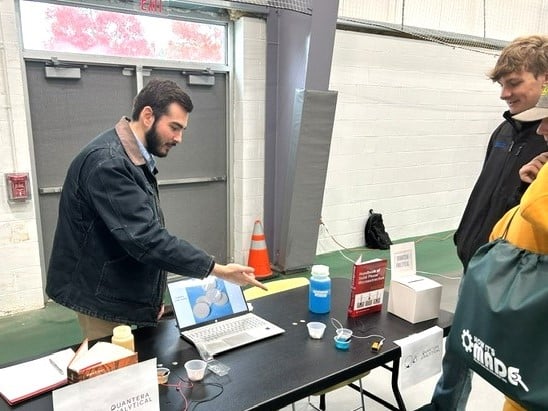
Quantera’s new tech promises faster, safer chemical testing
Quantera Analytical is developing faster, safer chemical testing technology in Ithaca with roots at Cornell University.

“A Silent Force”: Gail Belokur brings creative leadership to the United Way
Gail Belokur, a Hometown Hero, brings compassionate and creative leadership to the United Way of Tompkins County.