
Frequent power outages impacting residents more since pandemic hit
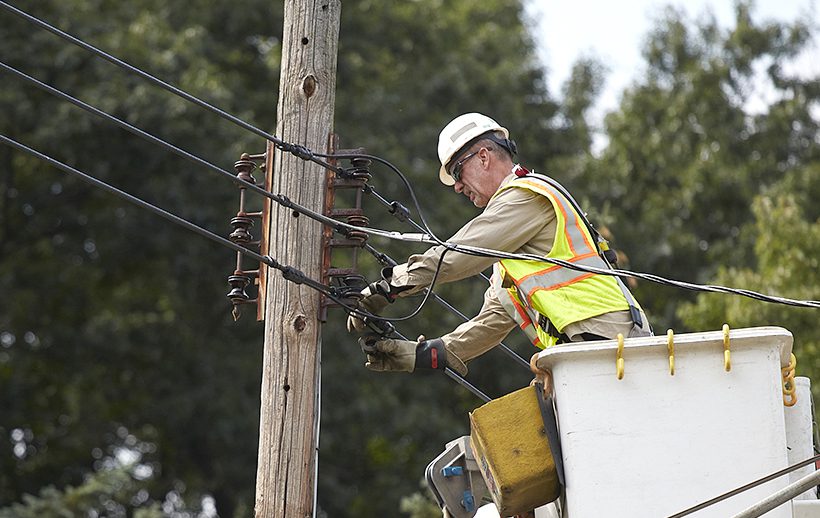
Tompkins County is no stranger to power outages, particularly in rural neighborhoods, but prior to the pandemic, most outages were little more than an annoyance. Unless a person depended on power for life-sustaining medical equipment, outages were usually a nuisance that meant having to reset clocks around the house after work or after waking up, but not much else.
However, the pandemic ushered in a new way of living and working for many residents, and with people spending more time at home now than before the pandemic, an outage is more than just an inconvenience — it can mean the cost of whole hours to a person’s work day.
This increased impact has left many residents frustrated, particularly when the cause of an outage isn’t immediately obvious, so Tompkins Weekly spoke with those involved to see the various effects an outage can cause and what’s being done to address the issue as a whole.
Effects on residents
Depending on where you live in Tompkins County, the number of power outages per year, as well as how long they last, can vary significantly. According to data from the New York State Electric and Gas Corporation (NYSEG), which supplies power to Tompkins County and neighboring regions, NYSEG’s Ithaca division — covering much of the county including rural areas like the villages of Lansing and Freeville — saw 985 outages in 2021 compared to 744 this year to date.
Still, for some people within that division, the number of outages has seemed to increase overall.
“It seems that over the past couple of years, power outages have been much more frequent than they used to be in the Village of Freeville and elsewhere in the Town of Dryden,” Freeville Village Trustee David Fogel said in an email. “During particularly bad periods, it’s felt like they’ve happened almost weekly.”
Lansing resident Steve Patrician, who moved to Lansing with his family in 2020, said he’s seen regular power outages at home since moving to town.
“I would say it’s been pretty consistent since we’ve moved in, at the minimum once a month and as many as two or three times a month,” he said.
Several people interviewed said they’ve even gone so far as to buy backup power sources because the power goes out so often.
“The worst one that I remember was in the winter, and we were actually down for almost an entire day,” Freeville Mayor Miles McCarty said. “And that prompted me to really think about the generator. I actually have our small generator, basically, just to power up our furnace and our well pump, and that’s about it.”
Lansing Town Supervisor Ed LaVigne said his town has even had to put generators at public buildings.
“We put in a generator fed off of propane [at Town Hall],” he said. “Even though we have natural gas at the Town Hall, … because of a moratorium, we can’t use natural gas. So, we have to go to propane. We do the same thing with the Highway Department building — that has a backup generator hooked up right now for propane, even though the building itself now that exists runs off of natural gas.”
As far as the impacts people see, that can vary considerably as well. Newfield Town Supervisor Michael Allinger, for example, said that, because most of his outages hit in the winter, the biggest effect he sees is a loss of heat.
“Our house, we’re fortunate to have a fireplace,” he said. “And if need be, there have been times when we’ve needed to adjust our sleeping arrangements so that we’re not sleeping in the back of the house but we’re sleeping close to the source of warmth, where that is in the wintertime.”
Patrician, in contrast, said his outages have had a substantial impact on his wife’s work in addition to the usual annoyance of resetting everything.
“It’s more than a nuisance,” he said. “My wife works from home three days a week, so she sometimes will get a dropped call with a client — she’s a psychologist — or she would lose internet access and then she’d have to wait for it to come back up so she can get back into the patient’s chart and things like that. So, that’s definitely annoying. And since everything in our house is electric, I have to go around resetting the timers on our electric heater and obviously the clocks everywhere and [I] have to go around double-checking, making sure all our sump pumps are working correctly.”
The situation can be especially frustrating when the cause of an outage doesn’t seem clear, like Fogel described.
“More often than not they’ve occurred for understandable reasons, during thunderstorms or as the result of utility poles being taken out in accidents,” he said. “But at other times, the power has gone out on sunny days, for no apparent reason. It’s been a source of real frustration for many Freeville residents, some of whom have vented their feelings on the village listserv.”
Some sources also shared that progress addressing the outages isn’t happening fast enough, as Dryden Town Supervisor Jason Leifer expressed.
“They have to maintain their equipment … and also maintain their rights-of-way,” Leifer said. “They have to cut trees back when they are supposed to. … They need to replace transformers that are just old — they should be doing that because that also affects the ability of people to get electric vehicles for the house. … Just doing normal maintenance upgrades, which is what we’re paying for as part of the delivery fees we pay to NYSEG.”
What’s being done
At NYSEG, leadership offered some explanations to address residents’ concerns. In regard to outages happening for no apparent reason on a seemingly sunny day, NYSEG President and CEO Patricia Nilsen said there can be a couple explanations. For one, wildlife could have disrupted power lines; Leifer recalls one time a squirrel shut down half the traffic lights in Ithaca.
An outage could also be caused by a vehicle colliding with a pole — a nonobvious cause if a resident can’t see the accident from their house or on their way home or to work.
Another explanation is the inconsistency of thunderstorms. Nilsen said storms can sometimes be so isolated that, while one house will see a downpour — and thus an outage makes sense — other houses will see only blue skies.
“And then if you’re sitting at home, and the storm didn’t [hit you], … people say, ‘Wait a minute, my sky is blue. Why did this happen?’” Nilsen said.
As far as what causes outages on the whole, the situation is complicated, to say the least. If one looks at isolated incidents, the most common immediate cause is downed trees or tree limbs, Nilsen said. But addressing that problem long term, like Leifer and others called for, is more difficult than it first appears, she said.
“Some of the challenges … are that even when we can trim trees and remove vegetation, … there’s quite a few trees that are outside of our right-of-ways, which we have no influence over,” Nilsen said.
And for the vegetation NYSEG does have jurisdiction over, Nilsen said it’s mostly a matter of bandwidth, with crews unable to do nearly as much maintenance work as they’d like.
“We would love to be trimming more often, not because we don’t like trees — we do,” she said. “If we trim more frequently, we’re doing less damage to the vegetation that’s in the area because it’s less severe; it’s a more of a slighter trim because we know we can come back. Part of the reason we’re not doing that is because we’re the one utility, I think, in New York state … that doesn’t have cycle trimming, which is something we’ve asked for in the Reliable New York proposal that we’ve put forth.”
Nilsen referenced NYSEG’s “Reliable Energy New York” plan, available at tinyurl.com/2nvns7cz, which largely centers around proposed changes to delivery rates with the New York State Public Service Commission. The plan also addresses another ongoing problem impacting outage numbers — aging infrastructure.
“NYSEG has older equipment,” Nilsen said. “You look at our poles — very carefully so you keep your eye on the road — but you look at our poles and our materials, and they are older. So, that’s another part of where we’re asking for infrastructure replacement, as part of that rate case that we filed.”
While NYSEG is hopeful for significant change with its “Reliable Energy New York” proposal, Nilsen said NYSEG’s crews are currently working to address the causes of power outages as effectively as possible with the resources it has. With infrastructure, for example, NYSEG crews are patrolling areas more frequently for infrastructure that needs addressing.
“We’ve been doing poles surveys across our service area, and people may see some poles being marked as ones that should be on the replacement list,” Nilsen said. “And our teams continue to do manual surveys, and … we’ve started doing drone flights to do some infrared and other testing, so don’t be surprised if you see us out in the field.”
Making this work difficult as of late has been staffing shortages — a problem affecting NYSEG in the same way it’s affected numerous other industries. To cope with this, NYSEG is actively bringing in apprentices (those interested can apply for open positions at nyseg.com) and increasing its use of technology, like upgrading its billing system.
“People are signing up for new programs that change the way we have to bill,” Nilsen said. “We’ve been doing a lot of that manually — that’s a people drain. So, this system is going to help us in terms of building automated and increased automated billing for our customers. So, the way we’ve changed the way we do business is we’re looking for automation resources where we can and keeping the people for the customer-facing things that they need to do the most.”
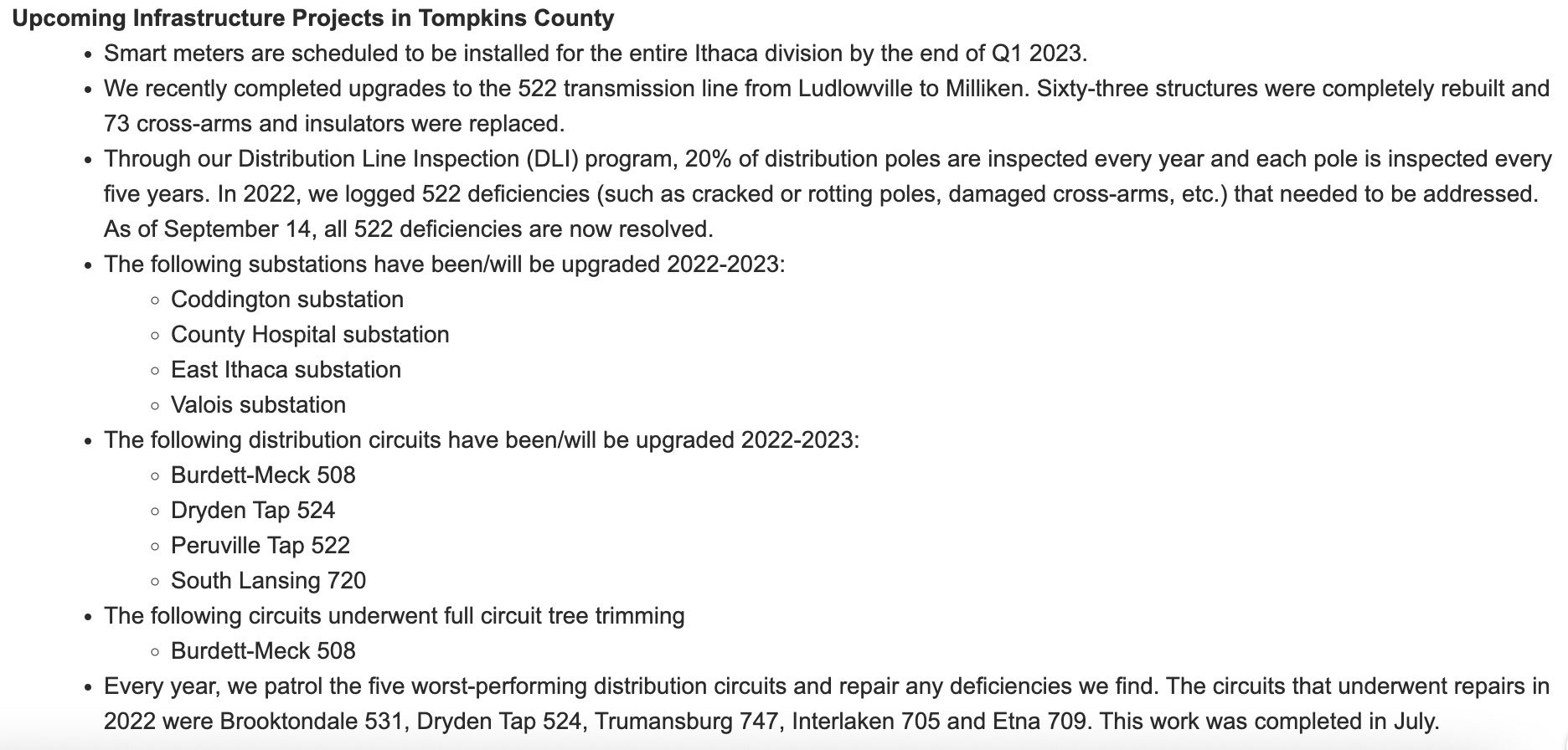
Looking ahead, NYSEG has a variety of planned infrastructure and trimming projects in the works over the next few years in Tompkins and neighboring counties. For a full rundown, see the list shown with this article.
Advice for dealing with outages, mitigating impact
Sources provided different advice for dealing with an outage when it hits as well as how to prepare for them in the future. Nilsen, for example, said that, as soon as you notice an outage, let NYSEG know as soon as you can. You can call NYSEG at (800) 572-1131, fill out an outage form online at tinyurl.com/2fmqbe3j or download the NYSEG app and report an outage there.
“When we get outage information from all these customers and all these devices, our system will automatically start to pinpoint where the cause seems to be,” Nilsen said. “And then, our people in the field who are standing by, they’re either in the field or they’re at the barn, they get dispatched out and they patrol the area.”
Town leaders largely reported that, once an outage is reported, response time is usually fairly quick.
“Typically, NYSEG is very good about being on top of these things,” Allinger said. “They have a very good website. They can show you point areas where they’re getting reports and power outages. By the time I reach out to them, they’ve already been aware of it.”
To mitigate the overall effects of an outage, sources offered several approaches. For one, Nilsen said that if someone in your home relies on power for life-sustaining medical care, let NYSEG know.
“We take that tremendously seriously,” she said. “Our incident commanders actually, when they get the outage list, there’s a flag in the system that will note if somebody on the circuit has a special need, just something that they can keep in mind for safety sake. But it’s not a guarantee that we can restore the service. But we will check on that person every 24 hours and make sure they’re OK and that they have a plan.”
Other sources stressed the importance of having a plan ahead of time.
“People need to be proactive,” LaVigne said. “I’ve said this before — plan for an emergency. If you think a bad storm is coming, fill your bathtub with water, … have supplies in your house, if you can, or have an action plan where you can go to somebody’s house that has a generator. We’ve housed these people up before at our house when the blackouts happened just because you try to be that good neighbor, and talk to each other.”
For smaller power needs, have plenty of battery packs, flashlights and candles on hand, Allinger said.
“If you do have a cell phone, those usually operate [during] power outages, so keep those charged and ready,” he said. “These days, you can get some rechargeable batteries [to use] if you’re going into an extended power outage.”
Jessica Wickham is the managing editor of Tompkins Weekly. Send story ideas to them at editorial@VizellaMedia.com.
Related Articles

Holiday traditions bring community cheer
Tompkins County holiday traditions light up homes, farms, and schools with festive cheer and community spirit.

The gift of an experience: Local businesses offer hands-on holiday fun
Holiday experience gifts in Tompkins County include candle making, gourd crafts, and pottery workshops for creative seasonal fun.
Code Blue shelter opens amid praise, concerns and ongoing debate
Ithaca’s Code Blue shelter opens with larger space, showers, and case management to help residents during cold weather.