
George Jr. Republic wins regional Envirothon
By Sue Smith-Heavenrich
On May 5, two teams from the George Junior Republic Union Free School District in Freeville traveled to Owego for the 2016 Southern Tier Regional Envirothon. The annual event is hosted by the Tioga County Sportsmen’s Association and sponsored by participating county Soil and Water Conservation Districts. This year, 27 teams participated from 10 schools scattered across Broome, Chemung, Schuyler, Tioga and Tompkins counties.
Both teams from George Junior Republic brought home trophies. The Hashtag Hawks won first place for Tompkins County, qualifying them to compete at the New York State Envirothon competition at the end of the month. This is the first time a team from George Junior Republic has made it to the state competition, says coach Bonnie Quackenbush. The Woody’s Woodchucks team, coached by Lucas Erno and Jane Wood, took second place.
The Envirothon is different from other knowledge-based competitions in that it presents hands-on problems for teams to solve. At the test site next to the pond, students gather clipboards and test questions. They talk quietly, while the dee-dees and whistles of songbirds fill the air. Then the blast of an air horn shatters the stillness and teams snap into motion.
One team heads to a table where there are fish and insects, another to a table with aquatic plants and a Secchi disk, and others start discussing answers to the questions. Members of the Woody’s Woodchuck team head over to the truck to listen to recordings of amphibians and birds.
The test asks a wide range of questions, from state and federal regulations (what is the Clean Water Act?) to general ecology, wetlands management and plant and animal identification. Teams have 20 minutes to answer because the Envirothon is also a timed event.
At the sound of the air horn it’s time to hustle to the next testing station. The soils section is held at the rifle range. In addition to the pencil and paper questions, the teams head off to the embankment where they examine a pit, identify soil layers, roll some of the mud around in their hands, see if it will thin out into a ribbon.
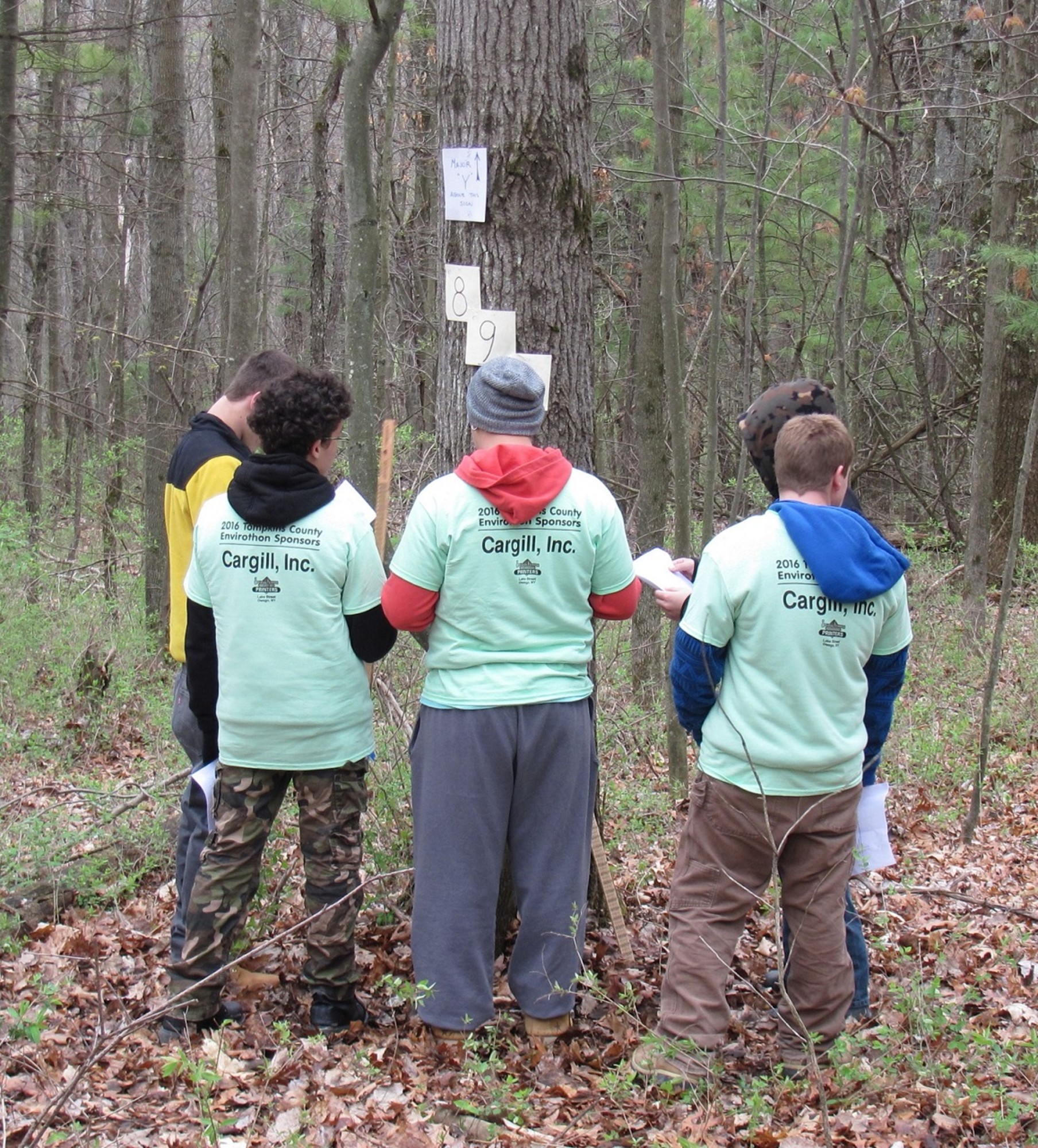
The forestry test is in the woods. Bob O’Brien, a forester for Cotton-Hanlon, reminds the kids to turn off their cell phones and calculators. “Everything you need is either in your head or there’s a tool down there for you to use,” he says. Along a path are trees tagged with numbers that correspond to test questions. They require team members to work together to determine the distance between two trees, to measure trunk diameter, calculate lumber, correctly name an implement and identify individual trees. Leaves are just emerging, so knowing bark patterns is essential.
Wildlife and current issues tests are inside the lodge. In the center lodge teams spread out at tables and cluster on the sofas to answer questions about invasive species. This year’s critical issue challenges teams to create a plan to deal with hydrilla invading a large pond. The hypothetical scenario closely resembles the real-life hydrilla problem in Cayuga Lake. With any luck, the young Envirothoneers will come up with ideas that could be implemented right here.
During the pizza lunch break, members of the Hashtag Hawks and Woody’s Woodchucks discussed the tests. “Forestry was the hardest part,” said Luis. He joined the team late, and worked hard to learn how to use a Biltmore stick and the identification features of a few trees.
Even though the kids have plenty of woods at their school (the campus has acres of fields, ponds and woods) Tony said it was neat being in different woods. For Joshua it was the fish that made his day.
Envirothon is about more than test answers. “The experience was beneficial for us as a group,” said Marquis. “It wasn’t so much about what we knew, but what we learned by working together on the questions.” And they all agreed that the pizza was pretty good, too.
Erno and Quackenbush have been coaching Envirothon teams for a number of years. Both teach science at George Junior Republic, and find that they can weave the concepts and general knowledge needed for Envirothon into their environmental science and agricultural science classes. Of course, some of the students do additional preparation during lunch periods and after school, says Erno.
Competing is about more than winning, Erno says. “We participate in the Envirothon each year so that our students can gain a positive educational experience and to open their eyes to many possible educational and career options that they might not get exposed to in the traditional educational setting.” He notes that the students enjoy the opportunity to take what they learn and apply it to real-life scenarios.
“One student is already planning to become a forester and is hoping to attend ESF in Syracuse after attending TC3,” says Quackenbush. “Because he is a vibrant young man of color, he wants to be a spokesman to promote people of color entering the field.”
Related Articles

5 things to do in Tompkins County this weekend
Plan your visit and discover what’s happening this weekend.

Tompkins Chamber announces Rob Montana as new vice president
Rob Montana, community leader and communications professional, has been appointed vice president of the Tompkins Chamber, where he will help drive economic growth, workforce development, and community engagement.