Health leaders share COVID vaccine updates
Ever since the county’s COVID-19 vaccination program began, health care officials have worked to get as many vaccines in residents’ arms as possible. While the past month has been filled with constant changes, challenges and unknowns, local leaders said they’re ready and willing to adapt however needed to ensure a smooth vaccination process over the next few months.
Progress
Though vaccinations still have a long road ahead of them, the county has already come a long way. As of the time of this publication, over 5,000 county residents have received the first dose of the COVID-19 vaccine, and officials report that efforts to prepare for mass vaccinations have paid off.
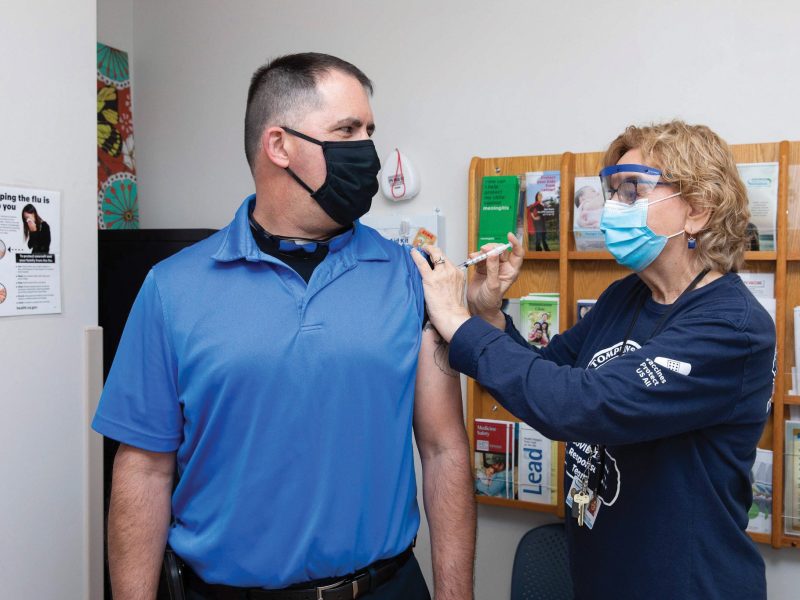
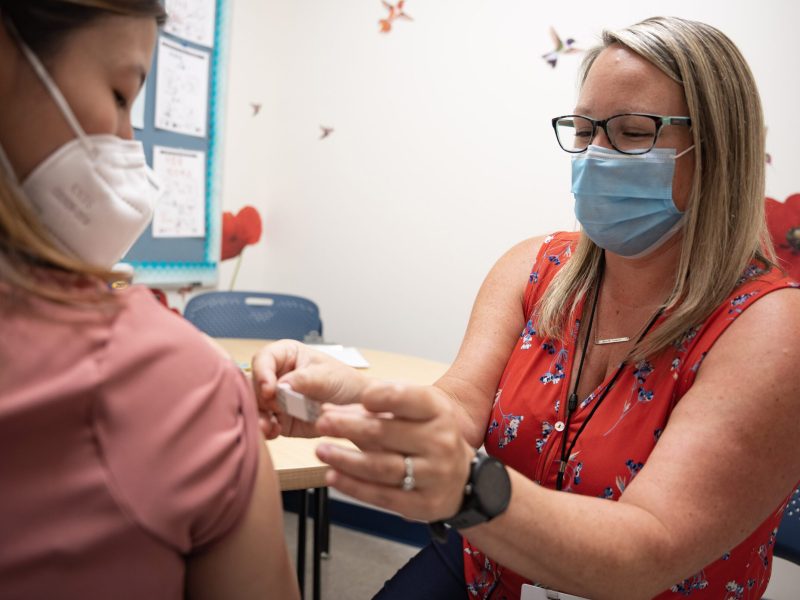
Public Health Director Frank Kruppa said the Tompkins County Health Department partnered with Cayuga Health Systems for the vaccination process late last month, and since then, a wide swath of residents have been vaccinated as part of phases 1A and 1B of the state’s vaccine plan.
“We saw 65-plus. We saw frontline grocery workers. We saw educators. We saw first responders and public safety folks come through,” Kruppa said. “We didn’t get everyone in any of those subgroups, but it did feel like at least a portion of each of the groups got an opportunity to get vaccinated.”
Helping to reach so many people in a relatively short time period was Cayuga Medical Center’s (CMC) mass vaccination clinic, which opened in the Shops at Ithaca Mall earlier this month. The 40,000-square-foot clinic is located in the former Sears department store. The clinic has increased the county’s vaccination efficiency, with the site capable of administering 2,000 doses daily with adequate supply.
In an address to the county this month, Cayuga Health President and CEO Dr. Martin Stallone explained CMC’s motivation for opening the new clinic. According to Stallone, CMC was interested in the space in the spring of 2020, when the hospital began its testing operations. At the time, CMC was able to operate outside, but staff knew that wasn’t feasible going into the colder months.
“We knew that coming into the fall and the winter months, the climate wouldn’t allow ongoing operations purely outside, and so, we opened conversations with the owners of The Shops at Ithaca Mall, and they graciously leased us this space, as well as the Bon-Ton, for any sort of operation we might need,” he said. “That’s proved very valuable to our health system.”
Stallone added that the vaccination clinic helped CMC be recognized by Gov. Andrew Cuomo’s office for reaching nearly 100% distribution of the allocated doses in the first supply of vaccines.
“Our mission was to dispense all of the allocated vaccine, and we’ve done that continuously,” he said. “Our understanding is that the more efficient we are, the greater the allocation we will receive in the future, and that was part of the impetus to build this very capable resource. And so, we hope to get more vaccine allocated, and we have an efficient way of delivering it to our community.”
Challenges
The county did not receive any of the expected vaccine doses from the state last week, partially stalling the vaccination process. As Kruppa explained, the shortened supply was caused by two main factors: a lack of doses provided by the federal government and the redirecting of provided doses to state-run vaccination sites.
“The state stood up these 13 sites across the state, and they need vaccines for those sites,” he said. “So, when you take that vaccine to those sites, the pool that’s available for everyone else that’s doing vaccination, obviously, is now smaller. So, we expected that as the state sites open, we might see a lower allocation to us.”
While the lack of doses for the week wasn’t welcome news, Kruppa said that it didn’t affect any vaccinations that were already scheduled, as the department only opens up appointments when doses are available. On Jan. 26, the Health Department announced that it has received 600 doses for this week for phases 1A and 1B individuals.
Kruppa said that the recent challenge of having plenty of residents eager to get vaccinated but not enough vaccines is opposite the challenge workers faced at the start of this process.
Late last month, several municipal leaders in the state called for the governor to increase the qualifications for groups that could get vaccinated because officials — including those in Tompkins County — didn’t have enough people to fill vaccination slots. The governor did increase the criteria, but that led to a different problem, Kruppa explained.
“They opened it up to all of 1B, essentially, without any further prioritization,” he said. “That added millions of New Yorkers that are now eligible, and our supply didn’t increase. So, we went from having more slots than eligible people to having way more people than we do slots. So, it’s really just the evolving nature of this, but there’s no perfect way to do it.”
That evolving nature has also required the Health Department to adapt its communication efforts, Kruppa said.
“One of the things we don’t want to do is put something out and then the next day have it be different because that just creates confusion and misunderstanding,” he said. “So, we’re trying to time our communication with where we think it’s going to be the most accurate information on what’s going to happen over the next few days.”
The Health Department continues to refine the vaccination process, Kruppa explained. Several recent questions from community members regarded access for those with limited or no internet access, so staff is working on ways to improve access.
“Our most efficient way of vaccinating the most people is through this mass site and using a web registration,” he said. “But we understand that that’s not going to reach everyone, and we have an obligation and a commitment to make sure that everyone in Tompkins County that wants to get vaccinated can. It’s just going to take us a little time to navigate the supply issues and then ultimately, make it available in ways that are more accessible for everyone.”

Community efforts
Despite these challenges, Kruppa said the process has gone well considering the circumstances. Some Health Department officials have been vaccinated, and their experiences have given insight into how residents have responded to the vaccinations.
“Most everyone that I’ve talked to has had really positive experiences with getting vaccinated,” he said. “We know it’s not perfect, and we know there’s been some waits over an hour in some instances, but I think across the board, we’ve generally found people to be thankful that we’ve made vaccines accessible to them. And generally, people, they get their vaccine, they wait their 15 minutes for observation, and they go about their day.”
Stallone said that the collaboration between CMC and other health care professionals has helped to make the process easier for everyone involved.
“It’s a team of dozens of individuals from different parts of our health systems in partnership with community organizations that are contributing to this effort,” he said. “And the community has come together in conjunction with the Health Department to make a fantastic process that has high scale and efficient volume.”
Testing
Stallone also called attention to the importance of continued COVID-19 testing to combat the spread of the virus.
“It’s really important that we continue to make people aware that we’re still battling a disease,” he said. “Just because we’re talking about vaccinations now doesn’t mean all of the other things go away. … We know that testing will continue to play a critical role during this pandemic, even as the vaccine is being dispensed.”
Toward this end, Stallone praised Ithaca-based company Rheonix Inc. for its advancements in testing technology.
Brooke Schwartz, Rheonix vice president of strategy and marketing, said that ever since the FDA issued an expanded Emergency Use Authorization for the Rheonix COVID-19 MDx Assay, testing centers like CMC have been able to use saliva as an approved sample type.
“All of our customers, including Cayuga Medical Center, were anxiously awaiting the EUA for the saliva testing method,” she said. “And what we’ve heard from them repeatedly is that the use of saliva as a sample type makes sample collection and handling so much easier for everyone involved, both patient collection site and the laboratory.”
Schwartz said saliva collection is much less invasive than the previous nasal swabs, and the collection method allows for greater social distancing, reducing workers’ exposure to infected individuals. In addition, saliva collection is significantly cheaper and easier to handle.
“The collection materials for nasal pharyngeal swabs cost $2 to $3 per sample, whereas for saliva, the collection materials cost 10 to 20 cents per sample,” Schwartz said. “This enables labs to save money and also conserve precious supplies because some of the materials that are needed for nasal pharyngeal swab collections, such as the swabs themselves and the transport media, have been in short supply over the past year.”
Schwartz said Rheonix is continuing to advance its technology, as staff has submitted data to the FDA in support of technology that would detect and differentiate COVID-19 from flu A, flu B and respiratory syncytial virus, or RSV.
“This is important because these viruses have similar symptoms, but the treatments are very different, and they’re all potentially high impact for at-risk populations,” she said. “So, the test also enables labs to save resources since one test replaces three. As soon as we receive emergency use authorization for this assay, we’ll be able to use it during the current flu season.”
Moving forward
While vaccine allocation from federal and state levels remains uncertain, Kruppa and others urged community members to remain vigilant and to continue following health safety guidelines, particularly with cases continuing to rise in the county.
“I know they’re frustrated, I know they’re angry, and it’s difficult to get an appointment right now,” Kruppa said. “But I hope they understand we’re doing everything that we can to make as much vaccine available as quickly as we can. And just be patient with us, be patient with each other, and we will get to a point where anyone that wants a vaccine can get it. And that’s my commitment to our community.”
For more information on the county’s vaccination efforts, visit tompkinscountyny.gov/health/covid19vaccine and cayugahealth.org.