
History Center director bikes 200 miles in 24 hours
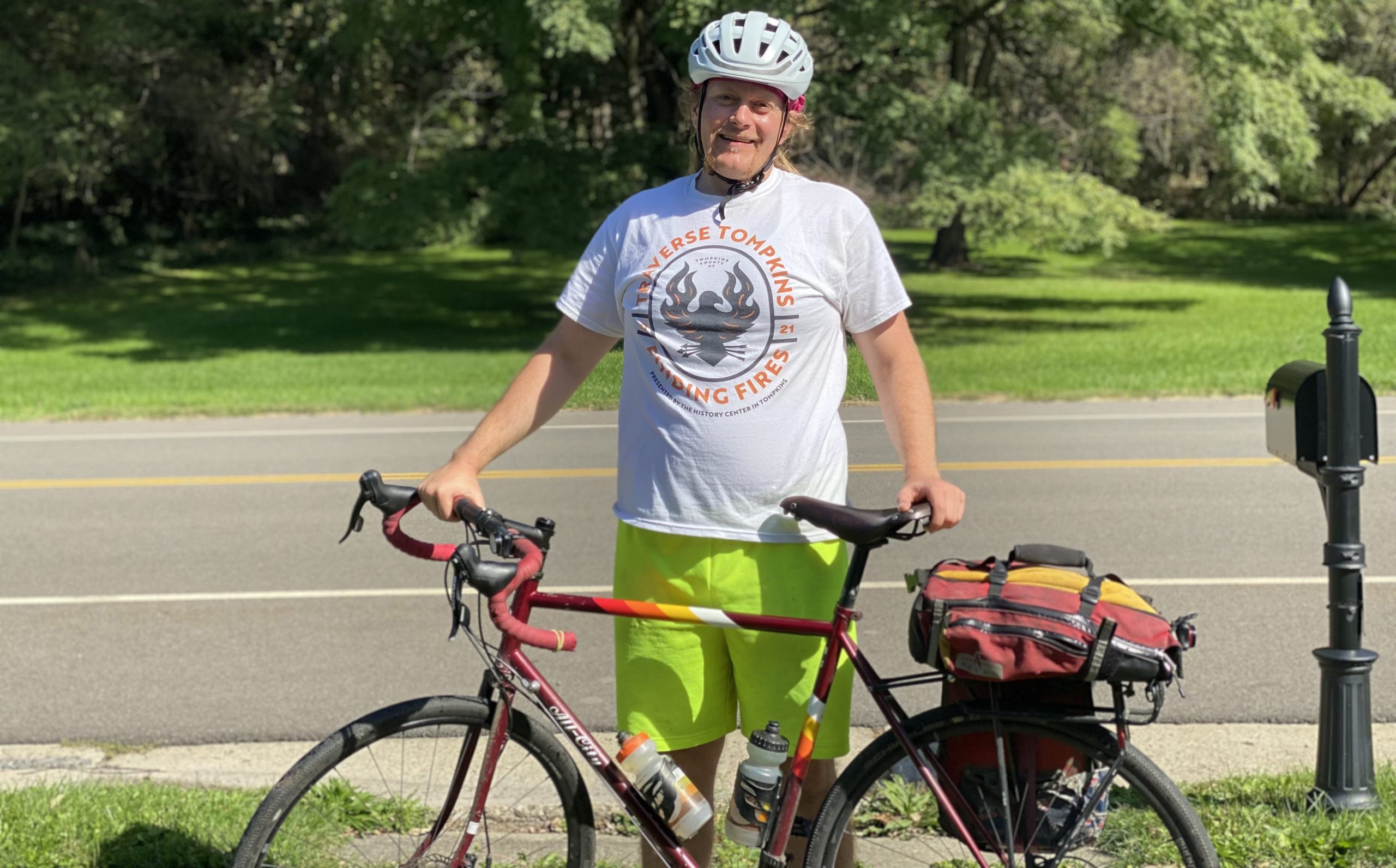
Last Saturday at midnight, Ben Sandberg, executive director of The History Center in Tompkins County, took off on his bike, set on a mission to bike for as many miles as possible in 24 hours. When he finally finished at midnight on Sunday, Sandberg had traveled over 202 miles.
This is the second year in a row that Sandberg has taken on this challenge to raise money for The History Center. Last year’s was an informal, almost spur-of-the-moment fundraising idea, but this year, it was formalized into Traverse Tompkins (charity.pledgeit.org/FindingFires), including a theme and more opportunities for the community to participate.
This year’s theme was Finding Fires, so Sandberg’s route had him exploring the locations of historical fires in Tompkins County. Residents participated by pledging their financial support of Sandberg’s trip, biking shorter routes or following guided tours through various historical fire sites.
After some much-needed sleep on Sunday, Sandberg shared what the experience was like for him.
“It was a delightful ride — both challenging and invigorating,” he said in an email. “Every time I get out into Tompkins County (and beyond!), I’m reminded [of] what incredible local history surrounds all of us. I’m hopeful that we can continue to inspire folks to explore the world around them. … I thoroughly enjoyed the chance to test my resourcefulness, all the while exploring our communities through the lens of historic fires.”
As Sandberg explained, the long biking trip that later became Traverse Tompkins was born out of a random conversation he had with his friends.
“It was trying to think creatively in the height of the pandemic of what might be an interesting fundraiser,” he said. “I do a lot of biking normally. And so, I had played around with some buddies. They had posed the question, ‘How many miles do you think you could do in a 24-hour period?’ And I was like, ‘I don’t know. Who the heck knows?’ And so, I was going to do it anyways. And they said, ‘We’ll make a donation of 10 cents, a quarter for every mile you do to the museum’ because they know that we were and continue to be in tough straits because of COVID. And so, that sort of sparked the idea that I could turn it into a fundraiser.”
Connecting biking and history might not seem like an obvious pairing, but for Sandberg, it made perfect sense.
“I say that biking is my gateway drug to history because I did some long bike tours, where I had all my camping gear, and I biked up and down the coast of California, or through Pennsylvania or around New York state, and would stop and visit local history museums,” he said. “And so, that was really how I first fell in love with local history.”
In 2020, Sandberg, like this year, biked all around the county with the goal to travel as far as he could in 24 hours, live-streaming videos as he explored historical points of interest in each municipality. The winds were rough, and Sandberg’s tire went flat, but still, he was able to make it to 175.1 miles.
The community feedback to Sandberg’s first ride was overwhelmingly positive, as last year’s event raised over $7,000 for The History Center. The response was so enthusiastic that many residents asked how they might be able to participate in future rides or provided suggestions for thematic focuses. So, this year’s event incorporated both — allowing residents to join in the biking and framing the rides around a central theme of historical fires.
“We settled on fires because it felt somewhat low stakes,” Sandberg said. “We’re still pioneering and developing this as a program model, so [it] could totally flop. Anytime you try something new or innovative, it could flop. And so, I felt like if this thematic focus flopped, nobody was really going to get angry about this piece of history.”
But that’s not to discount the important role fires have played in shaping the county, Sandberg said.
“The way our downtowns look often look … the way they are because fires have ripped through parts in our history,” he said. “I would say downtown Trumansburg is maybe the biggest example that has been shaped by fires that have come through that downtown area. And so, this seemed like a cool way to bring forth a history that folks don’t necessarily think about, and one that is not Ithaca-centric. Every community in Tompkins County has experienced fires.”
This year’s Traverse Tompkins raised a little over $10,000, which will go a long way in helping The History Center tackle the challenges it continues to face due to COVID-19.
“COVID has been tough for museums, locally, across the state [and] across the country,” Sandberg said. “It’s been difficult to program and plan around because we have to change and adapt, it seems, every couple of weeks. We’ve made use of a lot of the available financial resources from relief grants, unique fundraising opportunities that have gotten us this far. But it’s really the uncertainty that makes it so hard to plan. And that’s not unique to us. I think the level of uncertainty for everybody is a huge challenge.”
As for what lies ahead, Sandberg said he definitely wants to see Traverse Tompkins happen again next year.
“The dream is that next year, we’ll get more cyclists or runners or joggers or folks interested in signing up and being a part of it,” he said. “This is a new, innovative idea, and over the next year or two, we’re going to evaluate whether it makes sense to keep continuing it. And getting more folks excited to explore Tompkins County by foot, by bike, by rollerblade would really be exciting for us and definitely be an important piece of support for the museum.”
More broadly, Sandberg said he’s looking forward to continuing to lead The History Center and help it connect residents to local history.
“We really believe this idea that looking at [and] engaging with the past will make us today better stewards of our future,” he said. “And regardless of public health conditions or financial challenges or anything like that, that is a mission we believe in and are committed to and are looking forward to continuing to build opportunities for the community to connect to our local history.”
The History Center has many programs and events happening next month, including several Haunted History Tours. To learn more about this and other History Center offerings, visit thehistorycenter.net.
Related Articles
Cayuga Medical Center nurses to rally, alleging anti-union tactics by hospital management
CMC nurses plan a rally, alleging unsafe staffing and illegal anti-union tactics as the hospital highlights recent patient-safety gains.
Design details unveiled for new Center of Government
Design details for the Tompkins County government building in downtown Ithaca are now public, with a county survey open for feedback.
Holiday traditions bring community cheer
Tompkins County holiday traditions light up homes, farms, and schools with festive cheer and community spirit.