
Hochul signs Kelles-led crypto-mining moratorium bill
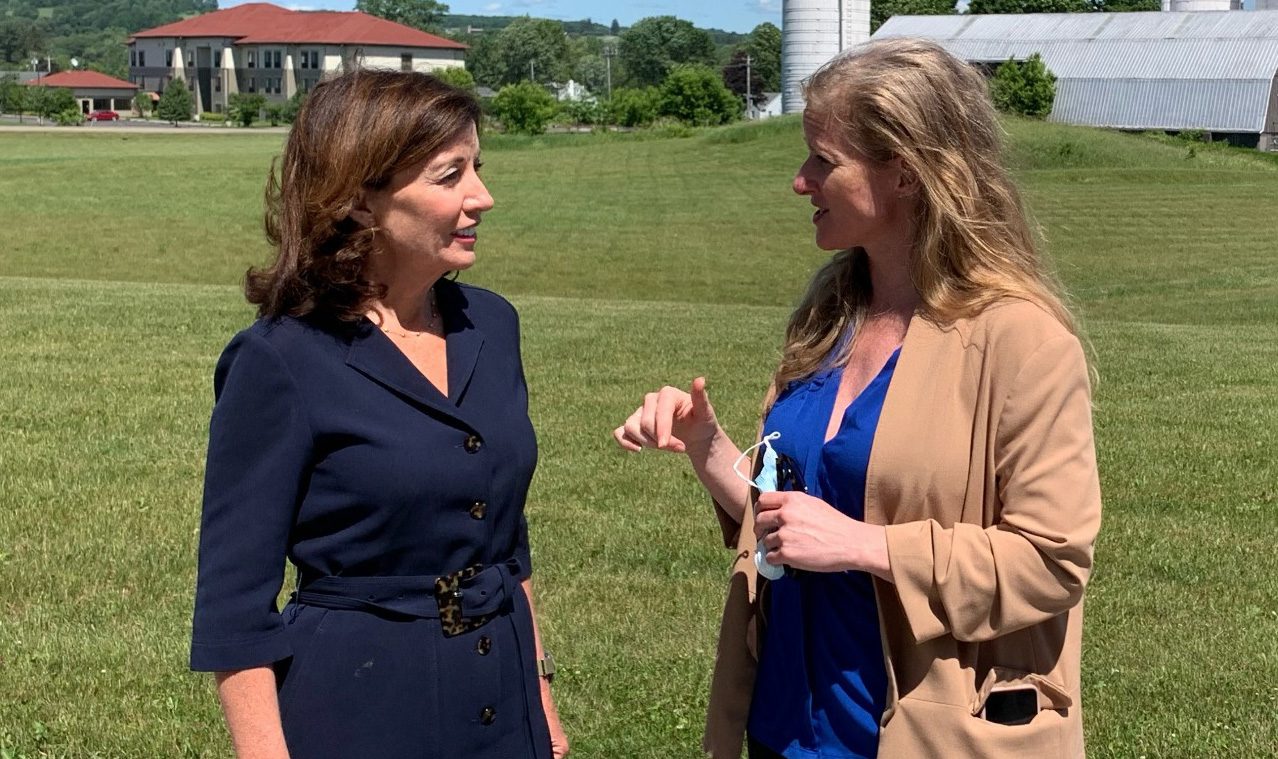
Late last month, Gov. Kathy Hochul signed into law a bill that now places a two-year moratorium on future fossil-fuel-intensive crypto-mining operations and initiates a study from the state’s Department of Environmental Conservation (DEC) to understand the full impact crypto-mining has on the environment.
The bill was drafted and championed by the Southern Tier’s own Anna Kelles, assemblyperson at the New York State Assembly, and affects data-mining centers that use proof-of-work as its currency-validating method. As Tompkins Weekly touched on earlier this year (tinyurl.com/2ofkrsso), proof-of-work validation requires a high amount of electric power, with computers needing to process mathematical equations at consistently peak speeds.
Kelles explained that she wrote the bill “in response to learning about the magnitude of the environmental impacts of large-scale cryptocurrency mining,” particularly as it pertained to the crypto-mining operation at Greenidge in Yates County. Greenidge, according to Kelles, recently purchased a fossil-fuel-based power plant.
“Their original intent as it was officially proposed was not to do cryptocurrency mining, but very soon within months to a year of when they proposed their plan, as cryptocurrency … value really skyrocketed, they very quickly shifted towards prioritizing mining over providing energy to the grid, which was their original proposed intent,” she said.
Kelles also learned that there are roughly 40 retired power plants, which she called “mothballed power plants,” across the state, and there were efforts to bring crypto-mining to other areas of the state as well.
“Based on that stress, I had sort of an epiphany thinking about the moratorium on fracking in New York state with the intention of doing a full environmental impact assessment to understand the environmental impacts of the industry,” she said. “And being a scientist, the thought of collecting data, of course, it’s always very appealing to me because I like to make decisions based on data. So, the inspiration of the bill was a flash late at night, inspired by both my concern and by the process of how we went about evaluating and then regulating and ultimately banning fracking in in the state.”
While Hochul was initially hesitating on signing the bill leading up to Election Day, there has been new momentum in the past few weeks that led to the governor finally signing it late last month. Kelles expressed great appreciation toward the governor for her decision.
“I think that it was absolutely the right thing to do,” Kelles said. “It is a very solid bill because it walks a fine line, focusing on an area of cryptocurrency mining that could be singly the most environmentally impactful and singly undo all of our in our efforts to meet our environmental goals, which is the purchasing and operation of fossil-fuel-based power plants in the state for cryptocurrency mining. And that’s why the bill specifically focuses on that area so that we can create a pause in the this trend.”
Kelles added that she was glad to see Hochul recognizing that this gives the state the opportunity to be a “climate champion, while not hindering economic development in the technology sphere.”
“The reason that that is really important is because if a cryptocurrency mining operation could develop renewable energy infrastructure completely on site, not plugged into the grid, where they use the energy behind the meter, that is not restricted by this piece of legislation; it would be innovative,” she said. “And because it wouldn’t be tied into our electric grid, it wouldn’t necessarily impact our ability to convert all of our current energy demand to electric based off of renewable energy infrastructure. And so, it really creates the ability for the industry to innovate.”
The idea of the bill being innovation-restrictive has been prominent in the crypto-mining industry within the state, but Kelles pushed back.
“The industry will say this is anti-tech, and it is giving the message that we are not in support of innovation in this state,” she said. “And I would say that is an absolute lie because this bill is actually saying to the industry that we want you to put your money where your mouth is. … Show us that you can build a cryptocurrency mining operation that is exclusively based on renewable energy infrastructure that is built on site, completely encapsulated and self-sufficient. Show us it’s possible — that’s what this bill says. If you say that that is your goal, now show it to us.”
On top of that, Kelles said the moratorium the bill creates buys the DEC time to “comprehensively evaluate the environmental impacts of cryptocurrency mining in the state,” especially the impacts on the state’s ability to meet the climate goals established through the Climate Leadership and Community Protection Act (climate.ny.gov).
As far as local impacts, Kelles said that she doesn’t expect this bill to affect any Tompkins County operations, including the still-pending decision on whether to turn the former Cayuga Power Plant in Lansing into a crypto-mining base.
“The value of cryptocurrency mining plummeting as much as it has in the last six months probably has a greater impact on their calculus of whether or not to build a cryptocurrency mining operation there than this bill,” she said. “This bill puts a pause on the obtaining of permits for power plants. And right now, the Cayuga Power Plant is fully mothballed. And they have stated publicly that they have no intention of rewiring that power plant.”
Still, Kelles said that the signing of the bill has a lot of symbolic importance for the region.
“The most important thing is that the signing of this bill makes a strong statement that the huge agritourism industry, that is about $3.9 billion worth of an industry that employs over 60,000 people, is an industry worth protecting,” she said. “And that’s what this bill does in the Finger Lakes area.”
Now that the bill has been signed, Kelles said she and others will essentially be in waiting mode as the DEC works to carry out the environmental impact study. Once the two years are up and the study is complete, Kelles hopes to use those results to guide future decisions.
“It will certainly be an active discussion of how the state should respond to that data,” she said. “The whole point of me doing this bill was so that whatever discussion we do have is data driven and not anecdotal and not driven by industry aspirations, but hard facts of the environmental impacts of the industry on our state’s environmental goals. So, I’m thrilled that we are going to get a comprehensive environmental impact assessment by our environmental experts of the state. And I’m thrilled that it will be a transparent process.”
Jessica Wickham is the managing editor of Tompkins Weekly. Send story ideas to them at editorial@VizellaMedia.com.
Related Articles
Cayuga Medical Center nurses to rally, alleging anti-union tactics by hospital management
CMC nurses plan a rally, alleging unsafe staffing and illegal anti-union tactics as the hospital highlights recent patient-safety gains.

AmeriCU proudly connects students with annual scholarship opportunity
AmeriCU scholarship program awards $1,000 to students pursuing college or vocational education. Applications are open through March 15.
Street Beat: What’s one of the best holiday gifts you ever received?
We asked five random people. Here’s what they had to say.