
Hotter weather, staffing issues complicate water recreation
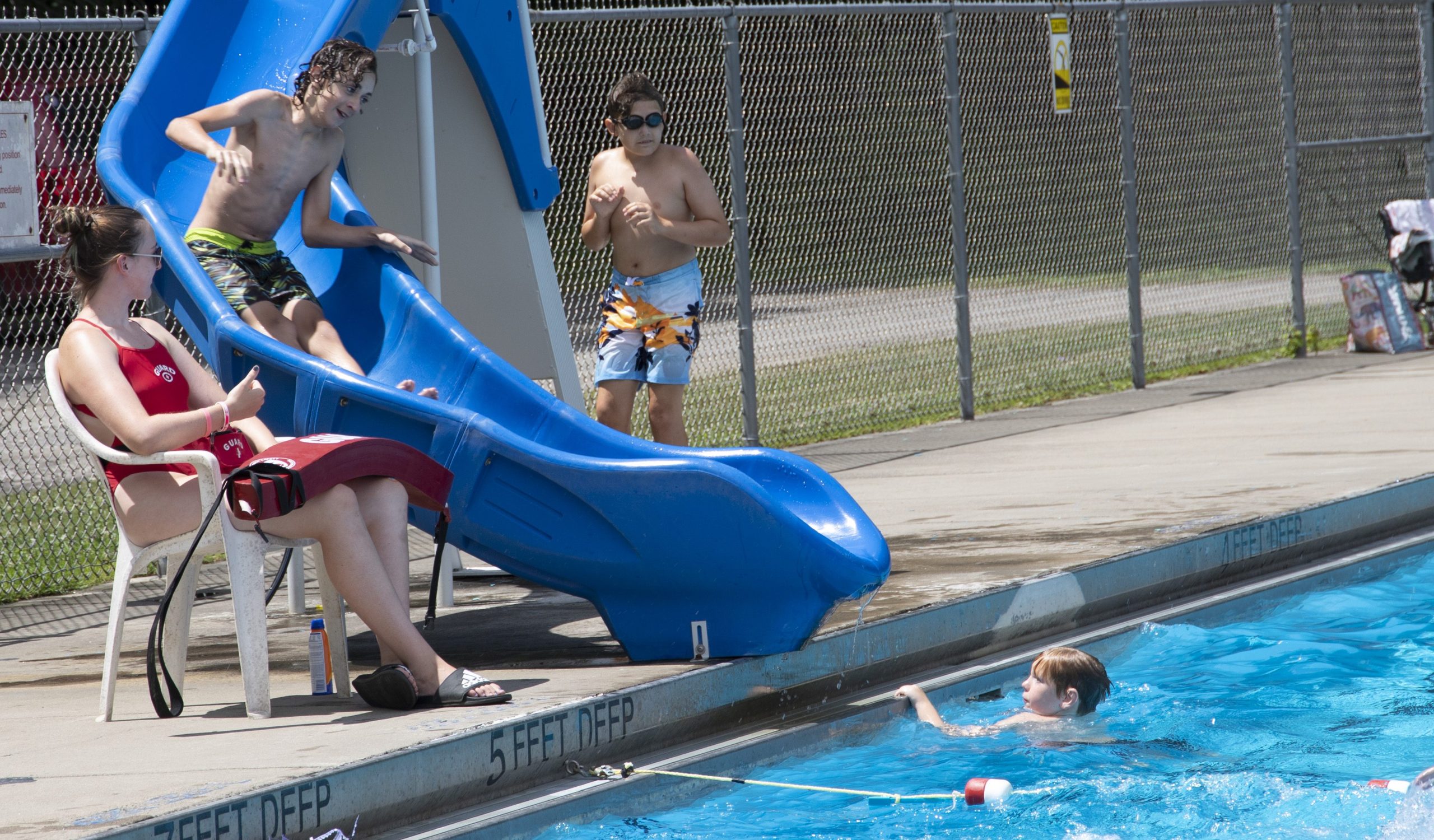
Last week, Tompkins Weekly’s cover centered around ice cream, and this week, we’re taking a look at another thing that helps residents cool down over the summer — water recreation, including activities like swimming, boating and more.
As sources attest, no matter how residents choose to enjoy the water, the staff that make those offerings possible are all facing their own sets of challenges. For pools, it’s staffing shortages. For those who depend on Cayuga Lake, it’s the lake’s health, especially in regard to harmful algal blooms (HABs). And, as is true for many in Tompkins County, supply issues and rising costs abound for both groups.
Challenges
About two years ago, Tompkins Weekly covered some of the efforts to monitor Cayuga Lake’s health (tinyurl.com/yg8zx7gy), and one of the biggest concerns for leaders back then was HABs. While it’s still a bit early before the lake is at its warmest, that concern continues to be top of mind for many this year.
“We started our program in 2018, and we have seen a very clear increase in the number of blooms that are reported to us,” said Grace Haynes, outreach and program coordinator at the Community Science Institute (CSI, communityscience.org). “[In] 2018, we saw 40 blooms reported, and this last year in 2021, we had 102 blooms reported to us. And anecdotally, from members of the public, people who have lived on the lake for years and years have been seeing more, reporting seeing more HABs.”
Just last week, a bloom spotted at Taughannock Falls State Park shut down swimming temporarily, showing just how much the lake’s health can affect recreation. And it’s not just swimming that sees these effects. Businesses that depend on Cayuga Lake also see direct and indirect ramifications from HABs, as Paddle-N-More (paddlenmore.com) owner Jennifer Wells can attest.
“As soon as they shut down the swim area, you’ll see cars pull in, they find out [the] swim area’s closed, out [of] the park they go,” she said. “It drives people away. And those are typically our walkouts. So, it definitely has an indirect impact, even though we don’t have to close. So, it’s interesting to see that occurring. And that’s a trend that I’ve been witnessing over the past few years — that even though we don’t have to close, it does still affect us.”
Another recent problem related to lake health is runoff. As Glenn Ratajczak, production manager at Bolton Point (boltonpoint.org), explained, large thunderstorms have increased in recent years, which can make water quality and HABs worse.
“We’re getting these large storm events, and the runoff that goes into the lake is incredible,” he said. “And we’re seeing turbidity, which is basically the measure of the cloudiness of the water, which is the particles in the water. I’ve been here seven years almost, and talking to the guys who have been here forever, they’ve never seen turbidity as high as what we’ve seen in the last year or two. And it’s coming more frequently, too.”
Although rain so far this summer has generally been light, delaying the return of HABs, there was enough rain earlier this month to close down swimming at Taughannock. As Fred Bonn, Finger Lakes regional director of the New York State Office of Parks, Recreation and Historic Preservation (parks.ny.gov), explained, rain is great to keep the county’s waterfalls full, but it can create a difficult situation for visitors’ health.
“It’s impossible to predict when and where an HAB is going to break out, but the experience that we have in tracking it is that [it] typically occurs after some rain events and nutrients get washed in, and that tends to start to pop up the HABs along the shoreline,” he said last week. “So, when it was raining last week, yeah, I was thankful that our lawns were getting watered but hoping that it was going to be soft rain enough that will just soak in. [That] didn’t prove to be the case.”

Runoff has also led to a slow but steady shallowing of Cayuga Lake’s water level in certain areas, which affects lakefront businesses like Ithaca Boat Tours (ithacaboattours.com), as owner David Openshaw explained.
“Our major challenge is the non-dredging of the inlet at this point,” he said. “It’s been very challenging. The inlet is 25 or 35 years overdue for a dredging. … The speed that it’s filling in [has] actually significantly increased over the past couple of years. Every season, the inlet’s about 6 inches shallower than it was a year before, and I’ve never seen it progressing that quickly or becoming shallower [before].”
Moving away from lake health, sources also reported challenges related to rising costs and supply and staffing shortages.
“What we’re having a bigger problem with now is that fallout of short supplies,” said Roxy Johnston, watershed coordinator for the City of Ithaca Water Treatment Plant (cityofithaca.org/295/Water-Treatment-Distribution). “Some of our replacement parts, the raw materials might be hard to get, so if you need a new probe, and you have to have that probe, it might be months before you get it. … We’re having to really work hard to find other solutions or other ways to get our data or whatever we need to do to get those gaps filled.”
Warren Allmon, director of the Paleontological Research Institution (PRI, priweb.org) — which runs the lakefront’s Cayuga Nature Center — said supply chain issues are hurting his renovation and construction projects.
“We have some major pending repair and construction projects at the at the museum and the associated buildings on West Hill,” he said. “Those are being affected by some supply chain issues. And there’s nothing we can do about it. The contractors are just telling us to just sit and wait. So, probably some renovation and repair projects that we had hoped would happen over the summer are probably going to be in the fall.”
For area pools, the biggest supply issue they’re facing is a widespread chlorine shortage.
“There is a chlorine shortage in the area, and that’s specifically the liquid chlorine,” said Jennifer Jones, Groton’s recreation director. “And from what I understand, it’s more about the transportation. We’ve been taking precautions to try to shut the pool down overnight and have supplies ready ahead of time. We have a bigger tank now, so it hasn’t been a problem for us yet, but it definitely is a problem in the area.”
It’s a similar story at the Greater Ithaca Activity Center’s (GIAC, cityofithaca.org/327/Greater-Ithaca-Activities-Center) pool, as Pool Coordinator Michael Thomas explained.
“Tomorrow, I’ll have to drive to Binghamton to pick up chlorine because this is the second week in a row they didn’t deliver to us,” he said last week. “I’m not a licensed hazard driver, so I can only carry about 75 pounds of chlorine. That’s all I can bring back. So, that’ll get us through three days until I have to go back and get more. And they’re not guaranteeing me that they will be coming.”
As for rising costs, Wells explained how operational costs have continued to climb for her business.
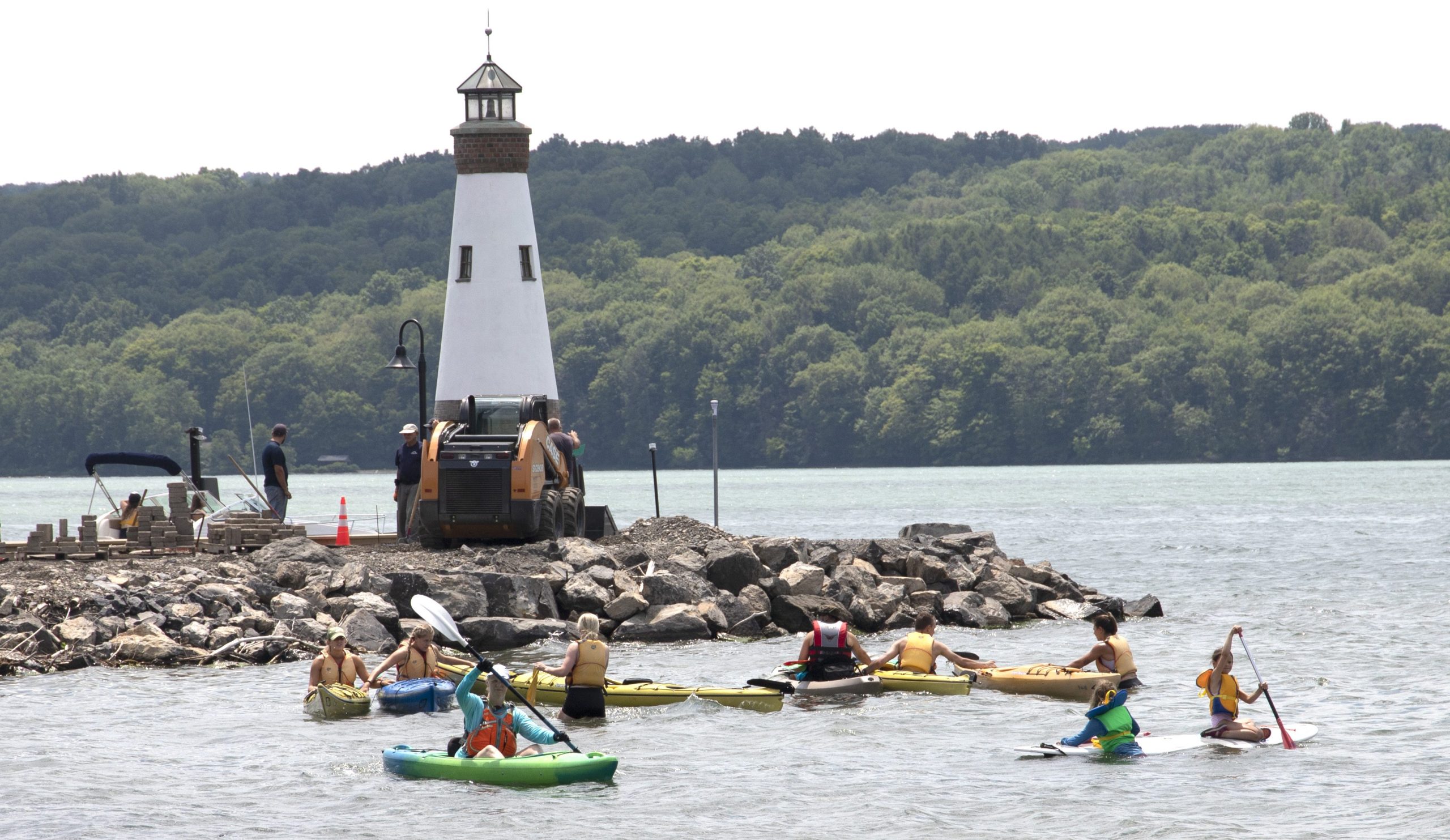
“I always started with this business with wanting to keep things at a reasonable price,” she said. “But with insurance going up, payroll, minimum wage is going up — and I try actually really try to pay a living wage too, especially our supervisors and more of our managers, … I’m definitely seeing now that we have to start increasing prices, which kind of saddens me. I don’t want to do that. But at the same time, we have to meet the expenditures, and … staffing is the biggest budget item.”
And finally, there is a widespread lifeguard shortage not just in the county but nationwide, as sources attested. While the Groton pool is practically overflowing with an abundance of lifeguards this year, GIAC is really feeling the lifeguard shortage. As Thomas explained, GIAC traditionally uses a “grow your own” model, bringing in teens whom staff would then train to become lifeguards.
“This year has been a real struggle,” he said. “Only a few of them came forward and wanted to take the course. And the ones that had been working for the past four or five years, they’ve now graduated college, and they’ve moved on. So, the group that we were hoping that would take over didn’t come back this year. … We have enough [lifeguards] to run the facility, but we don’t have enough for the extra things we used to do. We used to have lap swim in the morning [and] teach some lessons, and those things we cannot do because we don’t have the staffing for it.”
Progress
While the challenges sources are facing don’t show any signs of lessening within the summer, there are still plenty of positives that folks are celebrating this year. In regard to lake health, sources said that there’s been much more attention brought to factors like HABs, which has subsequently led to increased resources to combat those problems.
“Glenn and his team do a great job here,” said Steve Riddle, general manager at Bolton Point. “They’ve got a lot of new equipment to help identify HABs, got some new lab equipment. They’ve taken a lot of trainings on how to identify HABs. We got a creative a few years back and started using a drone to kind of survey around our intake because it is 400 feet out into the lake from the lake shore. So, when we see HABs on the lake shore, we can then fly out to see if it’s anywhere near our intake. It’s just a nice way to know how big the blooms are.”
Johnston also spoke to improved detection methods.
“We have in place now some monitoring, live-time monitoring, at the reservoir,” she said. “We were working on getting that deployed last year. So, that’s an improvement; it gives us a quicker response time for changing water conditions. … We’ve also been using some new software that we purchased a year and a half ago, but it took a while to get through the training, that helps us manage our data better and helps us more easily do trend analyses so that we could predict maybe long-term changes in water quality and look ahead for what might be needed.”
Jon Negley, district manager of the Tompkins County Soil and Water Conservation District (tompkinscountyny.gov/swcd), described some of the best management practices (BMPs) that his office implements to protect lake health.
“Nutrient storage structures on farms allow proper timing, placement, and rates of applications of these nutrients to crop fields,” he said in an email. “Diversions, waterways and collection basins help alleviate flood water from affecting downstream properties and the lake from receiving excess runoff during heavy rainstorm events. Riparian buffers and grazing management systems allow vegetation to hold soils in place near sensitive areas such as streams, rivers and wetlands. Each BMP system has its own unique challenges to implement, but we have learned to adapt to many economic and weather-related complications that have arisen.”
For those not involved in improving Cayuga Lake’s health, the biggest progress has been pandemic recovery, including a large bounceback in visitorship.
“We are seeing people come in the pool just like we did in 2018, 2019, pre-pandemic,” said Greg Pinkowski, Groton pool director (grotonny.org/copy-of-park-pool-pavilions). “It’s almost back in full swing, I’d say. We have our swim lessons back, which are very cool. People love them. Like I said, these last couple of days and the last couple of weeks, it’s just been jam-packed. And it’s really great to see because we love when the kids come and use our pool. It puts a smile on our face.”
Looking Ahead
While sources are generally optimistic for more progress and success over the course of the next year or so, they also identified ways that leaders at almost any level can help ease the challenges they’re facing. Ratajczak, for example, spoke to the need for more education, demonstrated in a story told to him by a colleague who said there were two kids swimming in the middle of an algal bloom.
“The problem with that was it was [at] a short-term rental, so they knew nothing about HABs, never heard of it before,” he said. “So, definitely, there’s an educational aspect of that could be improved. I know there’s a lot of groups out there working on it. I think a lot of [what] it comes down to is a lot of them are working on it on their own, and nobody’s putting the whole big picture together.”
Sources also identified upcoming policies and programs addressing the lake’s health, like the state’s Drinking Water Source Protection Program (dec.ny.gov/chemical/115250.html).
“We are working with New York State Health Department and DEC on a drinking source water protection plan for Bolton Point, which is basically focusing on the south end of the lake and how we can advise municipalities within that watershed how to help protect the lake in the future, at least from our drinking water standpoint,” Riddle said. “So, we are hoping to have that complete in 2023. … Being able to get ahead of the contaminant issues before they become a problem for us, that’s kind of our focus.”
Negley added that the county recently released the Tompkins County Resiliency and Recovery Plan (available at tompkinscountyny.gov/planning/climate-adaptation), which aims to protect the county’s water sources.
“Over the years, I have seen the challenges that having too much water and too little water can pose to health of our lake and those who use it for a variety of uses,” he said. “As we face these challenges, I believe that we all need to plan ahead for what the next steps are to lessen the effects of climate fluctuations. The updated Tompkins County Resiliency and Recovery Plan … lays out a lot of strategies to reduce the risk associated with hazards posed by extreme weather and other disaster events.”
Jessica Wickham is the managing editor of Tompkins Weekly. Send story ideas to them at editorial@VizellaMedia.com.
Related Articles

5 things to do in Tompkins County this weekend
Plan your visit and discover what’s happening this weekend.

Holiday traditions bring community cheer
Tompkins County holiday traditions light up homes, farms, and schools with festive cheer and community spirit.
Newfield nonprofits prepare for community meals, festivals and new traditions next year
Newfield Community Events in 2026 include Old Home Days, town meals, and local traditions highlighting volunteerism and community service.